
Ramesses II, better known as Ramesses the Great, ruled Egypt for about sixty-six years and became the defining king of the 19th Dynasty. He combined military ambition, diplomatic skill, religious authority and an unparalleled building program. From the Battle of Kadesh and the peace with the Hittites to Abu Simbel, the Ramesseum and a new royal capital, his reign shaped the image of pharaonic power for more than three thousand years.
Why Is Ramesses II Called “the Great”?
The title “the Great” reflects Ramesses II’s exceptionally long reign, enormous monument-building program, vast royal family and ability to turn military campaigns into enduring political prestige. Although he did not win every battle, he protected Egypt’s interests, negotiated a landmark peace with the Hittites and filled Egypt and Nubia with monuments that kept his royal image visible long after his death.
Ramesses II’s Early Life and Royal Training
Around 1303 BCE, Ramesses II was born into the family that founded Egypt’s 19th Dynasty. Ramesses I, his grandfather, came from a military background and ruled only briefly. His father, Seti I, restored Egyptian influence in the Levant, campaigned in Nubia and built important monuments, including his celebrated tomb and the temple at Abydos. Meanwhile, his mother, Queen Tuya, remained highly honored throughout her son’s reign.
From childhood, Ramesses grew up in a court closely connected to the army. Reliefs show him accompanying Seti I and participating symbolically in royal campaigns while still young. Seti I appointed him crown prince early and gave him his own household. Ancient sources do not give us a modern school record, but court tutors probably trained the future king in ritual, administration, chariotry, archery and the public performance of kingship.
His youth mattered because the dynasty was new. Ramesses inherited no centuries-old family claim to the throne; the court therefore emphasized military competence, divine approval and visible continuity with Egypt’s great kings.
Accession and the Early Reign of Ramesses II
In 1279 BCE, Ramesses II succeeded Seti I, probably while in his twenties. Soon after accession, he celebrated royal festivals, appointed trusted officials and launched building works across Egypt. Moreover, his early monuments linked him to Amun, Ra and Ptah while presenting him as the legitimate heir of Seti I.
Meanwhile, the new pharaoh faced the strategic problem of Syria. Egypt and the Hittite Empire competed for influence over cities and trade routes in the Levant. Ramesses campaigned north in his early regnal years and prepared a much larger operation against Kadesh in year five. Meanwhile, at home, the government drew wealth from agriculture, temple estates, mining, tribute and international exchange.
| Date | Event | Historical Importance |
|---|---|---|
| c. 1303 BCE | Birth of Ramesses II | Born to Seti I and Queen Tuya in the emerging 19th Dynasty. |
| 1279 BCE | Accession | Begins a reign of roughly sixty-six years. |
| c. 1274 BCE | Battle of Kadesh | Major confrontation between Egypt and the Hittite Empire. |
| c. 1259 BCE | Egyptian–Hittite treaty | One of the earliest surviving bilateral peace treaties. |
| c. 1213 BCE | Death of Ramesses II | Merneptah succeeds after many older princes had died. |
Ramesses II’s Queens, Children and Royal Family
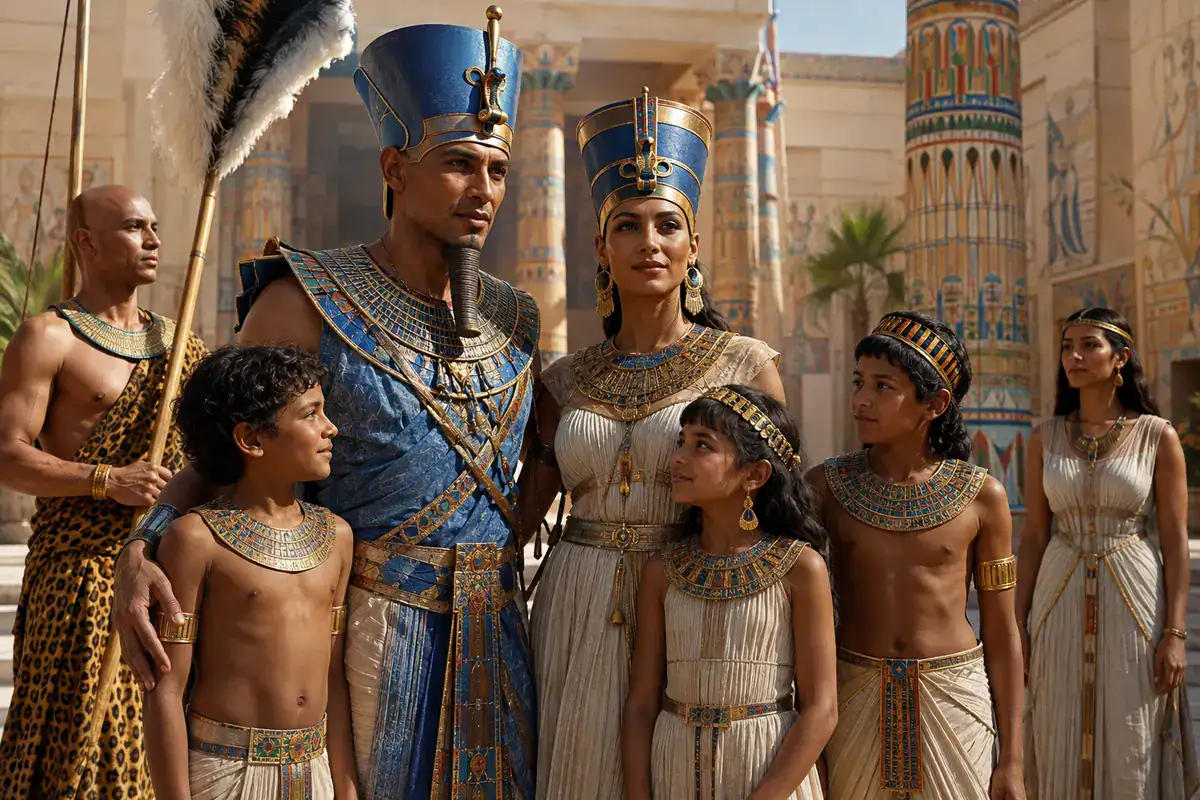
Furthermore, Ramesses II married several women and fathered an exceptionally large family. Surviving monuments name or represent around one hundred sons and daughters, although exact totals vary. Consequently, their repeated appearance in processions advertised fertility, succession and the stability of the royal house.
Queen Nefertari
Above all, Queen Nefertari was his most celebrated Great Royal Wife. She appears in temple scenes, corresponded with the Hittite queen and received the smaller rock-cut temple at Abu Simbel, where she is shown on an unusual monumental scale. Her decorated tomb, QV66 in the Valley of the Queens, is among the finest surviving royal tombs in Egypt.
Isetnofret and the Succession
By contrast, Queen Isetnofret was mother to several influential children, including Prince Khaemwaset and the future king Merneptah. Khaemwaset became high priest of Ptah at Memphis, and later tradition celebrated his restoration of older monuments. Because Ramesses lived so long, many crown princes died before him. Merneptah, already an older man, ultimately inherited the throne.
KV5 in the Valley of the Kings, a vast multi-roomed tomb associated with Ramesses II’s sons, demonstrates the scale of the royal family and the resources committed to its commemoration.
Pi-Ramesses: Capital, Army Base and Economic Center
During his reign, Ramesses II developed Pi-Ramesses in the eastern Nile Delta as a royal residence and strategic capital. Its location placed the court near the roads to Sinai and the Levant, allowing faster movement of troops, chariots and supplies. Palaces, temples, workshops, harbors and military facilities turned the city into the operational center of empire.
Archaeological work at Qantir and nearby Tell el-Dab’a has revealed evidence for large-scale bronze production, horse keeping and international material culture. Later, when the Nile’s Pelusiac branch shifted, builders transferred many monuments to Tanis. This movement once caused scholars to confuse the two sites.
Administration, Wealth and Trade
The king governed through viziers, viceroys, mayors, military commanders, scribes and temple institutions. Grain taxes supported state workers and campaigns, while Nubia supplied gold and the Levant connected Egypt with timber, metals and luxury goods. Temples were religious institutions but also major landholders, employers and storage centers. The reign’s abundance of monuments reflects both royal ambition and a sophisticated labor and supply system.
The Battle of Kadesh: Ramesses II’s Most Famous Campaign
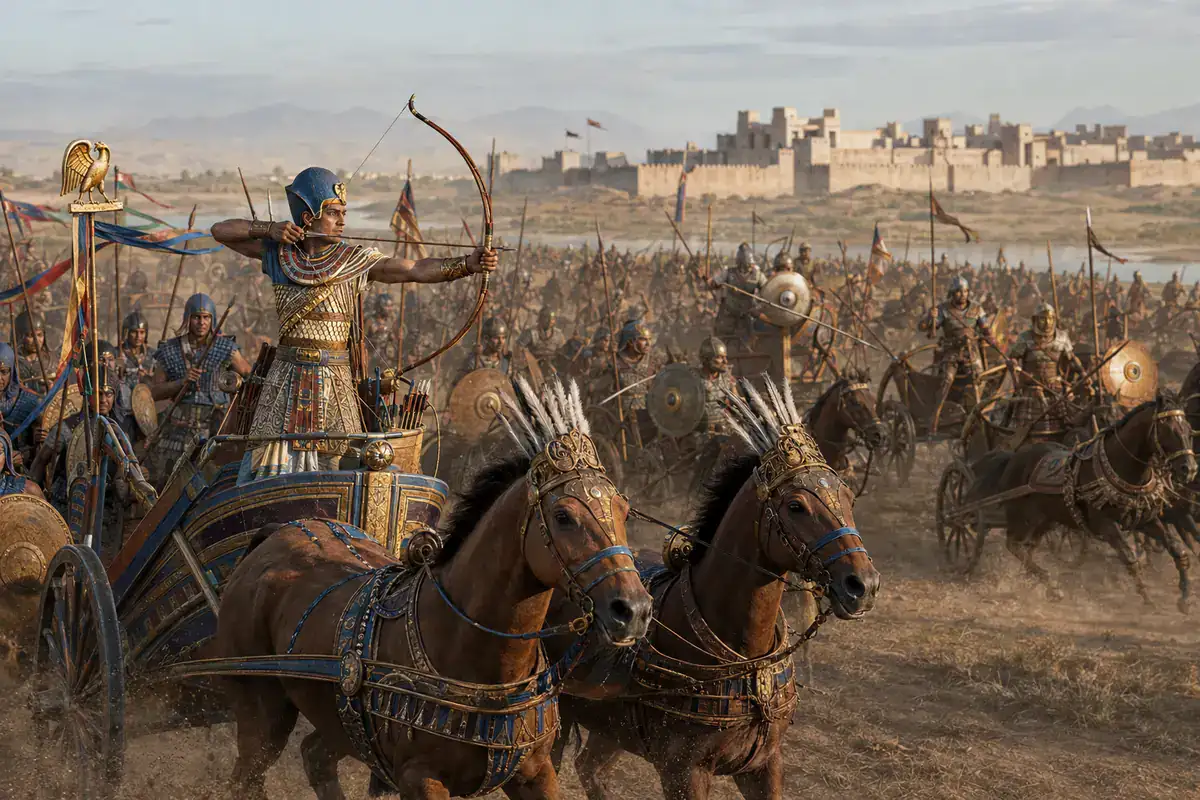
In about 1274 BCE, Ramesses II led four Egyptian divisions—named for Amun, Ra, Ptah and Seth—toward Kadesh on the Orontes River. Hittite king Muwatalli II concealed a large force near the city and used false information to convince the Egyptians that his army was farther away.
Before all his divisions had concentrated, Ramesses advanced toward Kadesh. Hittite chariots struck the marching Ra division and burst into the Egyptian camp. The surviving Kadesh inscriptions then place the isolated pharaoh at the center of a heroic counterattack. Reinforcements helped stabilize the situation, and the Egyptians survived a dangerous tactical crisis.
| Question | Egyptian Royal Version | Modern Historical Assessment |
|---|---|---|
| Did Ramesses fight bravely? | The poems and reliefs show him defeating enemies almost alone with divine aid. | He probably played an active command role, but the scenes are royal ideology, not neutral reporting. |
| Who won? | Ramesses proclaimed victory. | Egypt avoided disaster, but Kadesh remained outside secure Egyptian control; the strategic result was inconclusive. |
| Why is it important? | It demonstrated the king’s superhuman power. | It is unusually well documented and reveals chariot warfare, logistics and ancient propaganda. |
The Hittite Peace Treaty and Diplomatic Victory
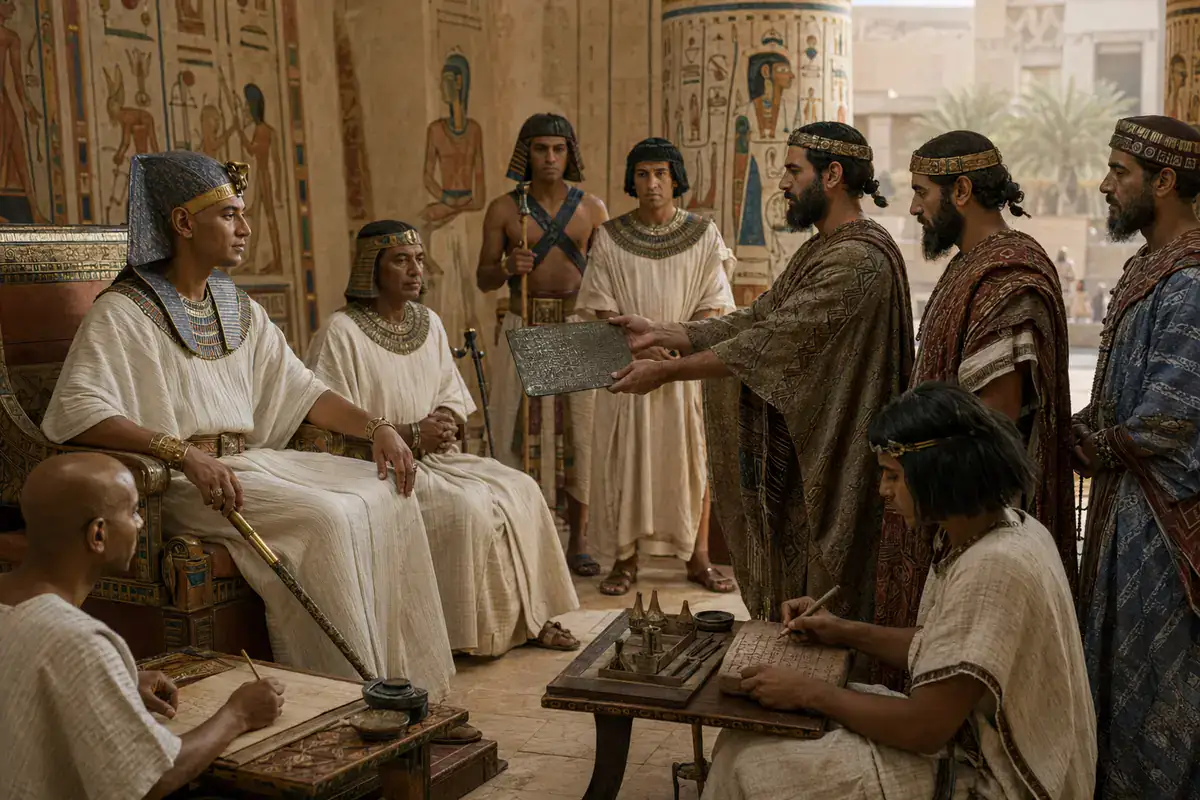
Years of continued rivalry did not produce a decisive conqueror. In about year 21 of Ramesses II’s reign, Egypt and the Hittite king Hattusili III formalized peace. Egyptian hieroglyphic versions survive on temple walls, while the Hittite archive at Hattusa preserved a cuneiform version.
The agreement established mutual peace, recognized the existing rulers, promised assistance against external attack and internal rebellion, and included provisions for returning fugitives. It is best described as one of the earliest surviving international peace treaties, rather than the first treaty ever made.
Diplomacy continued through letters, gifts and royal marriage. Ramesses married a Hittite princess, known in Egypt as Maathorneferure, and later another Hittite princess. The settlement stabilized northern relations and allowed both powers to respond to other threats.
Ramesses II’s greatest strategic success may not have been a battlefield victory, but the transformation of a dangerous rival into a diplomatic partner.
Campaigns in Nubia, Libya and the Levant
Kadesh dominates modern retellings, but Ramesses II’s military record was broader. Early Levantine campaigns reinforced Egyptian garrisons and vassal relationships. Later inscriptions claim operations in regions including Moab, Edom and Amurru, although reconstructing the exact sequence from royal scenes is difficult.
Furthermore, in Nubia, Egypt protected access to gold, trade routes and manpower. Temples at Abu Simbel, Beit el-Wali, Gerf Hussein and elsewhere projected the king’s authority into the south. The viceroy of Kush governed the region for the crown. Along the western frontier, fortifications and military settlements helped monitor Libyan groups.
These campaigns did not create Egypt’s empire from nothing; Ramesses inherited a New Kingdom imperial system. His achievement was maintaining its principal resources and prestige during a long reign while using monuments to present every operation as a universal victory.
The Monumental Building Program of Ramesses II
Certainly, no discussion of Ramesses the Great is complete without architecture. He founded new temples, enlarged older sanctuaries, erected colossal statues and carved his names onto monuments across Egypt and Nubia. However, some work was genuinely new; other projects completed buildings begun by Seti I, restored ancient sites or added Ramesses’s cartouches to earlier monuments.
- Luxor Temple: a great first court, pylon, obelisks and colossal statues reshaped its approach.
- Karnak: Ramesses completed and decorated parts of work associated with Seti I, including reliefs in the Great Hypostyle Hall.
- Abydos: he completed Seti I’s temple and built a separate temple of his own nearby.
- Memphis: he supported the cult of Ptah and erected numerous royal statues.
- Nubia: rock-cut temples proclaimed Egyptian power and integrated the king with regional gods.
The scale of this program explains why Ramesses II’s name appears so frequently. It also warns us to distinguish construction, completion, restoration and appropriation when evaluating individual monuments.
Abu Simbel: Ramesses II’s Temple of Power
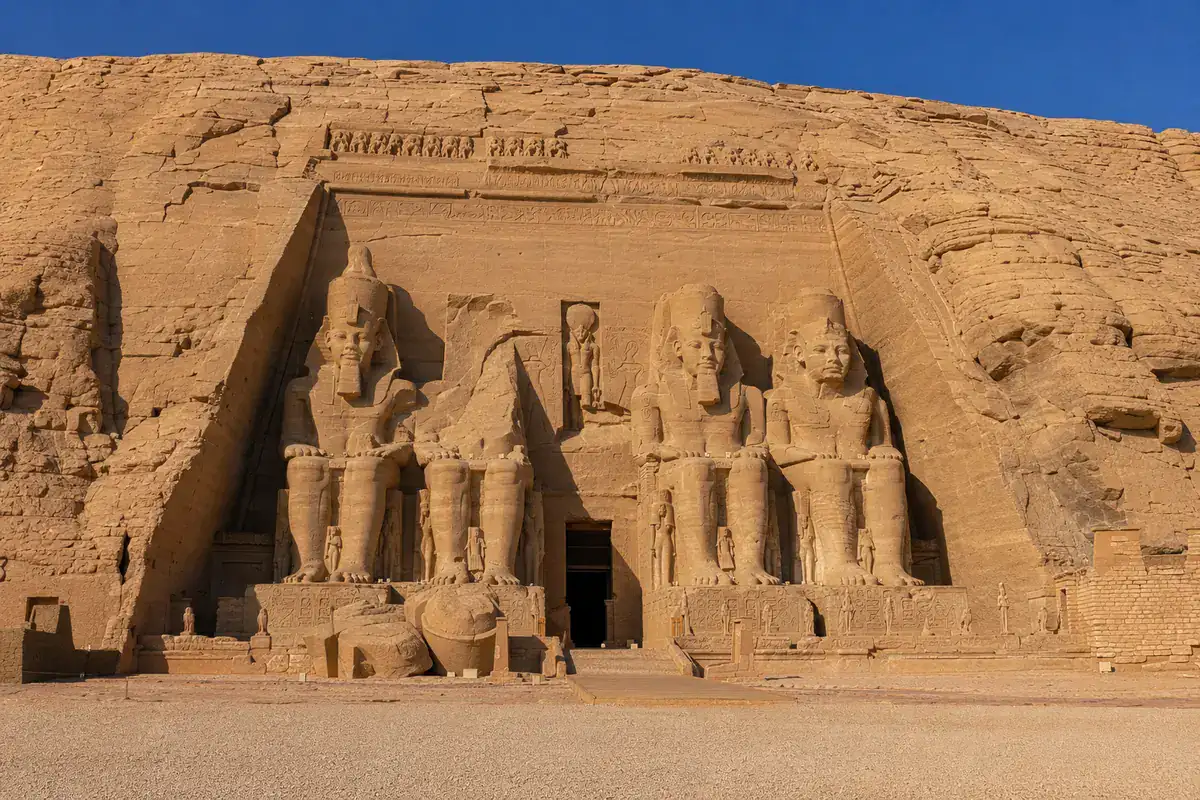
The Great Temple at Abu Simbel was cut into sandstone near Egypt’s southern frontier. Four seated colossi, each about twenty meters high, dominate the façade. Inside, Osiride pillars, battle reliefs and divine scenes lead toward a sanctuary where Ramesses appears among major gods.
Moreover, the neighboring temple honors Hathor and Queen Nefertari. Its façade gives the queen statues nearly equal in height to the king’s—a powerful statement of her status. Together, the temples addressed local communities, travelers and the divine world.
The Sun Alignment
Sunlight reaches the inner sanctuary on two days each year, now generally observed around 22 February and 22 October. Popular stories link the dates to the king’s birthday and coronation, but those exact associations are not proven by ancient evidence.
How Abu Simbel Was Saved
The construction of the Aswan High Dam threatened the temples with submersion. During the UNESCO-led Nubian campaign in the 1960s, engineers cut the monuments into large blocks and reassembled them on higher ground. Consequently, the rescue became a landmark achievement in international heritage conservation.
The Ramesseum: Mortuary Temple of Ramesses II
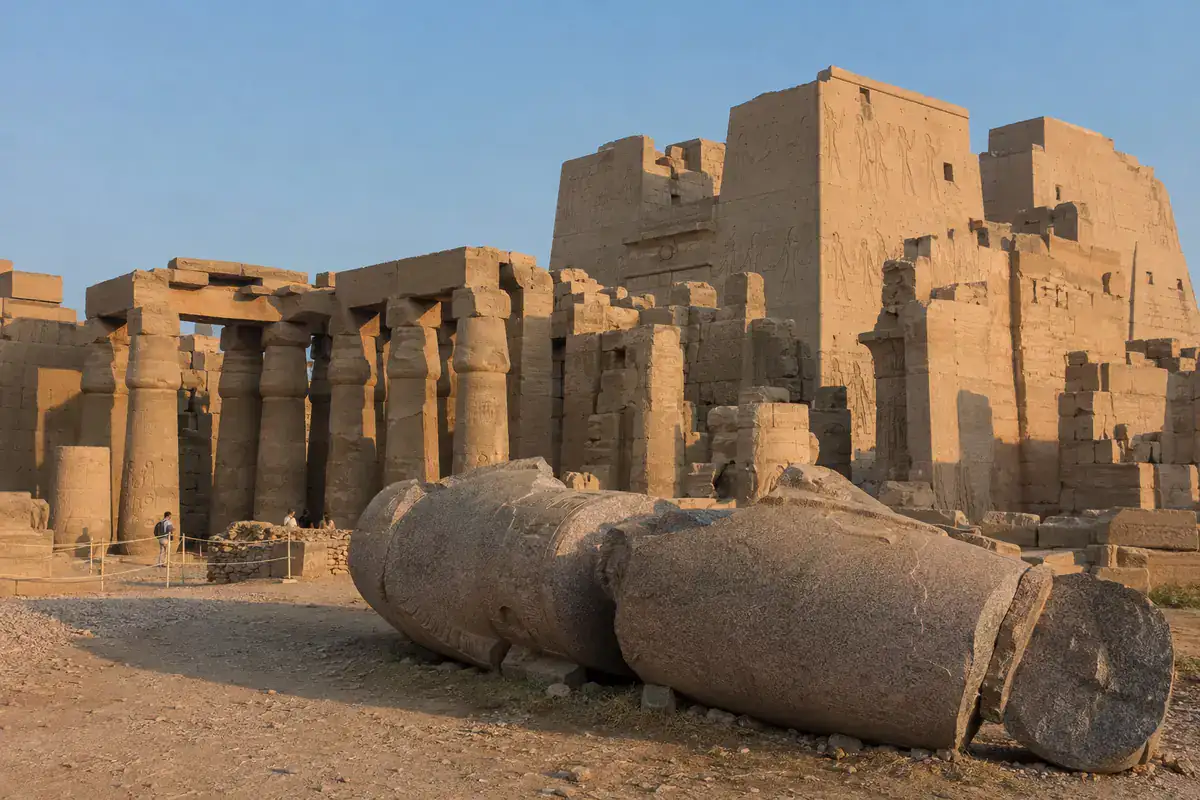
This complex was the king’s “house of millions of years” on the west bank of Thebes. Its pylons and courts displayed the Battle of Kadesh, religious processions and the king before the gods. Storerooms and administrative spaces reveal that the complex was an economic institution as well as a place of commemoration.
Moreover, a colossal seated statue of Ramesses once towered over the complex. Its broken granite remains inspired later visitors and the famous image of a ruined ruler in Percy Bysshe Shelley’s poem “Ozymandias.” The poem is not a historical description of the reign, but it demonstrates how the monument entered global cultural memory.
Religion, Divine Kingship and the Sed Festivals
Throughout his reign, Ramesses II presented himself as the chosen son of the gods and, in some settings, as a deity worthy of worship. His monuments connected him especially with Amun-Ra, Ra-Horakhty, Ptah and Seth. At Abu Simbel, the sanctuary placed his deified image within a divine company.
Furthermore, royal support enriched temples through land, workshops, offerings and personnel. This strengthened traditional religion while binding influential priesthoods to the crown. Ramesses also celebrated numerous Sed festivals after his thirtieth regnal year. These jubilees ritually renewed the king’s strength and made longevity itself part of his political message.
Religion and politics were not separate fields in ancient Egypt. Maintaining temples, performing offerings and defeating chaos were fundamental duties of kingship. Ramesses’s military reliefs therefore functioned as sacred images of order as well as historical claims.
Death, Tomb and Mummy of Ramesses II
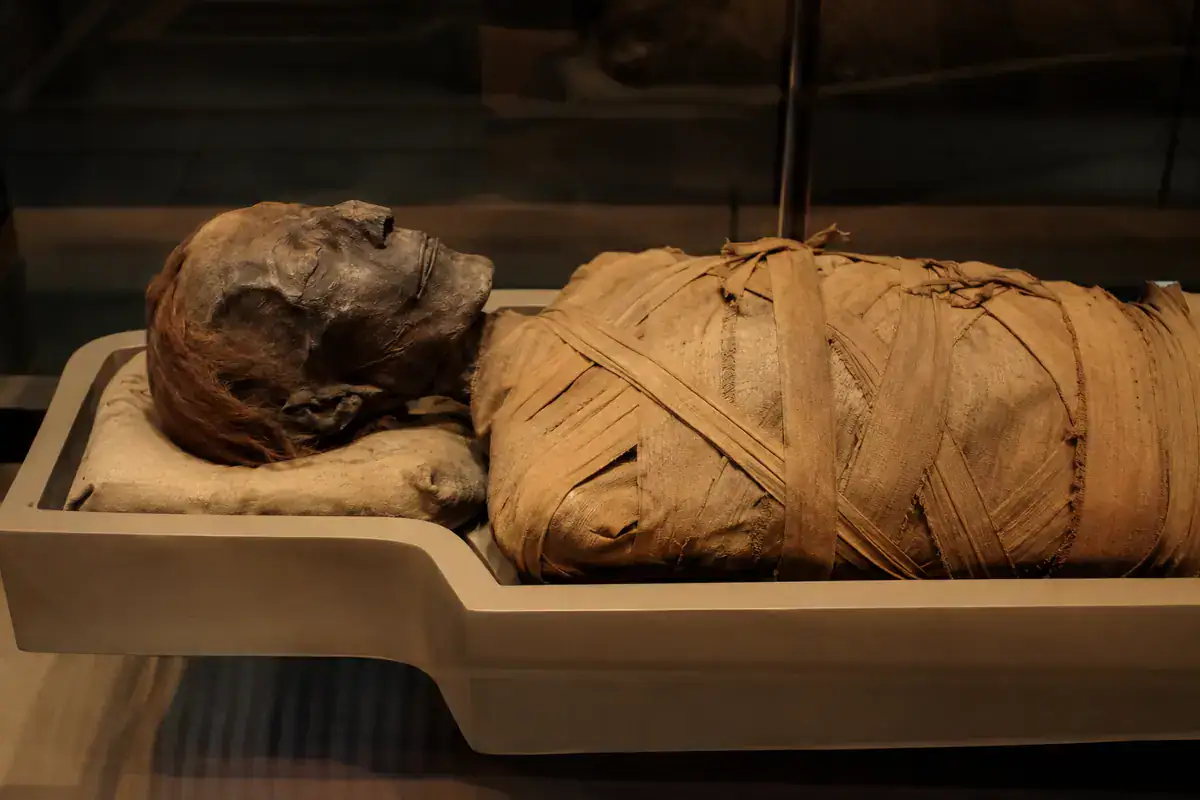
Around 1213 BCE, Ramesses II died after a reign of roughly sixty-six years, probably aged about ninety. For most Egyptians alive at the time, he had been the only pharaoh they had ever known. His death created an extraordinary generational change, and his son Merneptah succeeded him.
Embalmers buried the king in KV7 in the Valley of the Kings. Flooding and robbery damaged the tomb, so ancient priests moved the mummy more than once for protection. Eventually, priests placed it in the Deir el-Bahari royal cache, discovered in 1881.
In 1976 the mummy traveled to Paris for conservation after conservators identified fungal deterioration. Examinations have reported age-related conditions including severe dental disease and changes to the spine and arteries. However, writers often repeat claims about an official passport or a single certain cause of death, but these stories should not overshadow the documented conservation work.
Today, visitors can see the royal mummy in the Royal Mummies Hall at the National Museum of Egyptian Civilization in Cairo. The museum setting reunites Ramesses II with other rulers of the New Kingdom and explains mummification within its archaeological context.
Was Ramesses II the Pharaoh of the Exodus?
In popular culture, filmmakers and writers often cast Ramesses II as the pharaoh of the biblical Exodus, partly because the Book of Exodus mentions a store city named Raamses and because his reign fits some proposed chronologies. Consequently, films and novels have made the association appear certain.
However, archaeology has not produced conclusive evidence that identifies Ramesses II as the Exodus pharaoh, and the biblical text does not name that ruler. Scholars disagree about the date, historical setting and scale of any events behind the tradition. The responsible conclusion is that Ramesses II is a candidate in some interpretations, not an established identification.
| Popular Claim | What the Evidence Supports |
|---|---|
| Ramesses II won Kadesh decisively. | He recovered from an ambush, but the strategic result was inconclusive and Kadesh did not become securely Egyptian. |
| He signed the world’s first peace treaty. | The Egyptian–Hittite agreement is one of the earliest surviving bilateral peace treaties. |
| He built every monument bearing his name. | He built extensively, but also completed, restored and sometimes reinscribed earlier works. |
| The Abu Simbel dates prove his birthday and coronation. | The solar alignment is real; those specific ancient date meanings remain unproven. |
| He was certainly the pharaoh of Exodus. | No conclusive archaeological or textual evidence identifies him. |
Where to See Ramesses II in Egypt Today
Across Egypt, travelers can follow the extraordinary legacy of Ramesses II. At Abu Simbel, his most dramatic façade dominates the Nubian landscape, while Luxor brings together his additions at Luxor Temple, Karnak Temple and the Ramesseum. For a journey combining several of these monuments, explore our 12 Days Egypt Tour Package or browse our Egypt Nile Cruises. Farther north, Abydos preserves temples of Seti I and Ramesses II, while Memphis preserves colossal statues and a strong connection with the cult of Ptah.
- Cairo: see the royal mummy in the National Museum of Egyptian Civilization and major objects from the New Kingdom.
- Luxor east bank: explore Ramesside courts, statues and inscriptions at Luxor Temple and Karnak Temple.
- Luxor west bank: visit the Ramesseum and the broader royal landscape of Thebes.
- Abu Simbel: view the Great Temple and Nefertari’s temple beside Lake Nasser.
- Abydos and Memphis: understand his relationship with earlier kings, Ptah and royal memorial architecture.
Ramesses II, Ramses II or Rameses II: Which Spelling Is Correct?
Ramesses II, Ramses II and Rameses II all refer to the same pharaoh. Ancient Egyptians wrote his name in hieroglyphs without the vowels used in modern English. Consequently, scholars and publishers transliterate the royal name in several ways. “Ramesses II” is common in academic English, while “Ramses II” remains widespread in museums, travel searches and popular culture.
His birth name, Ramesses, means “Ra has fashioned him” or “Born of Ra.” Meanwhile, his throne name, Usermaatre-Setepenre, expresses the power of the cosmic order of Ra and the king’s divine selection. Ancient inscriptions enclosed both names in cartouches. Therefore, visitors may encounter several royal names at the same monument even though they identify one ruler.
The modern title “Ramesses the Great” does not form part of his ancient fivefold titulary. Instead, later historians use it to distinguish his scale and influence. For search purposes, the spellings Ramesses II, Ramses II and Ramesses the Great are synonyms rather than different kings.
How Ramesses II Governed Egypt
Although the king dominated temple walls, he could not govern Egypt alone. Two viziers supervised major branches of administration in Upper and Lower Egypt. In addition, royal scribes recorded taxes, grain, labor and correspondence, while provincial officials managed towns and agricultural districts. The viceroy of Kush represented the crown in Nubia, and military commanders protected borders and foreign possessions.
To administer the kingdom, Ramesses relied on experienced officials whose careers often crossed military, religious and civil institutions. For example, the high priesthoods managed temple wealth and ritual, but priests also served the state as diplomats, builders and administrators. The court rewarded loyalty through titles, offices, land and proximity to the royal family.
Economy, Agriculture and International Trade
The Nile’s annual cycle supported Egypt’s agricultural economy. Farmers produced grain that the state collected, stored and redistributed as wages and rations. At the same time, temple estates controlled fields, livestock, workshops and fleets. Copper from Sinai, gold from Nubia, timber from the Levant and luxury goods from wider trade networks supplied royal projects and diplomacy.
Pi-Ramesses strengthened this system because its harbors connected Nile transport with routes toward the eastern Mediterranean. Moreover, workshops manufactured weapons and chariot equipment close to the army’s northern base. The city’s foreign deities and imported objects reveal a cosmopolitan capital where Egyptians interacted with people from across the Near East.
The Army of Ramesses II
The New Kingdom army combined infantry, archers, chariot units, scouts, engineers and supply personnel. Divisions carried divine names, while experienced officers coordinated marches over long distances. Horses and chariots offered speed and prestige; however, infantry still performed most battlefield and siege work.
Campaign success depended on water, fodder, food, river transport and reliable intelligence. Indeed, the crisis at Kadesh showed what could happen when reconnaissance failed and divisions became separated. Ramesses later turned that danger into a lesson about royal courage, but the episode also reveals the complexity of ancient military logistics.
Royal Propaganda, Art and the Image of Ramesses the Great
Through repeated royal imagery, Ramesses II demonstrated a clear understanding of political communication. Colossal statues made his body larger than ordinary human scale, while temple reliefs showed him defeating foreign enemies before the gods. As a result, worshippers and officials encountered the same message from the Delta to Nubia: the king protected order and deserved divine support.
Battle scenes did not function like modern photographs or independent journalism. Artists organized scale, pose and inscriptions to communicate meaning. The pharaoh appears calm, enormous and active; enemies appear disordered and small. Nevertheless, the texts remain historically valuable when researchers compare their claims with archaeology, Hittite records and the geography of campaigns.
Did Ramesses II Steal Other Pharaohs’ Monuments?
On some older statues and buildings, Ramesses placed his own names, a practice often called usurpation. Yet ancient motives varied. A new inscription might claim an object, restore its cultic use, associate the present king with a respected predecessor or mark later work on an existing structure. Therefore, the simple word “stealing” can hide a more complicated history.
At the same time, Ramesses commissioned an extraordinary amount of original construction. Archaeologists distinguish new work from reuse by studying carving technique, erased names, architectural phases and the relationship between inscriptions and stone surfaces. This evidence prevents the frequency of his cartouches from becoming a misleading count of everything he personally built.
Ramesside Style
Artists produced everything from monumental pylons to delicate jewelry, painted tombs and glazed tiles. Deeply cut reliefs remained visible in strong sunlight and could survive later recarving better than shallow work. In addition, workshops repeated standardized royal forms efficiently across a huge building program. The result created a recognizable visual language of power without eliminating regional craftsmanship or individual artistic quality.
Merneptah and Egypt After Ramesses II
Because Ramesses II lived for so long, the royal succession became unusually complicated. Several prominent sons served as crown prince and then died during their father’s lifetime. Eventually, Merneptah—traditionally identified as the king’s thirteenth son and a child of Isetnofret—became heir. He took the throne as an older man and ruled for about a decade.
Merneptah inherited a state with impressive monuments and strong institutions, but he also faced new pressures. He fought Libyan forces and groups later associated with the Sea Peoples, responded to unrest in Nubia and continued royal building. His famous victory stela contains the earliest generally accepted ancient Egyptian reference to Israel.
After Merneptah, disputes over succession weakened the final phase of the 19th Dynasty. However, Ramesses II’s name retained enormous prestige. The rulers of the 20th Dynasty repeatedly adopted the name Ramesses, and later Egyptians treated his age as a benchmark of royal greatness.
How Historians Reconstruct His Reign
No single source gives a neutral biography of Ramesses II. Instead, researchers combine temple inscriptions, administrative ostraca, papyri, tombs, statues, settlement archaeology and Hittite archives. Scientific examination of the mummy contributes evidence about the king’s body, while excavations at Qantir illuminate his capital and military economy.
Each source answers different questions. Royal texts explain ideology and official memory; administrative documents reveal daily systems; archaeology tests where people built, traded and lived. Consequently, the strongest modern history compares sources rather than repeating royal claims as literal fact.
The Legacy of Ramesses the Great
Far more than a warrior or builder, Ramesses II drew his power from a combination of army, diplomacy, family, religion, administration and visual communication. He converted an indecisive battle into a durable story of courage, transformed rivalry into treaty, and turned stone landscapes into a permanent royal presence.
Later Egyptians remembered his age as a model of greatness. Several later kings adopted the name Ramesses, while monuments and statues ensured that travelers repeatedly encountered his image. Modern archaeology has added nuance: his inscriptions are invaluable but partisan, his peace was as important as his warfare, and his building record mixes innovation with restoration and reuse. For wider New Kingdom context, compare his reign with Thutmose III, Queen Hatshepsut and Tutankhamun.
For that reason, Ramesses II remains one of history’s best-known monarchs. His reign produced both real institutional power and one of the most successful royal images of the ancient world.
Ramesses II: Egypt’s Most Powerful Monumental King
Across more than six decades, Ramesses II preserved Egypt’s regional influence, secured peace with a major rival and reshaped the Nile Valley with temples, cities and colossal images. The historical king was more complex than his propaganda, yet that complexity makes him greater—not smaller. Warrior, diplomat, father, builder and divine ruler, Ramesses the Great created a legacy that still defines how millions imagine ancient Egypt.
Frequently Asked Questions About Ramesses II
Who was Ramesses II?
Ramesses II was the third pharaoh of Egypt’s 19th Dynasty and ruled for about sixty-six years, from 1279 to 1213 BCE.
Why is Ramesses II called Ramesses the Great?
His long reign, extensive monuments, military reputation, diplomacy and enduring cultural influence earned him the modern title “the Great.”
How long did Ramesses II rule Egypt?
He ruled for approximately sixty-six years, one of the longest reigns in ancient Egyptian history.
Did Ramesses II win the Battle of Kadesh?
He survived and countered a dangerous Hittite ambush, but Kadesh remained outside firm Egyptian control. Most historians consider the strategic result inconclusive.
What was the peace treaty of Ramesses II?
It was an agreement between Ramesses II and Hittite king Hattusili III that established peace, mutual assistance and rules concerning fugitives.
Who was Ramesses II’s favorite wife?
Nefertari was his most celebrated Great Royal Wife and received a magnificent tomb and a temple beside his own at Abu Simbel.
How many children did Ramesses II have?
Surviving monuments name or represent around one hundred sons and daughters, though exact totals differ among modern reconstructions.
Where is the mummy of Ramesses II?
The National Museum of Egyptian Civilization displays it in the Royal Mummies Hall in Cairo.
Was Ramesses II the pharaoh of the Exodus?
Some interpretations propose him, but no conclusive evidence identifies Ramesses II as the Exodus pharaoh.
What did Ramesses II build?
His projects include Abu Simbel, the Ramesseum, Pi-Ramesses, additions at Luxor and Karnak, and temples across Egypt and Nubia.
Plan Your Trip
Follow the world of Ramesses II from Cairo and Luxor to Abu Simbel with a private itinerary designed by our local team.
Read Also
- Queen Nefertari: Life, Tomb QV66 and Abu Simbel
- Thutmose III: Egypt’s Warrior Pharaoh
- Queen Hatshepsut: Egypt’s Powerful Female Pharaoh
- Tutankhamun: A Short Life, Eternal Treasures
- Abu Simbel Temple: Complete Visitor Guide
- Luxor Temple
- Karnak Temple
- The Egyptian Museum in Cairo
- 12 Days Egypt Tour Package
- 10 Days Egypt Tour Package
- Egypt Nile Cruises
- Egypt Tour Packages