
Tutankhamun lived a short life, yet his name became eternal. The young king ruled Egypt for only about a decade, but the discovery of his nearly intact tomb transformed him into the world’s most recognizable pharaoh. His treasures reveal royal life, religion, craftsmanship and burial traditions at the end of the turbulent Amarna Period.
Why Is Tutankhamun So Famous?
Tutankhamun is famous because Howard Carter discovered his richly furnished tomb, KV62, in the Valley of the Kings in 1922. More than 5,000 objects survived inside its four small chambers, including the golden burial mask, nested coffins, a throne, chariots, jewelry and objects prepared for the afterlife.
Tutankhamun’s Family and Royal Lineage
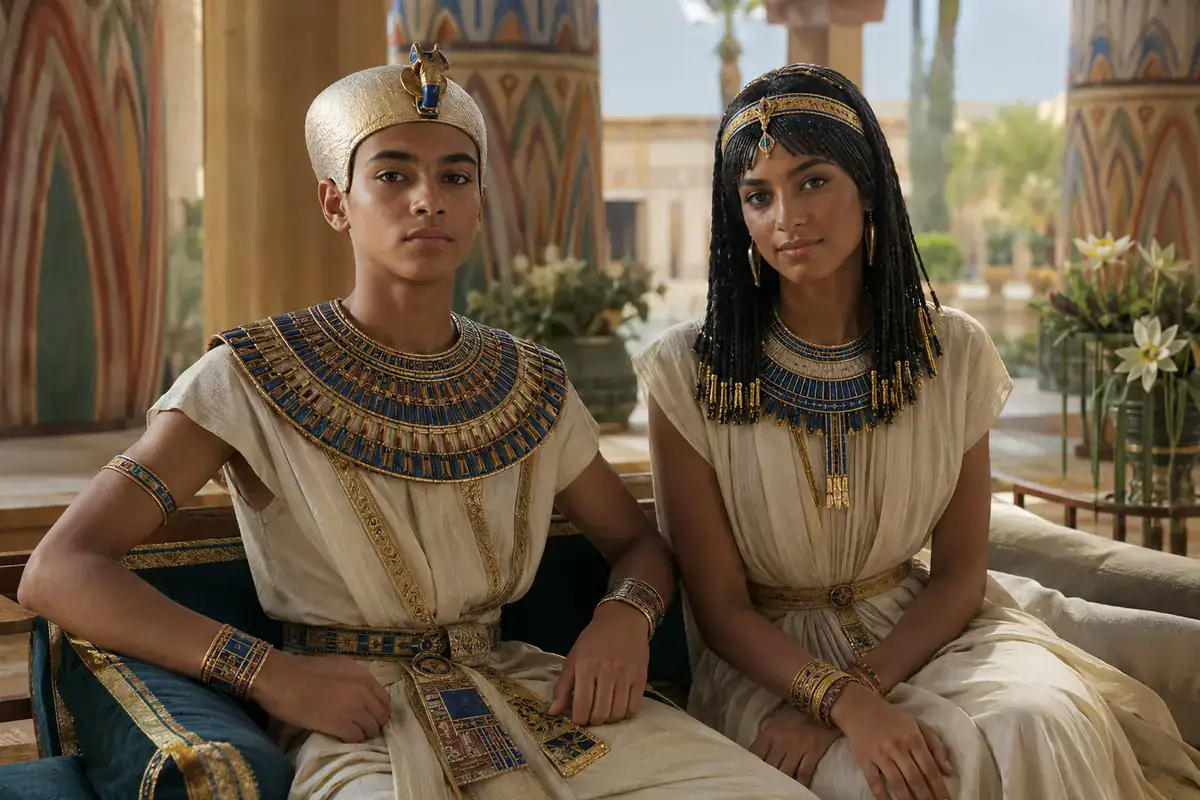
Tutankhamun was born around 1341 BCE during Egypt’s 18th Dynasty. DNA research supports the identification of his father as the mummy from KV55, widely associated with Akhenaten. Through Akhenaten, Tutankhamun belonged to the royal line of Amenhotep III and Queen Tiye. The mummy known as the “Younger Lady” from KV35, a full sister of the KV55 individual, was identified in the 2010 study as Tutankhamun’s mother.
The identity of his mother remains uncertain because the genetic result does not by itself supply her historical name. Moreover, specialists have questioned aspects of ancient-DNA interpretation, so responsible summaries distinguish the genetic family model from unresolved historical names. This close royal kinship may have increased the risk of inherited health problems, although researchers continue to debate several diagnoses.
Marriage to Ankhesenamun
Tutankhamun married Ankhesenamun, a daughter of Akhenaten and Nefertiti. She was therefore probably his half-sister. Two small mummified fetuses were found in the tomb and are generally interpreted as their stillborn daughters. The couple left no surviving heir, creating a succession crisis after the king’s early death.
Tutankhamun: The Child Who Became Pharaoh
Tutankhamun came to the throne when he was about eight or nine years old. His original name, Tutankhaten, meant “Living Image of Aten” and reflected the religious world created by Akhenaten at the new capital of Akhetaten, modern Tell el-Amarna.
A child could carry full royal titles, but experienced officials managed much of the state. The elderly courtier Ay and the powerful general Horemheb became especially important. Both men later ruled Egypt as pharaohs after Tutankhamun’s death.
Tutankhamun and the Restoration of Egypt’s Gods
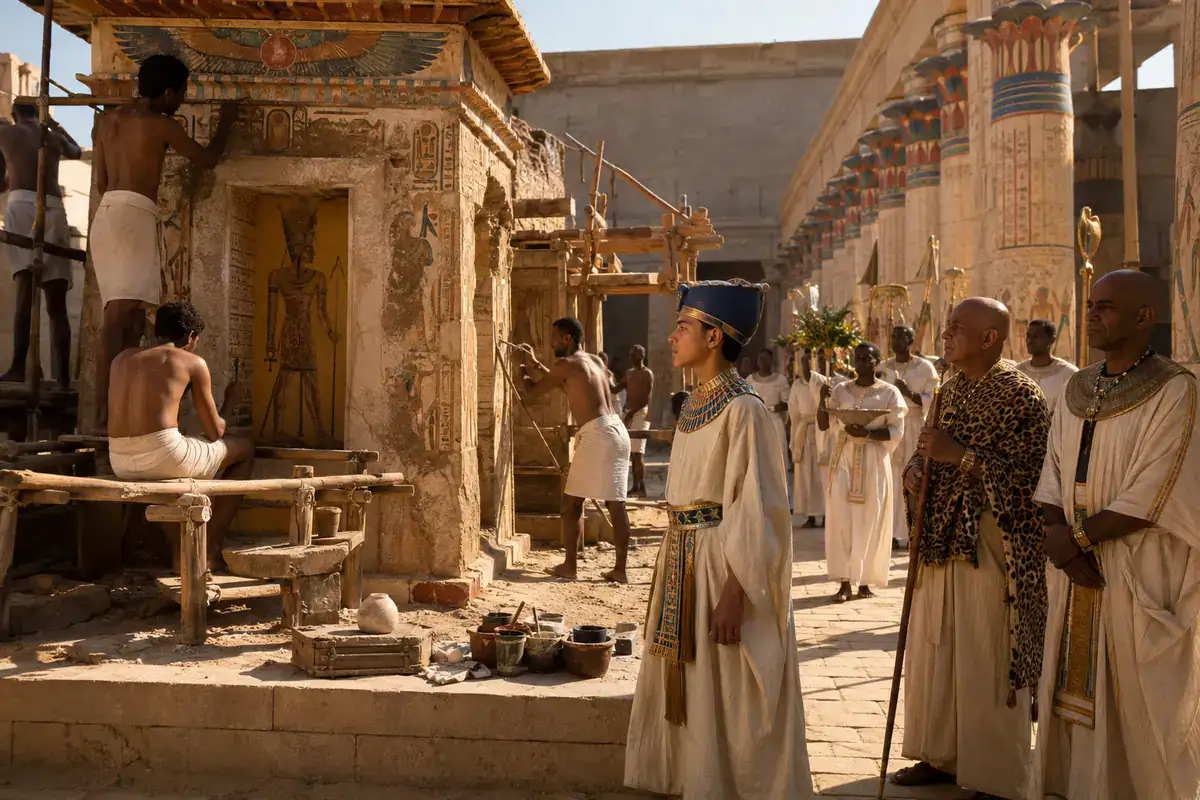
Early in the reign, the royal court abandoned the exclusive prominence given to Aten and restored the traditional temples and priesthoods. The king changed his name from Tutankhaten to Tutankhamun, “Living Image of Amun,” while Ankhesenpaaten became Ankhesenamun.
The Restoration Stela, later claimed by Horemheb, describes temples in ruin and sanctuaries neglected before the king renewed divine images, offerings and priestly offices. Like all royal inscriptions, it presents an ideal political message; nevertheless, it reflects a major reversal of Akhenaten’s religious program.
The government left Amarna, while Memphis probably served as an important administrative center. Thebes again became central to the cult of Amun. Workshops also resumed traditional artistic and religious production, although traces of Amarna style remained visible.
Was Aten Worship Completely Abandoned?
The change was decisive at the level of royal policy, but cultural transitions are rarely instant. Aten imagery survived on objects made for the young king, including the golden throne. At the same time, temples of Amun, Ptah and other deities again received royal support. Tutankhamun’s reign therefore bridges two worlds rather than erasing one overnight.
Tutankhamun’s reign mattered not because it created a new empire, but because it helped guide Egypt out of the Amarna crisis and back toward traditional kingship.
The Health and Mysterious Death of Tutankhamun
Tutankhamun died around 1323 BCE at approximately eighteen or nineteen years of age. No surviving text explains his death, and modern investigations have produced evidence rather than one universally accepted answer.
CT scans identified a serious fracture in the left leg, possibly sustained close to death. DNA studies reported malaria parasites, while examination of the feet suggested a painful condition that may have affected mobility. More than 130 sticks and staffs found in the tomb include examples showing signs of use.
| Proposal | Evidence | What Remains Uncertain |
|---|---|---|
| Leg injury | A fracture was identified in the left femur. | Researchers debate whether it occurred before death or during later handling. |
| Malaria | DNA testing detected malaria parasites. | Malaria may have contributed without being the only cause. |
| Inherited conditions | His parents were closely related and he had physical abnormalities. | Several proposed syndromes remain disputed. |
| Accident or violence | Older theories proposed a blow or chariot accident. | Modern scans do not confirm a fatal blow to the head. |
The best cautious conclusion is that several health stresses may have combined: a serious injury, infection and genetic vulnerability. A sensational murder theory is not supported by strong current evidence.
Howard Carter and the Discovery of Tutankhamun’s Tomb
Howard Carter had excavated in Egypt for years before working with his patron, the 5th Earl of Carnarvon. Carter believed that one royal burial still remained hidden beneath the debris in the Valley of the Kings.
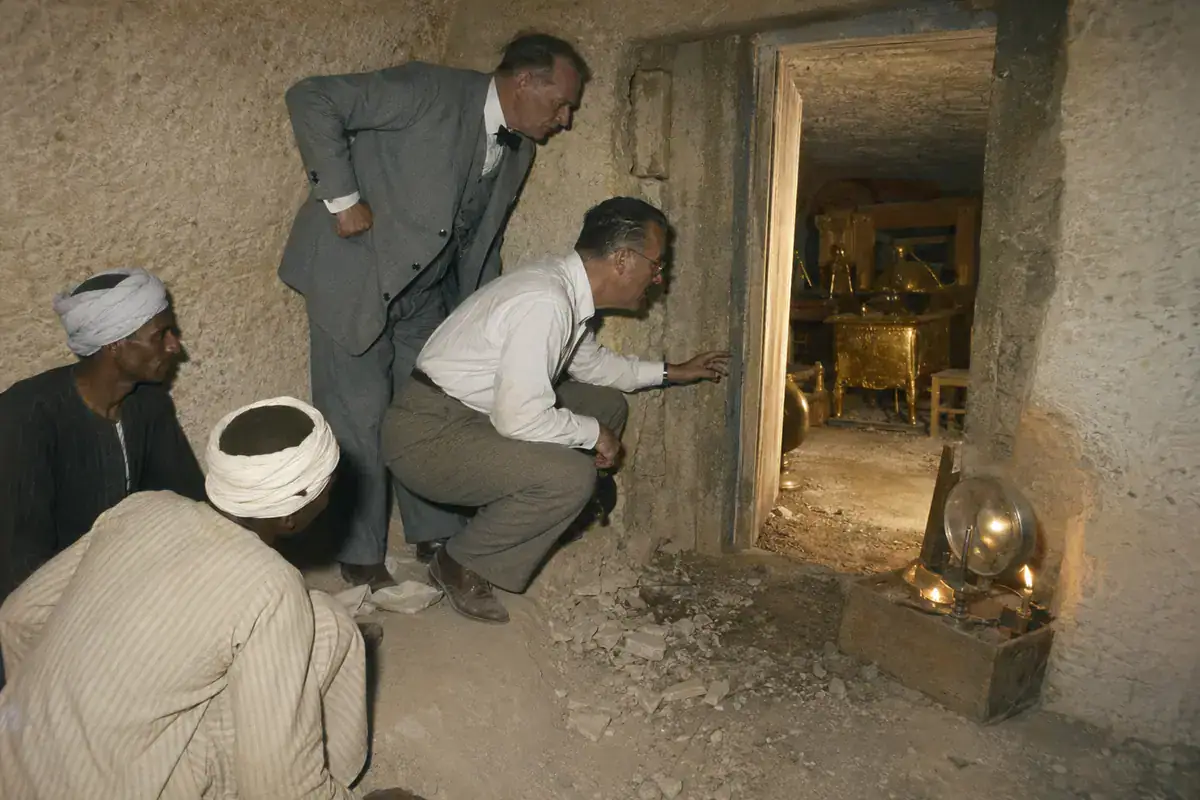
On 4 November 1922, the excavation team uncovered the first step of a staircase. Carter soon found a sealed doorway bearing ancient impressions. After Lord Carnarvon arrived in Egypt, the team opened a small hole in the second sealed entrance on 26 November and looked into the antechamber.
When Carnarvon asked whether he could see anything, Carter later recalled answering, “Yes, wonderful things.” The famous line captured a chamber crowded with gilded couches, chests, dismantled chariots and guardian statues.
Tutankhamun Tomb Discovery Timeline
The clearance of KV62 was not a single dramatic night. It became a decade-long archaeological and conservation project. Carter’s records, photographs, drawings and object cards now allow researchers to reconstruct where thousands of items originally stood.
| Date | Event | Why It Matters |
|---|---|---|
| 4 November 1922 | The first step of the tomb staircase was uncovered. | The discovery confirmed that a sealed structure survived beneath later debris. |
| 26 November 1922 | Carter looked through the second doorway into the antechamber. | The famous “wonderful things” moment revealed an extraordinary royal assemblage. |
| 16 February 1923 | The burial chamber was officially opened. | The team encountered the outer gilded shrine surrounding the royal burial. |
| 1924 | The sarcophagus lid was lifted during the second season. | Nested coffins inside the stone sarcophagus became accessible. |
| 1925 | The innermost coffin and mummy were examined. | The golden mask and objects placed on the king’s body were documented. |
| 1932 | The principal clearance work concluded. | Nearly ten years of recording and conservation created the core archive. |
The Egyptian Team Behind the Discovery
Popular accounts focus on Carter and Carnarvon, but Egyptian excavators, foremen, conservators, guards and officials made the work possible. Their names were not always recorded with the same care as those of European specialists. Modern scholarship increasingly examines photographs, payrolls and archives to recover their contribution and place the discovery within Egypt’s own archaeological history.
Inside Tutankhamun’s Tomb KV62
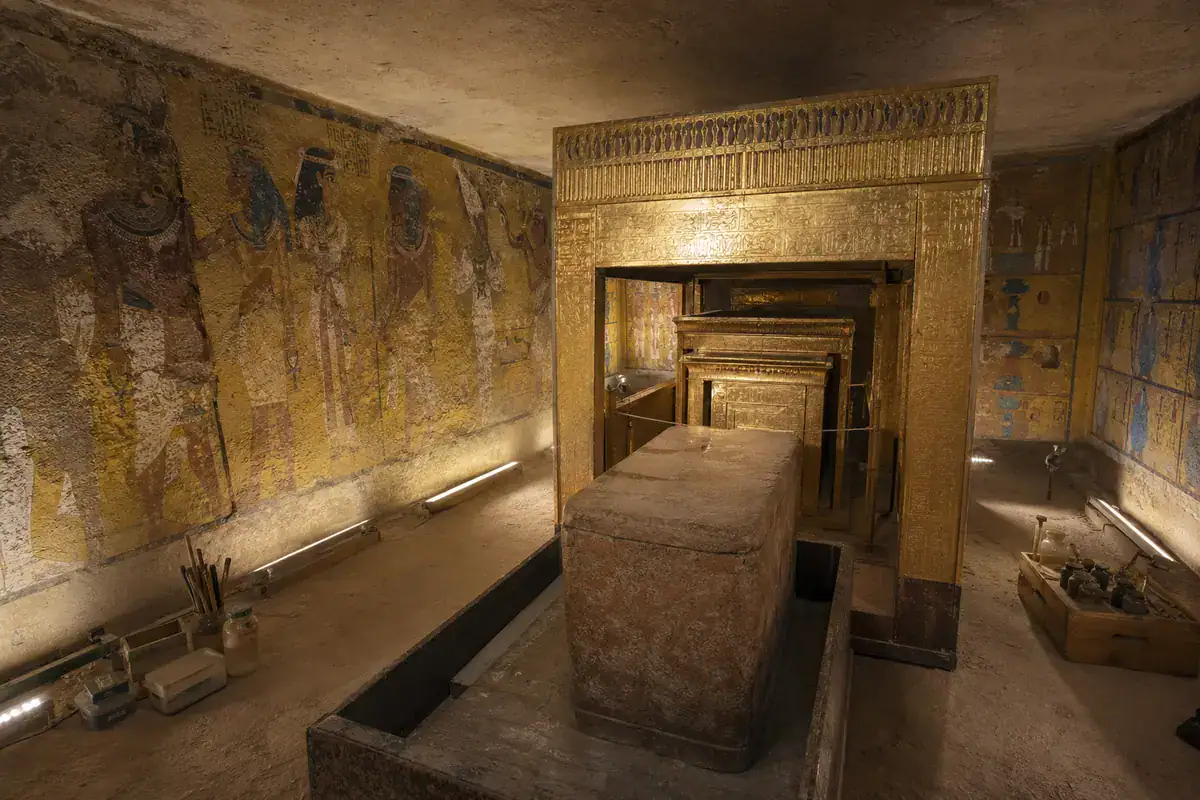
KV62 is smaller and less carefully finished than many royal tombs. It contains four principal spaces: the antechamber, annex, burial chamber and treasury. The modest plan suggests that a smaller tomb may have been adapted quickly when the young king died unexpectedly.
Ancient intruders entered the tomb at least twice, but officials resealed it. Later construction debris and flood deposits helped hide the entrance. As a result, the burial survived with most of its contents still inside, even though objects had been disturbed.
The Nested Burial
Four gilded wooden shrines filled much of the burial chamber. Inside them stood a quartzite sarcophagus containing three anthropoid coffins. The innermost coffin was made of solid gold and weighed more than 110 kilograms. Within it lay Tutankhamun’s mummy, protected by the golden mask and layers of jewelry and amulets.
Tutankhamun’s Golden Burial Mask
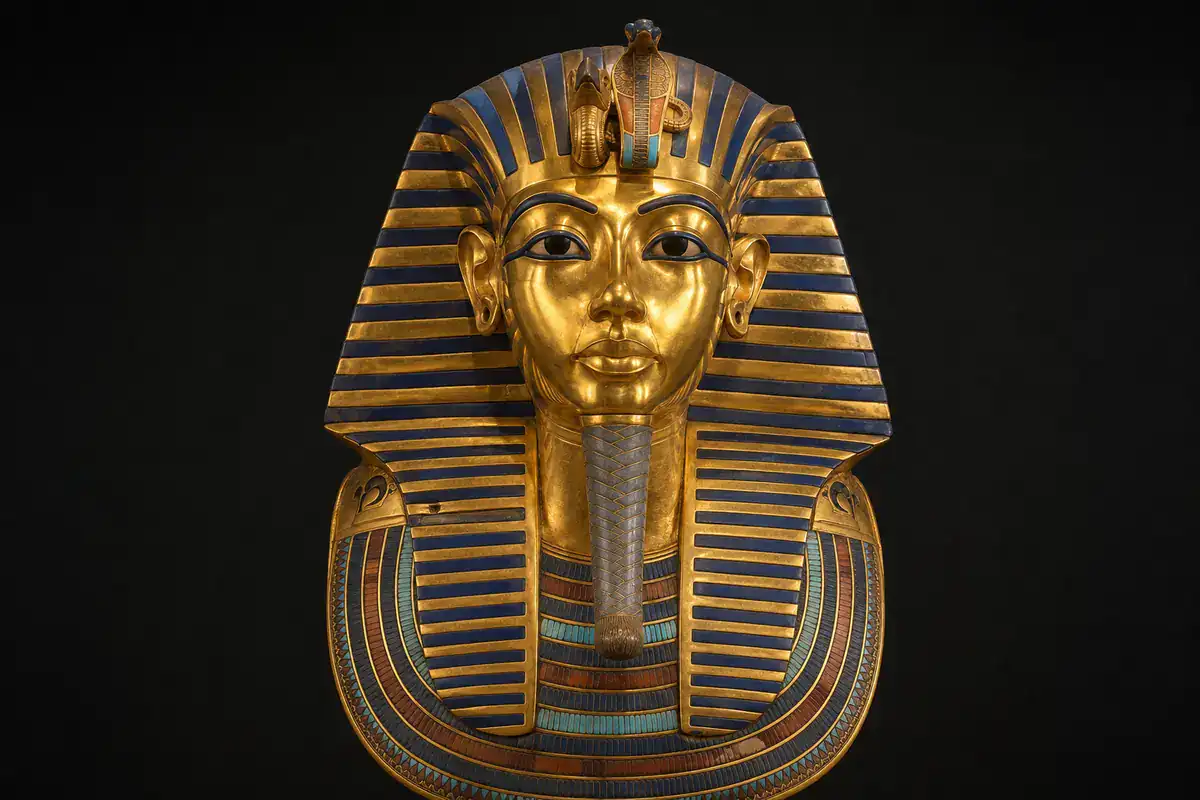
The golden mask covered the king’s head and shoulders. Crafted from gold and enriched with glass and semi-precious materials, it presents Tutankhamun as an ideal eternal ruler. The striped nemes headdress bears the cobra and vulture, symbols of sovereignty over Lower and Upper Egypt.
The face is youthful but perfected, while the ceremonial beard identifies the dead king with Osiris. A protective spell is inscribed on the back and shoulders. The mask weighs a little more than ten kilograms and became the most familiar image of Ancient Egypt.
The mask is now part of the Tutankhamun Galleries at the Grand Egyptian Museum.
What Tutankhamun’s Treasures Reveal
The tomb contained more than 5,000 catalogued objects, ranging from monumental gilded shrines to food, clothing and simple personal possessions. They were not collected merely to display wealth. Each object helped equip, protect or transform the king in the afterlife.
| Object Group | Examples | What It Reveals |
|---|---|---|
| Royal regalia | Diadems, crook, flail and ceremonial jewelry | Kingship, divine protection and political identity. |
| Funerary equipment | Shrines, coffins, mask and canopic containers | The complex ritual transformation of the dead king. |
| Daily life | Clothing, sandals, beds, games and food | The material world expected to continue after death. |
| Transport and warfare | Chariots, bows, arrows and shields | Royal mobility, hunting and military symbolism. |
| Personal objects | Walking sticks, boxes and childhood items | Clues to the individual behind the royal image. |
The Golden Throne
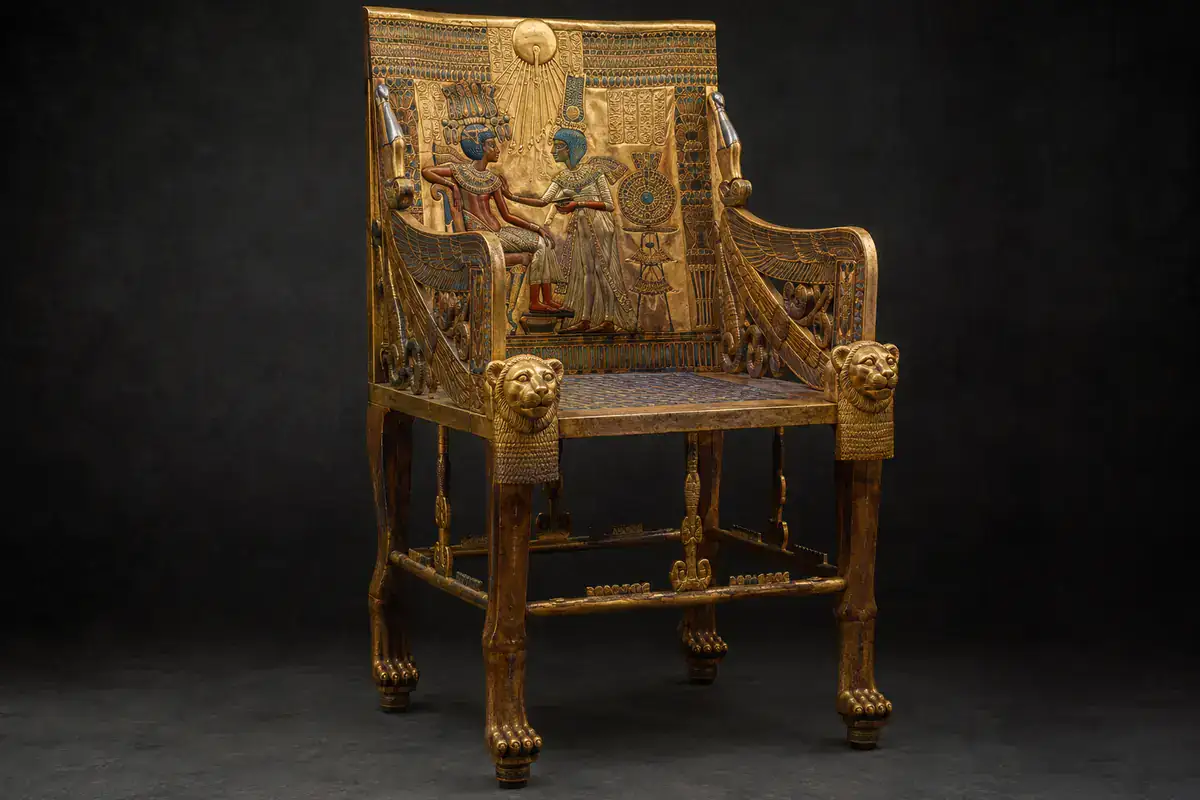
One of the most intimate objects is the gilded throne showing Tutankhamun seated while Ankhesenamun applies perfume or ointment to his shoulder. Aten’s rays descend above them. The scene preserves Amarna-style tenderness even after the official restoration of Amun. The official Grand Egyptian Museum catalogue identifies wood covered with gold sheets, glass, faience and semi-precious stone among its materials.
Were All the Treasures Made for Tutankhamun?
Not necessarily. Changes to names, reused components and stylistic differences suggest that some objects were adapted from equipment prepared for other members of the Amarna royal family. Reuse would make sense after an unexpected death, when embalmers and workshops had about seventy days to complete the burial. This does not reduce the objects’ value; instead, it reveals how royal workshops responded to political urgency.
Tutankhamun Myths and Facts
| Popular Claim | What the Evidence Shows |
|---|---|
| Tutankhamun’s tomb was completely untouched. | Ancient robbers entered it at least twice. Officials restored order and resealed the entrances, leaving most contents behind. |
| Howard Carter discovered the burial chamber on 26 November 1922. | He looked into the antechamber that day. The burial chamber was opened in February 1923. |
| Tutankhamun was murdered by a blow to the head. | Modern imaging does not support the famous head-blow theory. His precise cause of death remains uncertain. |
| A “mummy’s curse” killed everyone involved. | Newspapers amplified unrelated deaths into a supernatural story. Many excavation participants lived for years afterward. |
| Every object was made specifically for the boy king. | Some pieces appear to have been modified or reused from other royal burials. |
| Howard Carter worked alone. | A large Egyptian workforce and specialists were essential to discovery, clearance, security and conservation. |
Where Can You See Tutankhamun Today?
The Grand Egyptian Museum lists the golden burial mask, golden throne, royal diadem and many other objects within its Tutankhamun Galleries. Because gallery arrangements and conservation schedules can change, visitors should consult the museum’s official collection and visitor information before traveling.
Tutankhamun’s mummy remains in KV62 in the Valley of the Kings. The tomb is historically exceptional, but it is small and its wall decoration is more limited than that of many other royal tombs. Travelers should check whether admission requires a separate ticket and follow all photography and conservation rules.
Is Tutankhamun’s Tomb Worth Visiting?
Yes, particularly for travelers who value the exact archaeological setting of the 1922 discovery. However, visitors seeking the most elaborate tomb paintings may also wish to enter larger royal tombs nearby. A balanced Valley of the Kings visit combines KV62’s historical importance with one or more richly decorated tombs.
Tutankhamun’s Historical Legacy
Tutankhamun did not conquer a vast empire or build monuments on the scale of Ramesses II. Later rulers removed his name and those of other Amarna-period kings from official lists. Ironically, this obscurity may have helped protect his burial from later robbers searching for famous royal tombs.
The 1922 discovery changed archaeology and popular culture. Carter’s careful documentation created an extraordinary record, although the project also reflected the unequal politics of colonial-era archaeology and long underrecognized Egyptian labor and expertise.
Worldwide exhibitions introduced millions of visitors to Egyptian art. More importantly, the tomb provided an unmatched collection of objects from one royal burial, allowing researchers to study technology, trade, religion, health, clothing and court life together.
Tutankhamun: A Short Life, Eternal Treasures
Tutankhamun’s reign was brief, but his burial preserved an entire royal world. The child king lived during a moment of religious repair, died before reaching adulthood and disappeared from official memory. More than three thousand years later, KV62 returned his name—and the brilliance of Egyptian craftsmanship—to the world.
Frequently Asked Questions About Tutankhamun
How old was Tutankhamun when he became pharaoh?
He was approximately eight or nine years old when he came to the throne.
Who were Tutankhamun’s parents?
A 2010 DNA study identified the KV55 mummy and the KV35 “Younger Lady” as his parents, although specialists have debated the reliability and historical interpretation of some ancient-DNA results.
How did Tutankhamun die?
The exact cause is unknown. Evidence suggests that injury, malaria and underlying health problems may all have contributed.
Who discovered Tutankhamun’s tomb?
Howard Carter directed the excavation funded by Lord Carnarvon, while a large Egyptian workforce played an essential role in locating, clearing and preserving the tomb.
When was Tutankhamun’s tomb discovered?
The first stair was uncovered on 4 November 1922, and Carter looked into the antechamber on 26 November.
How many objects were found in the tomb?
The excavation catalogued more than 5,000 objects across the tomb’s four small chambers.
Was Tutankhamun’s tomb untouched?
No. Ancient robbers entered the tomb, but officials resealed it and most of the burial equipment survived.
Is the curse of Tutankhamun real?
No archaeological evidence demonstrates a supernatural curse. Newspapers turned a series of deaths and coincidences into a durable legend.
Where is Tutankhamun’s mummy?
His mummy remains in tomb KV62 in the Valley of the Kings, while many burial treasures are displayed in museum collections.
Where is Tutankhamun’s golden mask?
The golden burial mask is listed in the Tutankhamun Galleries collection of the Grand Egyptian Museum.
Plan Your Trip
Tell us your dates and travel wishes. Our local team will prepare a private Egypt itinerary for you.