
Nefertiti was the Great Royal Wife of Akhenaten and the most visible queen of Egypt’s revolutionary Amarna Period. She helped represent a new form of royal religion, appeared beside the king with exceptional authority and became the mother of six royal daughters. Yet her origins, final years, burial and possible reign as a female pharaoh remain debated. The famous painted bust from Amarna made her a modern icon, but the historical Nefertiti was far more than a beautiful face.
Why Is Queen Nefertiti So Famous?
Nefertiti is famous because she occupied an unusually powerful position beside Akhenaten, played a central part in the worship of the Aten and appears in art performing roles normally associated with kings. Her painted limestone bust, discovered at Tell el-Amarna in 1912, later became one of the world’s best-known images of ancient Egypt. Moreover, uncertainty about whether she ruled as Neferneferuaten and the location of her tomb keeps her story at the center of Egyptological debate.
Queen Nefertiti at a Glance
| Known role | Great Royal Wife of Akhenaten and Lady of the Two Lands |
|---|---|
| Principal residence | Akhetaten, now Tell el-Amarna in Middle Egypt |
| Religion | Central royal participant in the cult of the Aten |
| Most famous object | Painted limestone-and-stucco bust in Berlin |
| Greatest mystery | Whether she became Neferneferuaten, and where she was buried |
What Does the Name Nefertiti Mean?
The Egyptian name Nefertiti is commonly translated as “The Beautiful One Has Come” or “The Beautiful One Is Here.” Her name was Egyptian, so it does not prove that she came from a foreign royal family. Early in Akhenaten’s reign, she also adopted the expanded name Neferneferuaten Nefertiti, often rendered “Beautiful are the beauties of Aten; the Beautiful One has come.”
Titles identify status more securely than modern legends. In inscriptions she appears as the king’s Great Royal Wife, his beloved and Lady of the Two Lands. These formulas placed her at the center of kingship and ritual. Nevertheless, writers should not automatically call her “Chief Priestess of Aten,” because surviving evidence emphasizes her royal ritual partnership rather than a securely documented priestly office under that exact title.
Nefertiti’s Origins: What Do We Really Know?
No surviving inscription securely names Nefertiti’s parents. Therefore, her childhood, birthplace and exact relationship to the royal family remain unknown. One influential theory identifies the courtier Ay as her father because his wife Tey held the title “nurse of the Great Royal Wife.” However, that wording proves Tey helped raise Nefertiti; it does not prove that Ay fathered her.
Another older proposal identified Nefertiti with the Mitannian princess Tadukhipa. Most specialists reject that equation because Nefertiti bears an Egyptian name and the documents never connect the two women. Likewise, facial appearance in Amarna art cannot establish ethnicity. The period’s artists followed a distinctive court style that shaped every member of the royal family.
| Proposal | Why It Was Suggested | Current Limitation |
|---|---|---|
| Daughter of Ay | Ay and Tey stood close to the queen; Tey was her nurse. | No text explicitly calls Ay her father. |
| Foreign princess | Older writers linked her name and appearance with Mitanni. | Her name is Egyptian, and no contemporary text supports the identification. |
| Member of a royal collateral branch | Her rapid prominence may suggest elite birth. | The surviving family record remains incomplete. |
Accordingly, the most accurate answer is simple: Nefertiti probably came from Egypt’s highest courtly circles, but scholars have not identified her parents with certainty.
Nefertiti and Akhenaten: Marriage and Rise to Power
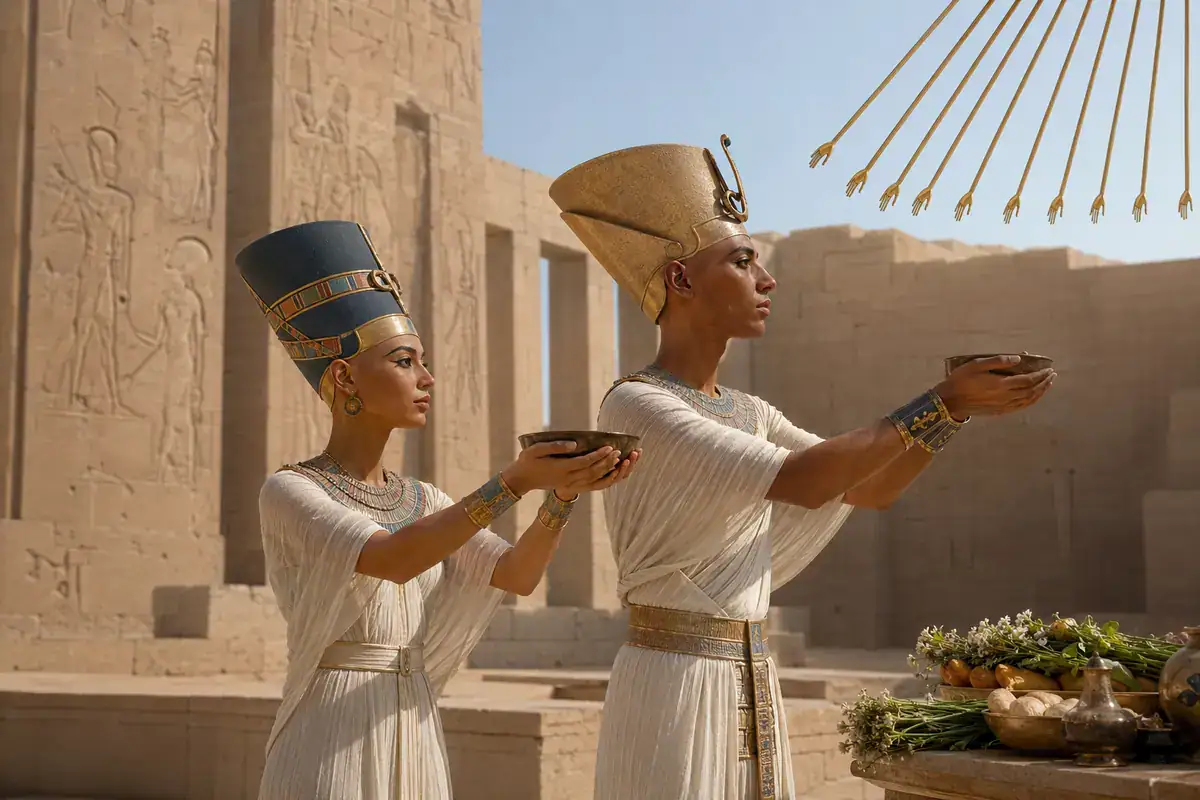
Nefertiti married Amenhotep IV, the future Akhenaten, either shortly before or early in his reign. As a result, she entered the royal family shaped by his father, Amenhotep III, whose monuments include the Colossi of Memnon on Luxor’s West Bank. The couple probably came to power in the mid-fourteenth century BCE, although competing chronologies differ by several years. At first, the king continued to build at Thebes. Soon, however, he promoted the Aten with growing intensity and changed his name from Amenhotep—“Amun is satisfied”—to Akhenaten, a name associated with service to the Aten.
From the beginning, Nefertiti appeared prominently in the new program. At early Aten buildings beside Karnak Temple, relief blocks show her making offerings, raising ritual instruments and acting before the god. Some compositions feature the queen even when Akhenaten is absent. Consequently, her prominence was not a later invention at Amarna; it formed part of the royal religious experiment from its early stages.
Their partnership also created a new public image of royal family life. Instead of showing only formal state ceremonies, artists represented the king and queen touching, mourning, riding together and caring for their daughters. Although these scenes feel intimate, they still conveyed theology: the royal family received the Aten’s life-giving rays and transmitted divine blessing to Egypt.
How Powerful Was Queen Nefertiti?
Nefertiti held more visible authority than most Egyptian queens. She stood almost equal in scale to Akhenaten, offered directly to the Aten and wore crowns that marked her unique royal identity. In some scenes she drives a chariot; elsewhere she presents captives or raises a weapon against female enemies. Egyptian art normally reserved the act of smiting enemies for the pharaoh, so the imagery deliberately placed her within the language of sovereign power.
Even so, images do not function as cabinet records. They demonstrate ideology and ritual status, but they do not prove that Nefertiti independently controlled every branch of government. Diplomacy, taxation, military command and temple administration involved large institutions. Her exceptional representations indicate a powerful partnership; the precise legal structure of that partnership remains difficult to reconstruct.
Queen, Co-Regent or Ritual Counterpart?
Calling Nefertiti a co-regent can be useful, but scholars do not universally accept the term for every stage of her career. Secure evidence identifies her as Great Royal Wife. Meanwhile, her unparalleled ritual role made her Akhenaten’s female counterpart within Aten theology. A formal kingship may have emerged later if she became the ruler Neferneferuaten, but that conclusion requires separate evidence.
Nefertiti’s importance rests on what the monuments clearly show: she was not decorative company beside Akhenaten; she was essential to the royal and religious image of the Amarna court.
Nefertiti’s Role in the Amarna Religious Revolution
Akhenaten’s reign transformed Egyptian religion. The court elevated the Aten, represented as a solar disk whose rays ended in hands, and reduced the public place of many traditional gods. Later in the reign, officials attacked the name and images of Amun in numerous monuments. Scholars describe this system in different ways—as Atenism, monolatry, henotheism or a movement toward exclusive worship—because the modern word “monotheism” can oversimplify ancient practice.
Nefertiti participated at the heart of the new cult. The Aten lacked the conventional human or animal body of Egyptian deities; instead, rays reached toward Akhenaten, Nefertiti and their daughters. The royal family consequently became the god’s privileged intermediary. Ordinary people often approached the Aten through loyalty to the king and queen rather than through the familiar temple statues of older gods.
Open courts allowed sunlight to fall on offering tables piled with bread, meat, flowers and drink. Moreover, hymns celebrated the sun’s daily creation of life. The system linked cosmic renewal with the royal household, making Nefertiti’s fertility and daughters politically meaningful. Nevertheless, older customs did not disappear uniformly from private life, and archaeology reveals a more complex religious landscape than royal decrees alone suggest.
Akhetaten: Nefertiti’s New Royal City
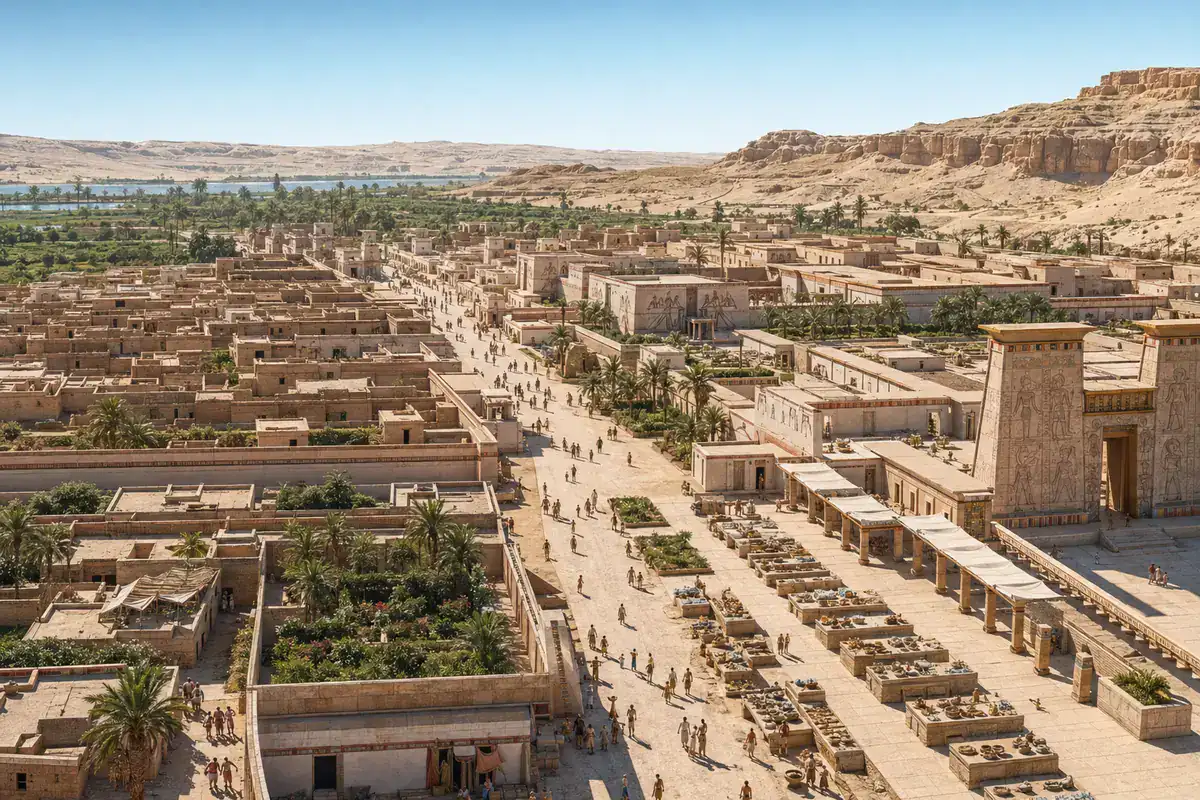
Around the fifth year of his reign, Akhenaten founded Akhetaten—“Horizon of the Aten”—on previously undeveloped desert land in Middle Egypt. Boundary stelae marked its sacred territory. Palaces, administrative offices, villas, worker settlements and vast open-air temples rose quickly along a long royal road. Today, the archaeological site is known as Tell el-Amarna.
Nefertiti’s image appeared across this landscape. The Great Palace and North Palace preserved royal imagery, while temples represented the couple serving the Aten. Processional appearances connected the residences to ritual spaces. In addition, window-of-appearance scenes showed the royal family rewarding officials with gold, thereby linking service, wealth and divine favor.
The city also remained an international capital. The Amarna Letters, diplomatic tablets written mainly in Akkadian cuneiform, record communications between Egypt and rulers across the Near East. They discuss gifts, marriages, loyalty and urgent requests from vassals. Although few documents isolate Nefertiti’s personal decisions, she lived at the center of this diplomatic world.
Akhetaten did not survive long as Egypt’s capital. After the Amarna royal line ended, the court returned to traditional centers, and builders later reused many stones. Yet the short-lived city preserved houses, workshops, cemeteries and archives that now offer an unmatched view of a royal capital created around one family and one god.
Nefertiti’s Children: Mother of Six Daughters
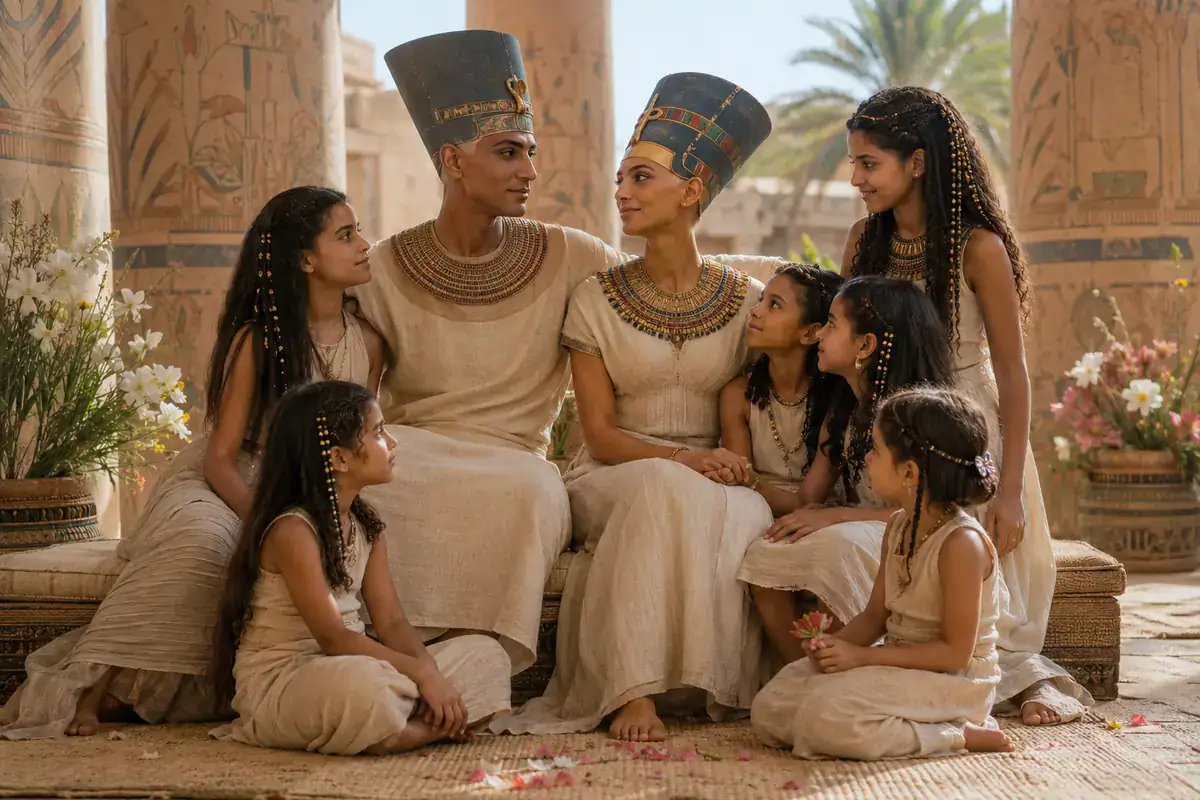
Nefertiti and Akhenaten had six known daughters. Their repeated appearance gave royal children unusual visibility in Egyptian state art. The girls shake ritual sistrums, accompany offerings, ride in chariots and receive the Aten’s rays beside their parents. However, the images also record tragedy: mourning scenes in the royal tomb probably relate to the deaths of royal women, including Meketaten.
| Daughter | What Is Known |
|---|---|
| Meritaten | The eldest daughter became Great Royal Wife late in the Amarna Period and played an important court role. |
| Meketaten | She probably died before the end of Akhenaten’s reign and appears in mourning scenes in the royal tomb. |
| Ankhesenpaaten | She later changed her name to Ankhesenamun and married Tutankhamun. |
| Neferneferuaten Tasherit | Her name means “Neferneferuaten the Younger”; evidence for her later life is limited. |
| Neferneferure | She appears in royal-family scenes but disappears from later records. |
| Setepenre | The youngest known daughter has the shortest documented life. |
No securely identified son of Nefertiti and Akhenaten survives in the inscriptions. Tutankhamun was certainly connected to the Amarna royal family, yet current genetic research identifies his mother as the KV35 “Younger Lady,” whose historical name remains unknown. Therefore, historians should not present Nefertiti as Tutankhamun’s proven mother.
Nefertiti in Amarna Art: Crown, Body and Royal Identity
Amarna art departed from the idealized proportions familiar from earlier royal monuments. Artists gave Akhenaten elongated features, a narrow torso and rounded hips, while family scenes used fluid poses and affectionate gestures. Scholars have proposed medical explanations, but no diagnosis can be made safely from stylized art. The visual changes primarily communicated a new sacred identity centered on the royal family.
Nefertiti wears several crowns. Her most recognizable is the tall, flat-topped blue crown shown on the Berlin bust. She also appears with double plumes, sun disks, uraeus cobras and other headdresses. Writers sometimes call the blue crown a “war crown,” yet it is better understood as her distinctive queenly crown; its precise meaning remains debated.
Scale also matters. Nefertiti sometimes approaches Akhenaten’s height and copies his ritual gestures. Elsewhere, she adopts traditional female forms while maintaining exceptional authority. The variety suggests that court workshops did not merely record appearance. Instead, they designed a flexible political theology in which king, queen and daughters formed a sacred household.
Did Nefertiti Become Pharaoh?
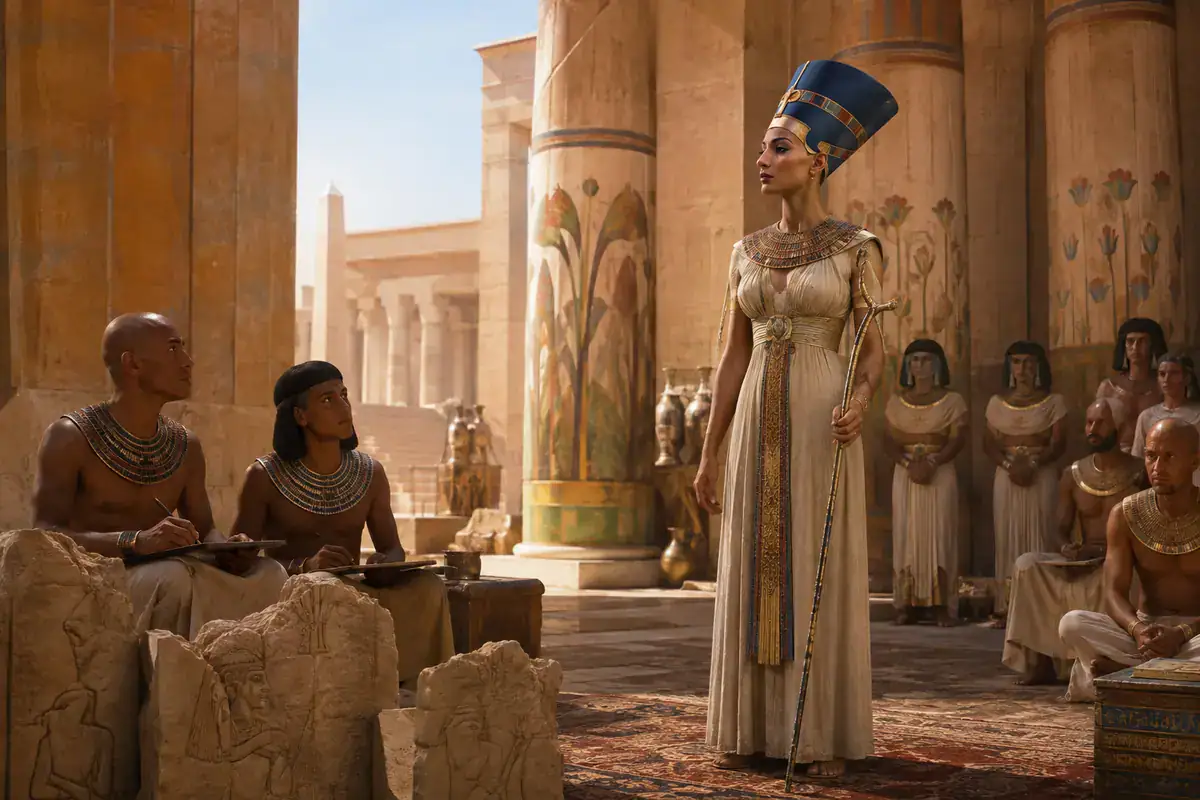
One of Egyptology’s biggest questions concerns the ruler Ankhkheperure Neferneferuaten, who appears near the end of the Amarna Period. Some inscriptions use feminine forms or epithets that point to a female king. Because Nefertiti already bore the name Neferneferuaten and held extraordinary authority, many scholars identify her as this ruler.
Under that reconstruction, Nefertiti first served as Great Royal Wife, then became co-regent or successor and ruled briefly before Tutankhamun. Other specialists assign the kingship differently or separate Nefertiti from Neferneferuaten. The evidence is difficult because later rulers dismantled Amarna monuments, reused burial equipment and removed names.
| Evidence Supporting the Identification | Why the Question Remains Open |
|---|---|
| Nefertiti already used the name Neferneferuaten. | Royal names could be reused and combined in complex ways. |
| The ruler’s epithets sometimes use feminine language. | Damaged inscriptions and changing titles complicate reconstruction. |
| Nefertiti held king-like ritual roles before Akhenaten’s death. | Exceptional queenship does not automatically prove formal accession. |
| A female transition ruler fits the turbulent succession. | The order and identity of Smenkhkare and Neferneferuaten remain disputed. |
What Happened to Nefertiti?
Older books often claim that Nefertiti vanished after Akhenaten’s twelfth regnal year. That statement is now too simple. A dated inscription from late in the reign appears to name the Great Royal Wife Nefertiti, indicating that she probably survived longer than researchers once thought. Even so, the final sequence of Amarna rulers remains uncertain.
Possible explanations include a natural death before Akhenaten, survival as senior queen, elevation as co-regent, or accession as Neferneferuaten. No reliable evidence shows that Akhenaten disgraced or banished her. Likewise, the death of Meketaten does not prove that Nefertiti died in childbirth; that popular story confuses separate women and uncertain tomb scenes.
After Akhenaten, the court restored Amun’s cult and abandoned Akhetaten. Tutankhaten became Tutankhamun, while officials reused or dismantled Amarna monuments. Later kings omitted the Amarna rulers from official king lists. This deliberate rejection shattered the chronological evidence and helped transform Nefertiti’s final years into a mystery.
The Bust of Nefertiti: Discovery, Meaning and Debate
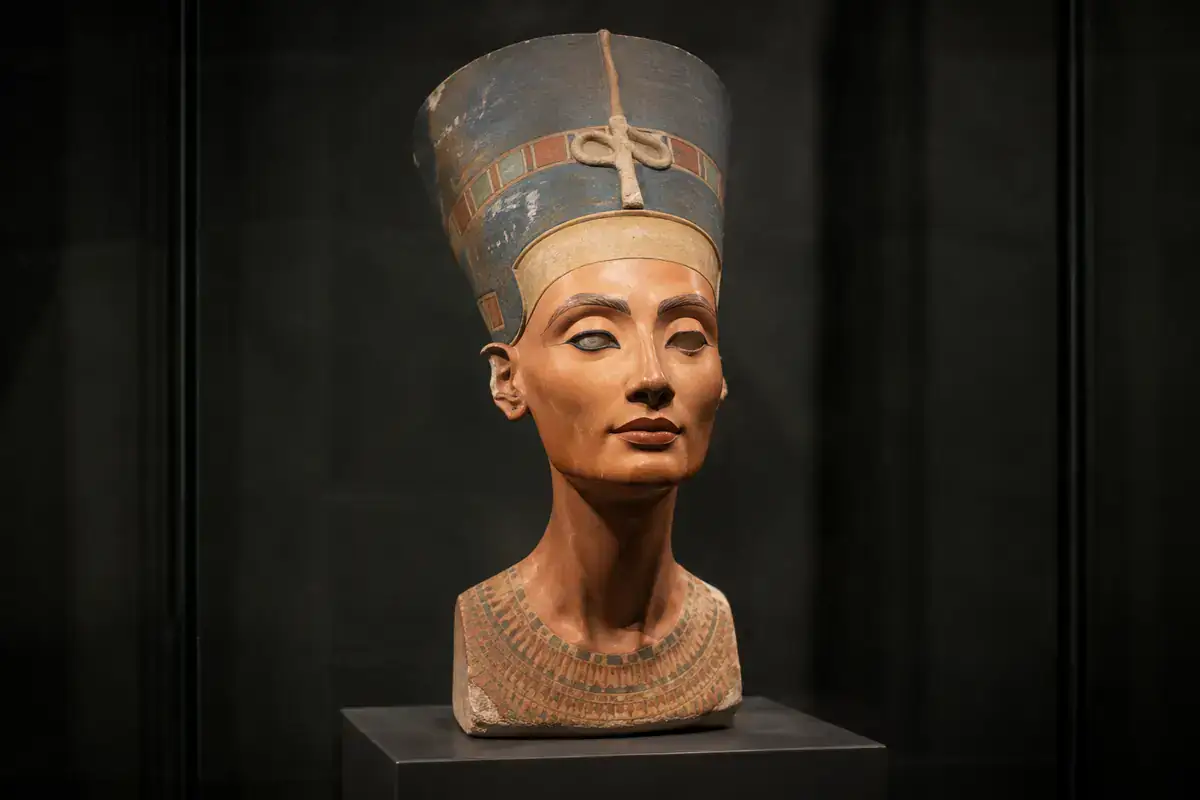
On 6 December 1912, a German expedition directed by Ludwig Borchardt uncovered the painted bust in the Amarna workshop of the sculptor Thutmose. The limestone core carries modeled plaster and remarkably preserved color. At about 47 centimeters high, the portrait combines symmetry, delicate surface work and Nefertiti’s distinctive blue crown.
The left eye lacks an inlay. Excavators found no missing insert, so experts have debated whether artisans never completed it, intended the bust as a workshop model or removed an element in antiquity. The object was not necessarily a formal temple statue. Its archaeological context among sculptors’ studies suggests that artists may have used it as a reference within the workshop.
After the excavation’s division of finds, the bust went to Germany and reached Berlin in 1913. Today, the Neues Museum displays it in the North Dome Room. Egyptian authorities have repeatedly sought its return, while Berlin’s museums defend the historical partage. Consequently, the bust symbolizes both ancient artistry and modern debates about excavation-era ownership.
Its beauty should not erase its politics. The crown, posture and controlled expression present royal authority, while the Amarna style joins ideal form with individualized detail. Modern reproductions transformed the object into a global beauty icon; however, its original purpose belonged to a workshop serving a revolutionary court.
Where Are Nefertiti’s Tomb and Mummy?
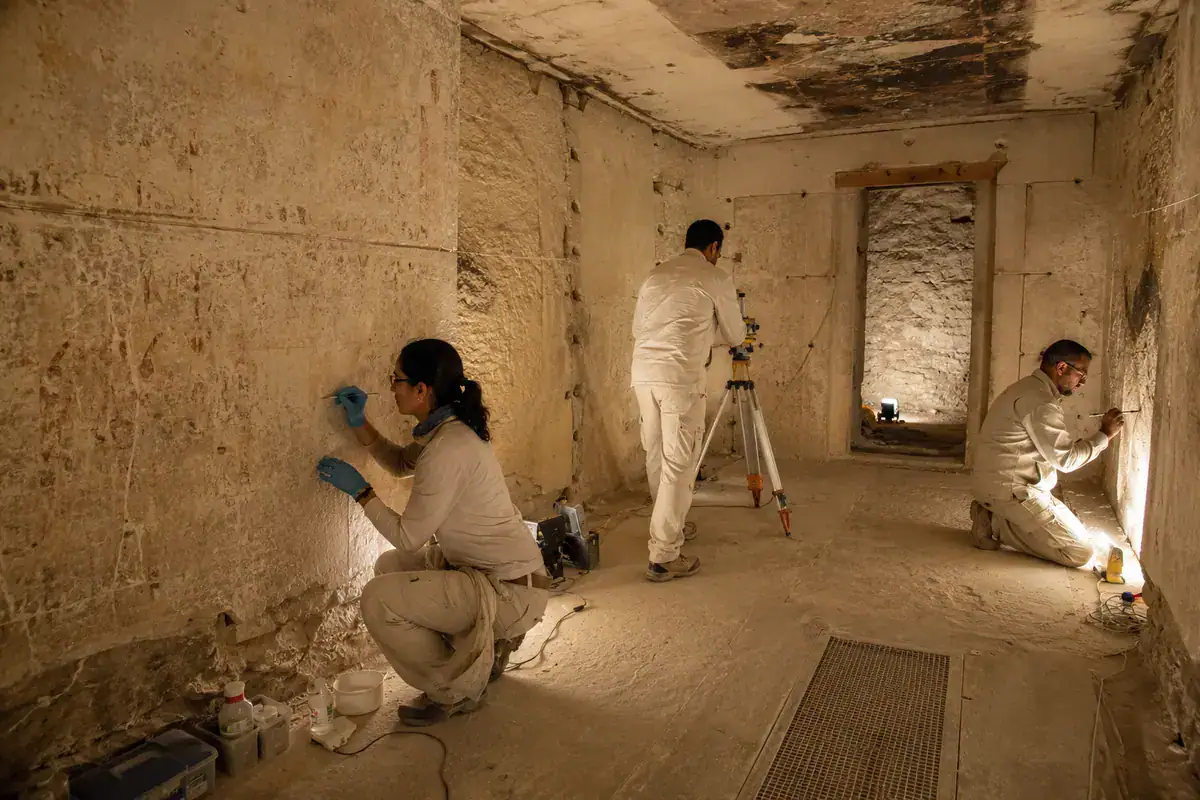
Archaeologists have not conclusively identified Nefertiti’s tomb or mummy. Akhenaten prepared a royal tomb in the cliffs east of Akhetaten, and fragments of royal burials came from the area. Yet political change may have led successors to move bodies and equipment to Thebes. Looting, reuse and later destruction further complicate the search.
Several mummies have attracted attention. The KV35 “Younger Lady” once appeared in popular Nefertiti theories, but DNA analysis identifies her as a daughter of Amenhotep III and Tiye and the mother of Tutankhamun. Since Nefertiti’s parentage remains unknown, most current family reconstructions do not equate the Younger Lady with her. Other unidentified female mummies also lack decisive inscriptions.
Radar investigations around Tutankhamun’s tomb, KV62, inspired proposals that hidden rooms might hold Nefertiti. Follow-up surveys produced conflicting interpretations, and no verified chamber or burial of Nefertiti has emerged. Therefore, headlines announcing that her tomb has been “found” go beyond the evidence.
A future discovery could change the picture. Until archaeologists find a body or burial assemblage with secure inscriptions and context, Nefertiti’s final resting place remains one of ancient Egypt’s genuine unsolved mysteries.
Nefertiti Myths and Historical Facts
| Popular Claim | What the Evidence Supports |
|---|---|
| Nefertiti was definitely a foreign princess. | Her parents are unknown; no contemporary evidence securely identifies a foreign origin. |
| Her name proves she arrived from abroad. | Nefertiti is an Egyptian name and cannot establish birthplace. |
| She introduced the world’s first monotheism. | She supported Atenism, but scholars debate whether modern “monotheism” accurately describes it. |
| She certainly ruled Egypt as pharaoh. | She is a strong candidate for Neferneferuaten, although the identification remains disputed. |
| She disappeared in year 12. | Late evidence suggests she survived beyond the date once assumed. |
| Nefertiti was Tutankhamun’s mother. | No secure inscription or current genetic model proves that relationship. |
| Her tomb lies behind Tutankhamun’s burial chamber. | Surveys have not confirmed a hidden Nefertiti burial in KV62. |
| The Berlin bust was a finished public cult statue. | Its workshop context and missing eye suggest a model or unfinished studio object, though its exact use is debated. |
Where Can You See Nefertiti Today?
The famous bust remains in Berlin, but travelers can explore Nefertiti’s world in Egypt. The archaeological landscape of Tell el-Amarna preserves the city she inhabited. Museums in Cairo hold Amarna reliefs, statuary and household objects, while Luxor preserves the Theban religious landscape that Akhenaten challenged.
- Neues Museum, Berlin: home of the painted bust; check current ticket and photography rules before visiting.
- Tell el-Amarna, Egypt: boundary stelae, tombs, palace traces and temple foundations explain the royal city.
- Egyptian collections in Cairo: see objects from the Amarna Period and the restoration under Tutankhamun.
- Metropolitan Museum of Art, New York: the collection includes an important relief of Nefertiti and other Amarna objects.
- British Museum, London: its collection includes a quartzite statuette associated with Nefertiti.
Nefertiti Timeline
| Approximate Date | Event | Importance |
|---|---|---|
| Before c. 1353 BCE | Birth and early life | Parents and birthplace remain unknown. |
| Early Akhenaten reign | Becomes Great Royal Wife | Appears prominently in Aten buildings at Karnak. |
| Around regnal year 5 | Move toward Akhetaten | The royal family establishes a new capital dedicated to Aten. |
| Years 5–12 | Peak of Amarna royal imagery | Nefertiti performs offerings and appears with six daughters. |
| After year 12 | Late career | Evidence suggests continued survival, but titles and chronology become difficult. |
| End of Akhenaten’s reign | Possible Neferneferuaten kingship | Major theory, not a universally established identification. |
| 1912 CE | Bust discovered | Found in Thutmose’s workshop at Tell el-Amarna. |
| Today | Ongoing research | Her tomb, mummy and final political role remain unresolved. |
Nefertiti’s Historical and Cultural Legacy
Nefertiti changed the visual language of Egyptian queenship. Earlier royal women could hold enormous influence, but Amarna artists represented her acting with a frequency and authority that remains exceptional. She offered directly to Aten, occupied monumental space and helped make the royal family the center of state theology.
Her religious project did not endure. Tutankhamun and later rulers restored traditional cults, abandoned Akhetaten and condemned Akhenaten’s experiment. Nevertheless, failure does not make the episode unimportant. The Amarna Period reveals how rapidly kingship, sacred practice, art and an entire capital could change under concentrated royal power.
Modern fame adds another layer. The Berlin bust made Nefertiti a standard of beauty in advertising, fashion, film and popular art. At the same time, its location raises continuing questions about archaeology, colonial-era partage and cultural ownership. Her image thus connects ancient royal ideology with modern museum ethics.
Most importantly, research has moved beyond the beautiful queen stereotype. Nefertiti emerges as a religious actor, political partner, mother within a sacred dynasty and possible ruler during a dangerous succession. The unanswered questions do not diminish her. Instead, they show how historians distinguish secure evidence from attractive speculation.
Nefertiti: Beauty, Authority and an Unfinished Story
Nefertiti stood beside Akhenaten during ancient Egypt’s boldest religious transformation and helped reshape the public image of queenship. Her six daughters, ritual power, distinctive crown and possible later kingship place her far beyond the role of royal consort. Yet no confirmed tomb, mummy or final biography closes her story. That combination of documented authority and honest mystery explains why Queen Nefertiti remains one of the most compelling figures of the ancient world.
Frequently Asked Questions About Nefertiti
Who was Nefertiti?
Nefertiti was the Great Royal Wife of Akhenaten, a leading royal figure in the 18th Dynasty and a central participant in the worship of Aten.
What does Nefertiti mean?
Her name is commonly translated as “The Beautiful One Has Come” or “The Beautiful One Is Here.”
Was Nefertiti a pharaoh?
Many scholars consider her a strong candidate for the female ruler Neferneferuaten, but the identification remains debated.
Who were Nefertiti’s parents?
No surviving inscription securely identifies them. Ay is sometimes proposed as her father, although the evidence is indirect.
How many children did Nefertiti have?
Nefertiti and Akhenaten had six known daughters: Meritaten, Meketaten, Ankhesenpaaten, Neferneferuaten Tasherit, Neferneferure and Setepenre.
Was Nefertiti Tutankhamun’s mother?
No secure evidence proves that she was. Genetic research identifies Tutankhamun’s mother as the KV35 Younger Lady, whose historical name remains unknown.
Where is the bust of Nefertiti?
The Neues Museum in Berlin displays the painted limestone-and-stucco bust in its North Dome Room.
Why is one eye missing from the Nefertiti bust?
No missing eye inlay was found. The bust may have served as a sculptor’s model or remained unfinished, but its exact workshop use is uncertain.
Has Nefertiti’s tomb been found?
No tomb or mummy has been conclusively identified as Nefertiti’s, and proposed hidden chambers near Tutankhamun’s tomb remain unconfirmed.
Why was Nefertiti so powerful?
She served as Akhenaten’s principal royal and religious counterpart, performed offerings, adopted king-like imagery and may later have exercised formal pharaonic authority.
Plan Your Trip
Explore the world of Nefertiti and Akhenaten through Cairo, Luxor and Tell el-Amarna with a private itinerary designed by our local team.