
Akhenaten, born Amenhotep IV, ruled Egypt during the 18th Dynasty and launched the most disruptive religious experiment of the pharaonic age. He elevated the solar Aten, founded a new capital called Akhetaten, transformed royal art and placed his family at the center of worship. Later rulers dismantled his monuments and tried to erase his name. Yet the surviving evidence reveals neither a simple prophet nor merely a mad heretic, but a complex king whose ideas changed Egyptian religion, art, politics and memory.
Who Was Akhenaten?
Akhenaten was a New Kingdom pharaoh who reigned for about seventeen years in the fourteenth century BCE. Originally named Amenhotep IV, he changed his name after promoting the Aten, moved the royal court from Thebes to a purpose-built capital at modern Tell el-Amarna and restricted the traditional cults—especially that of Amun. His reforms collapsed soon after his death, but the art, letters and ruins of the Amarna Period make his reign one of the best-known and most debated episodes in ancient Egyptian history.
Akhenaten at a Glance
| Birth name | Amenhotep IV, meaning “Amun is satisfied” |
|---|---|
| Later name | Akhenaten, often translated “Effective for the Aten” or “Beneficial to the Aten” |
| Parents | Amenhotep III and Queen Tiye |
| Great Royal Wife | Nefertiti |
| Central religious focus | The Aten, represented as the sun disk with life-giving rays |
| Major surviving sources | Boundary stelae, Amarna tombs, talatat blocks, sculpture, the Amarna Letters and archaeological remains |
| Greatest mysteries | The exact nature of Atenism, the succession and whether the KV55 mummy is Akhenaten |
Early Life and Accession of Amenhotep IV
Akhenaten was a son of Pharaoh Amenhotep III and the influential Queen Tiye. His elder brother, Crown Prince Thutmose, probably stood first in line for the throne but died before their father. Amenhotep IV therefore emerged as heir and succeeded during one of Egypt’s richest periods. His father had presided over monumental building, international diplomacy and an empire that stretched into Nubia and the Levant. His vast West Bank memorial complex was fronted by the Colossi of Memnon, two monumental statues that still dominate the Theban landscape.
The date of accession and the possibility of a co-regency with Amenhotep III remain debated. Some scholars have proposed that father and son ruled together for years; others favor little or no overlap. Because inscriptions can commemorate living or deceased rulers, individual monuments do not settle the question by themselves. The safest conclusion is that Amenhotep IV inherited an exceptionally powerful kingdom and a court already interested in solar theology.
His earliest monuments still respected traditional religion. He appeared before established deities and used the name Amenhotep, which honored Amun. Nevertheless, in the opening years he gave unusual attention to a solar form called Re-Horakhty “in his name of Shu who is in the Aten.” That theological formula soon developed into something far more radical.
Why Did Amenhotep IV Change His Name to Akhenaten?
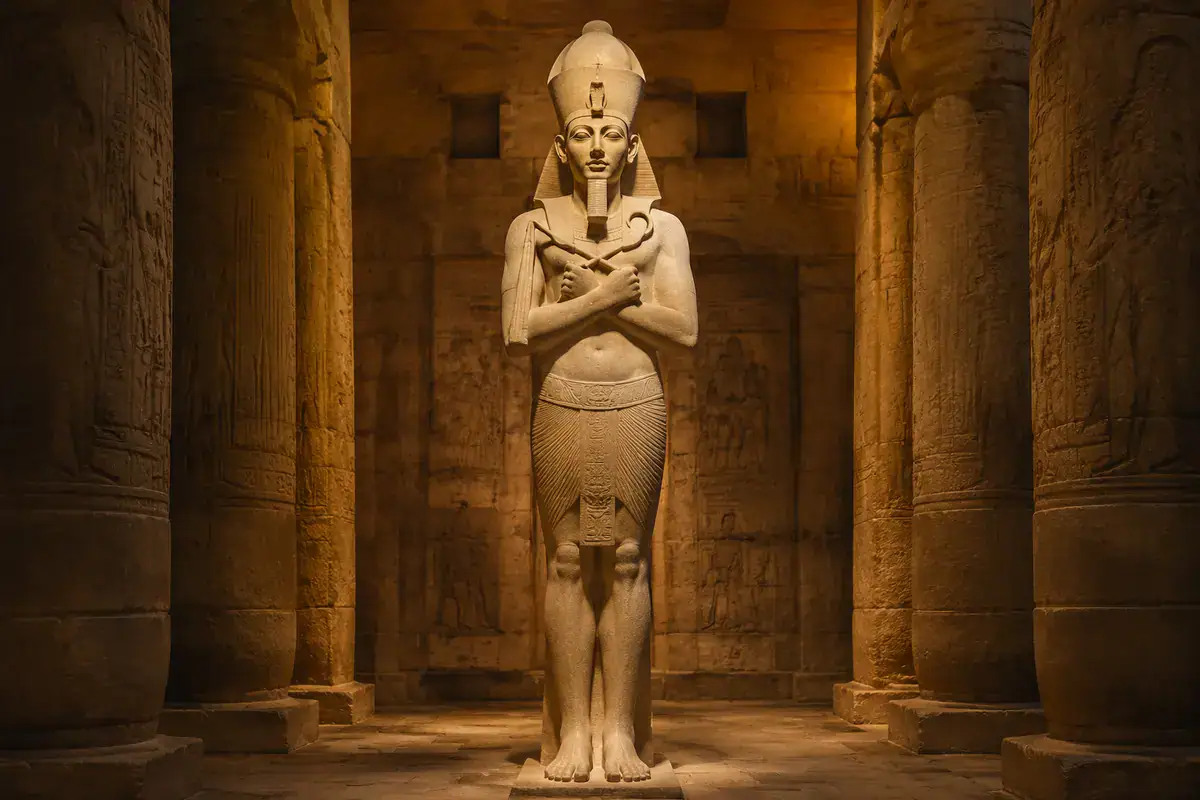
Around the fifth year of his reign, Amenhotep IV adopted the name Akhenaten. The change removed the reference to Amun and publicly bound the king to the Aten. Translations vary because the Egyptian element akh carries several related ideas, including effectiveness, usefulness and a transformed spirit. “Effective for the Aten” remains a practical English rendering.
This was not a private spiritual gesture. Royal names appeared on temples, decrees, statues and administrative documents; changing one announced a new state direction. At about the same time, the king established a city in Middle Egypt and declared the site for the Aten. His identity, his capital and his god became parts of a single royal program.
Akhenaten’s Religious Revolution and the Worship of Aten
The Aten had existed before Akhenaten. The word could refer to the visible disk of the sun, while earlier kings—including Amenhotep III—used solar language and honored the Aten. Akhenaten’s innovation lay in elevating this form into the dominant focus of royal worship and progressively excluding the traditional gods from official theology.
Early in the reign, artists depicted the new god as a falcon-headed solar deity. Soon, however, they abandoned the human or animal body. The Aten appeared as a sun disk whose rays ended in hands; some hands held the ankh, the sign of life, near the noses of Akhenaten and Nefertiti. This image communicated light, breath and life without placing a conventional divine statue opposite the king.
The architecture changed with the theology. Aten temples used large open courts rather than dark roofed sanctuaries, allowing sunlight to reach hundreds of offering tables. The royal couple performed rituals under the rays, while ordinary access to the Aten was mediated through them. Akhenaten did not simply replace the name of one god with another; he reorganized the relationship between deity, king, temple and population.
The Attack on Amun and Other Gods
Later in the reign, officials erased Amun’s name and images from monuments in many places. Plural forms of the word “gods” were sometimes attacked as well. Temple income and institutional influence shifted toward the Aten. Yet archaeology at Amarna shows that private people still kept objects connected with Bes, Taweret and other protective beings. Consequently, royal policy was radical, but daily belief did not change everywhere in the same way.
Was Akhenaten the First Monotheist?
Popular books often call Akhenaten “the first monotheist in history.” The phrase is memorable, but it requires caution. Atenism proclaimed an exceptionally exclusive solar god and reduced or rejected many other cults at the official level. For that reason, some Egyptologists describe it as monotheistic. Others prefer monolatry—the worship of one god without necessarily denying every other divine being—or henotheism, the elevation of one god above the rest.
The king and his family also occupied a unique position. The Aten’s rays reached them directly, and texts presented Akhenaten as the god’s privileged knower. Therefore, the religion was not simply a modern belief in one universal god open equally to every worshipper. It remained a royal cult organized through Egyptian kingship.
| What the Evidence Clearly Shows | What Remains Debated |
|---|---|
| The Aten became the dominant official deity. | Whether “monotheism” is the best modern label. |
| Amun’s name and images were deliberately attacked. | How completely the policy reached villages and private homes. |
| Royal texts used exclusive language about the Aten. | Whether Akhenaten denied the existence of every other divine power. |
| The king controlled access to the new cult. | Whether religious belief or political control was his primary motive. |
The First Aten Temples at Karnak
Before founding Amarna, Amenhotep IV built an enormous Aten complex east of the traditional Karnak Temple precinct at Thebes. The buildings included the Gem-pa-Aten and open ritual spaces exposed to the sun. Colossal statues portrayed the king with elongated features, a narrow chest, rounded abdomen and broad hips—forms that shocked modern viewers when archaeologists recovered them.
Builders used small standardized sandstone blocks now called talatat. Their manageable size allowed rapid construction. After the Amarna Period, successors dismantled the Aten buildings and reused thousands of blocks as fill inside later pylons and walls. That destruction accidentally preserved a fragmented visual archive. Egyptologists can digitally and physically match scenes to reconstruct ceremonies, palace life, processions and Nefertiti’s unusual ritual prominence.
The Karnak phase proves that the revolution developed in stages. Akhenaten did not arrive on the throne with a complete religious system. Iconography, architecture, the Aten’s formal name and the king’s own body image changed during the first years before the court moved north.
Akhetaten: Akhenaten’s New Capital at Tell el-Amarna
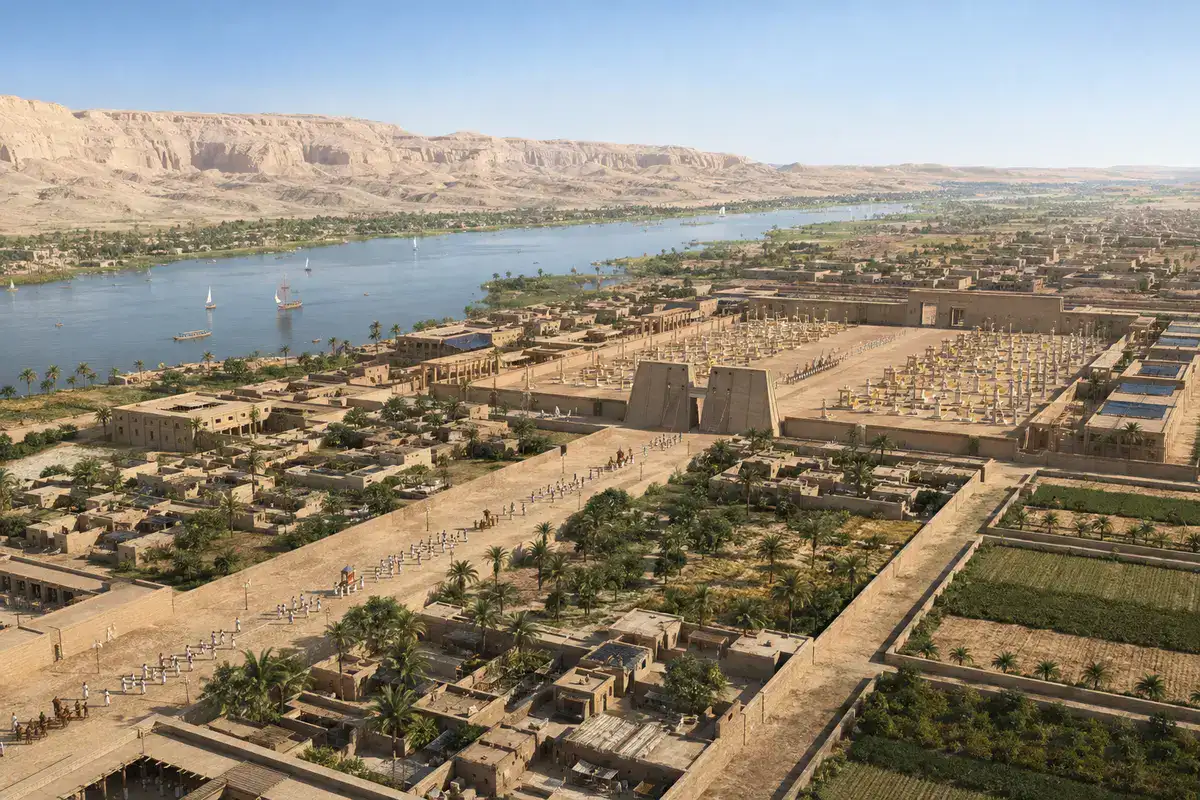
In regnal year five, Akhenaten selected a broad desert bay on the east bank of the Nile, roughly midway between Cairo and Luxor. He named the new capital Akhetaten, “Horizon of the Aten.” The site is now known as Tell el-Amarna. Fifteen known boundary stelae carved into the surrounding cliffs defined its sacred territory and recorded the king’s foundation proclamations.
The city was not merely a temple compound. It contained palaces, administrative offices, police and military quarters, workshops, villas, modest houses, worker settlements and cemeteries. A Royal Road linked important zones. The Great Aten Temple and Small Aten Temple used open courts and countless offering installations, while the Window of Appearance allowed the royal family to reward loyal officials publicly.
Akhetaten was built with extraordinary speed, largely in mudbrick. That speed produced an active capital but also social costs. Excavated non-elite cemeteries reveal hard physical labor, nutritional stress and unequal living conditions. The “city of sunlight” was therefore neither a perfect utopia nor only a stage for royal theology; it was a real community of officials, artisans, laborers, families and foreigners.
The Amarna Letters
Several hundred cuneiform tablets found in the administrative district preserve correspondence with rulers in Babylonia, Assyria, Mitanni, Hatti and city-states of the Levant. Written mainly in Akkadian, the diplomatic language of the age, the Amarna Letters discuss gifts, marriages, loyalty, conflict and requests for Egyptian assistance. They reveal that Akhenaten’s apparently isolated religious capital remained connected to an international system.
Amarna Art: Why Did Akhenaten Look So Different?
Traditional Egyptian royal art presented the pharaoh as ideal, youthful and physically powerful. Early Amarna artists disrupted that formula. They gave Akhenaten a long face, narrow eyes, heavy lips, a projecting chin, a slender torso, rounded abdomen and broad hips. Nefertiti, the princesses, courtiers and even foreign subjects sometimes shared elements of the style.
Older medical theories attempted to diagnose Akhenaten with disorders ranging from Marfan syndrome to endocrine disease. No diagnosis can be established from stylized art, especially when multiple figures follow the same visual language. Later portraits from the reign also appear less extreme. The forms probably expressed theological and artistic ideas rather than serving as clinical records.
Amarna art introduced movement and intimacy into monumental scenes. Akhenaten and Nefertiti touch, ride in chariots, hold their daughters and mourn a death. Servants hurry, horses rear, ribbons flutter and palace spaces fill with activity. Nevertheless, these scenes were not private family photographs. They showed the royal household receiving and transmitting the Aten’s life, making affection part of state theology.
The strange beauty of Amarna art was not a rejection of symbolism. It was a new symbolic language built around sunlight, movement and the sacred royal family.
Akhenaten, Nefertiti and the Royal Family
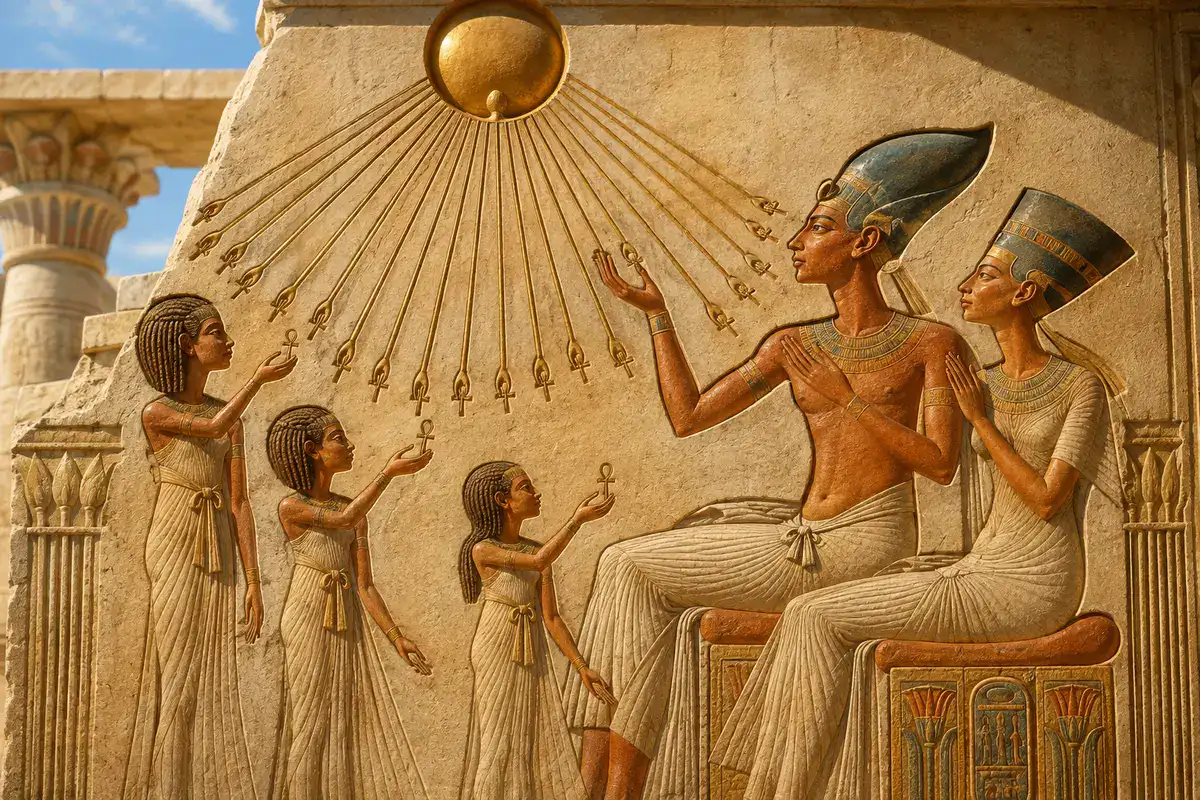
Queen Nefertiti was not a passive consort. She offered to the Aten, appeared nearly equal in scale to Akhenaten and sometimes performed gestures normally associated with kings. Together they had six known daughters: Meritaten, Meketaten, Ankhesenpaaten, Neferneferuaten Tasherit, Neferneferure and Setepenre.
The succession remains one of the period’s hardest problems. A ruler named Smenkhkare appears near the end of the reign, while the female king Neferneferuaten may have ruled before Tutankhamun. Many scholars identify Neferneferuaten with Nefertiti, but the conclusion is not universally proven. Names were erased, objects were reused and later restoration blurred the original sequence.
Genetic studies published in 2010 concluded that the KV55 mummy was Tutankhamun’s father and the KV35 “Younger Lady” was his mother; the parents were close relatives. This family model is influential, yet the historical names assigned to the mummies and some technical interpretations remain debated. It is reasonable to call Tutankhamun a likely son of Akhenaten, but not a son of Nefertiti on current evidence.
The Great Hymn to the Aten
The longest surviving composition devoted to the Aten appears in the Amarna tomb of the courtier Ay. Usually called the Great Hymn to the Aten, it describes sunrise awakening people, animals and plants; sunset bringing stillness; and sunlight sustaining foreign lands as well as Egypt. Its universal vision is one reason Akhenaten has fascinated theologians and historians.
The hymn belongs to an older Egyptian tradition of solar praise, yet it gives the Aten an unusually comprehensive role as creator and sustainer of life. At the same time, it declares that Akhenaten uniquely knows the god. Universal creation and exclusive royal access exist side by side.
Comparisons with Psalm 104 are popular because both texts celebrate sunlight, creation, animals, water and the rhythm of day and night. Similar themes do not prove direct borrowing. Scholars debate whether any historical connection existed, and there is no surviving chain of transmission that settles the question. The texts should first be understood in their own languages, dates and religious settings.
Did Akhenaten Neglect Egypt’s Empire?
A familiar story portrays Akhenaten as a dreamer who ignored foreign affairs while Egypt’s empire collapsed. The Amarna Letters certainly contain urgent pleas from Levantine vassals. They report rivalry, warfare and requests for archers. However, diplomatic letters are petitions designed to persuade the king, so their dramatic language cannot be read as a neutral military report.
Egyptian influence did face pressure, especially as Hittite power expanded and local rulers competed. Yet evidence also shows continued administration, tribute, diplomatic exchange and military action. Akhenaten maintained Nubian control, and a victory inscription suggests a campaign or punitive action there. The empire did not simply vanish during his reign.
The balanced view is that Akhenaten concentrated extraordinary resources on religious and building programs while regional conditions grew more difficult. How far his priorities personally accelerated Egypt’s losses remains uncertain. Horemheb and the Ramesside kings later presented themselves as restorers, which also shaped the negative image of Amarna rule.
Akhenaten’s Death and the Amarna Succession
Akhenaten died in or near his seventeenth regnal year, probably in his thirties or forties. No contemporary narrative records the cause. Plague has been suggested because royal women died and disease circulated in the wider eastern Mediterranean, but the evidence does not identify Akhenaten’s illness or prove an epidemic killed him.
The years immediately surrounding his death are fragmentary. Smenkhkare and Neferneferuaten appear in damaged and reused records; scholars disagree over their identities, order and possible co-regencies. Tutankhaten then came to the throne as a child. Under his government, the court restored the old cults, changed his name to Tutankhamun and left Akhetaten.
Akhenaten’s revolution had depended heavily on the king, court and newly built capital. Without a stable institution able to survive him, the system unraveled quickly. Restoration was also practical: Egypt’s traditional temples managed land, workshops, festivals and local employment. Reopening them rebuilt both religious legitimacy and economic networks.
Akhenaten’s Royal Tomb and the KV55 Mummy
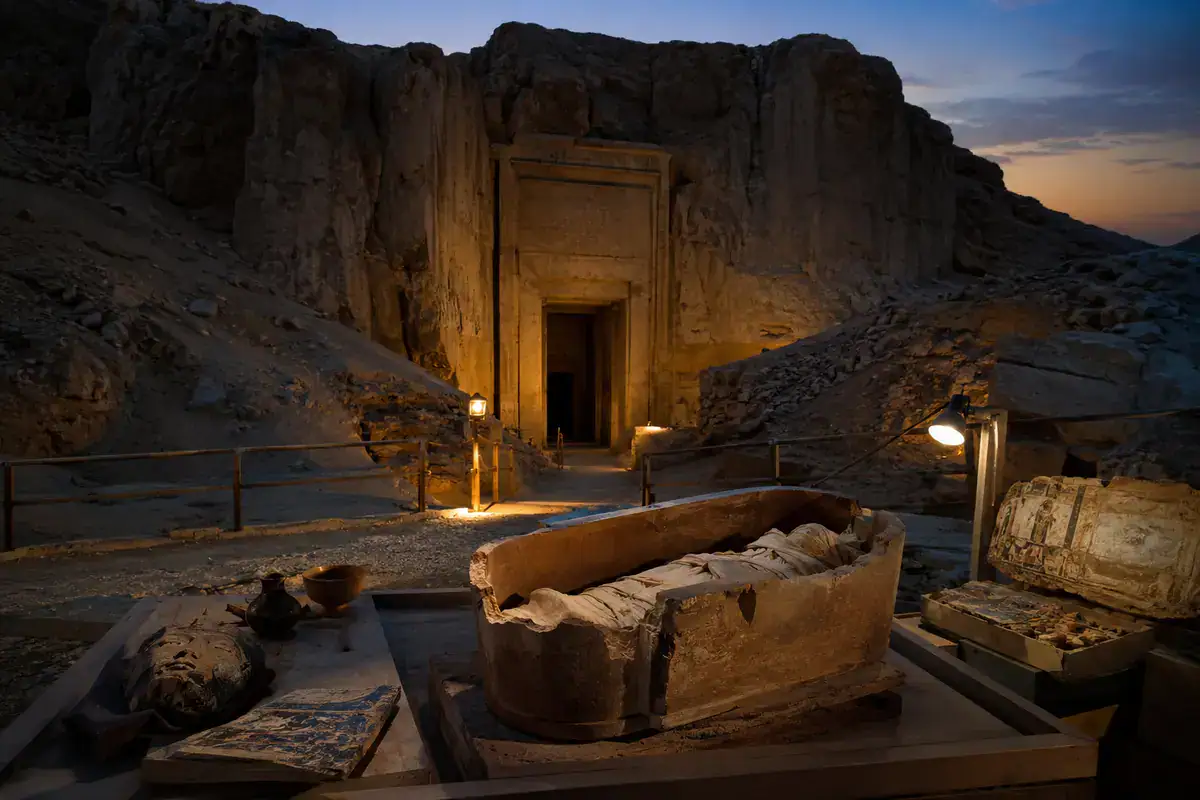
Akhenaten prepared a large Royal Tomb in a remote wadi east of Akhetaten. Its reliefs included the Aten’s rays, the royal family and mourning scenes, including the death of Princess Meketaten. The tomb was damaged and looted, and royal burials were probably removed after the abandonment of the city.
In 1907, archaeologists discovered tomb KV55 in the Valley of the Kings. It contained a male mummy in a desecrated royal coffin, objects connected with Queen Tiye and equipment from the Amarna family. The burial had been transferred, altered and attacked, making its history exceptionally difficult to reconstruct.
DNA analysis linked the man to Tutankhamun as his father and to Amenhotep III and Tiye’s family. Many researchers therefore identify the mummy as Akhenaten. The principal objection concerns age: some skeletal assessments once placed the man around twenty, too young for Akhenaten after a seventeen-year reign, while later studies argued for an older range. Because genetic relationships do not automatically supply a historical name, the identification remains strong but not completely uncontested.
Why Was Akhenaten Erased from History?
Tutankhamun’s restoration rejected the disruption of traditional worship and blamed earlier troubles on neglect of the gods. Ay continued the transition. Horemheb later dismantled Amarna monuments, usurped some royal works and omitted the Amarna rulers from official succession. Ramesside king lists often passed directly from Amenhotep III to Horemheb.
Workers broke up Aten temples and reused the talatat in later structures. Officials chiseled out Akhenaten’s names and images. Akhetaten’s population left, although nearby communities continued. This was not total historical amnesia; it was a state decision to deny legitimacy and recycle valuable materials.
Ironically, destruction helped preserve evidence. Blocks sealed inside later pylons survived, while the rapid abandonment of Amarna left houses, workshops and administrative areas accessible to archaeology. The effort to erase Akhenaten ultimately created the puzzle that restored him to modern history.
Akhenaten Myths and Historical Facts
| Popular Claim | What the Evidence Supports |
|---|---|
| Akhenaten invented the Aten. | The Aten existed earlier; Akhenaten elevated and radically redefined its state cult. |
| He was unquestionably the first monotheist. | Atenism was highly exclusive, but scholars debate whether monotheism, monolatry or henotheism best describes it. |
| His unusual body proves a genetic disease. | Stylized royal art cannot establish a medical diagnosis, and other figures share the visual language. |
| Akhenaten was Moses. | No contemporary Egyptian or Near Eastern evidence identifies the two; this is speculation, not established history. |
| He peacefully ignored all foreign affairs. | Diplomacy and administration continued, and there is evidence for military activity, though imperial pressures increased. |
| Nefertiti certainly ruled beside him as co-pharaoh. | Her authority was exceptional, but formal co-regency and her identification as Neferneferuaten remain debated. |
| Tutankhamun was definitely Nefertiti’s son. | Current genetic reconstruction identifies Tutankhamun’s mother as the KV35 Younger Lady, not securely Nefertiti. |
| The KV55 mummy is certainly Akhenaten. | It is the leading identification, but age estimates and damaged burial context sustain debate. |
| Egypt collapsed immediately under Akhenaten. | The kingdom and administration continued; the reign created strain, while the scale and timing of decline are complex. |
Where Can You See Akhenaten Today?
Akhenaten’s monuments were scattered by ancient demolition and modern excavation. No single collection tells the whole story, but several places preserve essential evidence.
- Tell el-Amarna: the city plan, tombs, boundary stelae and Royal Wadi provide the most complete landscape of his reign.
- Luxor and Karnak: the traditional religious center he challenged, plus reconstructed talatat scenes and evidence for his early Aten buildings.
- Egyptian collections in Cairo: colossal statues, relief blocks and Amarna objects illuminate the king’s art and theology. Confirm the current display location before visiting because collections can move.
- Luxor Museum: reconstructed talatat displays help visitors understand how small blocks once formed vast scenes.
- Metropolitan Museum of Art, New York: Amarna sculpture, reliefs and a detailed scholarly guide to Akhenaten’s art and city.
- British Museum, London: portraits, stelae, tablets and other objects connected with Akhenaten and Amarna.
- Neues Museum, Berlin: the Nefertiti bust and important works from the sculptor Thutmose’s Amarna workshop.
Akhenaten Timeline
| Approximate Date | Event | Importance |
|---|---|---|
| Before c. 1353 BCE | Born as Amenhotep, son of Amenhotep III and Tiye | Not initially the obvious heir if his elder brother Thutmose was still living. |
| Regnal years 1–3 | Rules as Amenhotep IV | Builds for the solar god at Karnak while traditional forms continue. |
| Regnal year 4 | Major artistic and theological changes | Aten disk with rays, talatat construction and Nefertiti’s prominence develop. |
| Regnal year 5 | Becomes Akhenaten and founds Akhetaten | Name, god and new capital form one royal program. |
| Years 6–12 | Court moves to Akhetaten | City, open temples and Amarna art reach maturity. |
| Around year 12 | Great reception of foreign tribute | Royal tomb scenes show international delegations and the royal family. |
| Late reign | Strong attacks on Amun’s name | Official religious exclusivity intensifies. |
| Year 17, c. 1336 BCE | Akhenaten dies | Uncertain succession follows. |
| Within a few years | Tutankhamun restores traditional cults | Court abandons Akhetaten and reverses Atenist policy. |
| Later 18th Dynasty | Horemheb erases the Amarna rulers | Monuments are dismantled and official history is rewritten. |
| 18th–20th centuries CE | Amarna and KV55 discoveries | Archaeology reconstructs the forgotten king’s reign. |
Akhenaten’s Legacy: Prophet, Heretic or Revolutionary King?
Akhenaten’s achievements cannot be separated from their costs. He created one of antiquity’s most original royal theologies and sponsored art that still feels startlingly intimate. He also concentrated worship around himself, disrupted long-established institutions and built a capital through immense labor. His experiment ended quickly because it was radical, personally controlled and poorly rooted beyond the court.
Calling him a prophet emphasizes the Great Hymn and the universal life-giving sun. Calling him a heretic reflects the judgment of later Egyptian restorers. Calling him a political strategist highlights his confrontation with Amun’s institutions. Each label captures something, but none explains the entire king.
His most lasting contribution may be the evidence he unintentionally left behind. Amarna’s houses reveal daily life; its cemeteries reveal inequality and labor; its letters reveal international politics; its art reveals a new royal ideology; and its ruins show how quickly state-sponsored belief can reshape a landscape. Few pharaohs allow us to examine religion, family, power, art and archaeology in such direct conversation.
Akhenaten: The Pharaoh Who Tried to Rebuild Reality
Akhenaten did more than worship a different god. He renamed himself, redesigned temples, founded a capital, transformed the royal image and challenged the institutions that had connected Egyptians with their gods for centuries. His revolution failed, and his successors attacked his memory. Yet every damaged statue, talatat block and Amarna letter proves that erasure was incomplete. More than three thousand years later, Akhenaten remains compelling because he forces us to ask how far one ruler can change faith, culture and history—and what happens when the vision disappears with the king.
Frequently Asked Questions About Akhenaten
Who was Akhenaten?
Akhenaten was an 18th Dynasty pharaoh, originally named Amenhotep IV, who elevated the Aten, founded Akhetaten and transformed Egyptian royal art and religion.
What does Akhenaten mean?
His name is commonly translated as “Effective for the Aten” or “Beneficial to the Aten.” Translations vary because the Egyptian word akh has several related meanings.
When did Akhenaten rule Egypt?
He ruled for about seventeen years in the fourteenth century BCE, often dated approximately 1353–1336 BCE, although exact chronologies vary.
Was Akhenaten the first monotheist?
He created an early, well-documented system of exclusive state worship centered on the Aten. Scholars disagree over whether it should be called strict monotheism, monolatry or henotheism.
Why did Akhenaten close the temples?
His government redirected official worship and resources toward the Aten and later attacked Amun’s name and images. The exact balance of religious conviction and political strategy remains debated.
Why did Akhenaten look unusual?
His long face, rounded abdomen and broad hips belong to the Amarna artistic style. They do not provide enough evidence to diagnose a genetic or hormonal disease.
Was Nefertiti Akhenaten’s wife?
Yes. Nefertiti was his Great Royal Wife, central ritual partner and the mother of six known daughters.
Was Tutankhamun Akhenaten’s son?
Genetic and historical evidence makes Akhenaten the leading candidate for Tutankhamun’s father, although the identification of the relevant royal mummies is still discussed.
Where was Akhenaten buried?
He prepared a Royal Tomb at Akhetaten. His burial was probably moved after the city’s abandonment, and many scholars identify the male mummy from KV55 as Akhenaten.
Why was Akhenaten erased?
Later rulers restored traditional religion, dismantled his Aten temples and denied the legitimacy of the Amarna kings. His name was removed from monuments and official king lists.
Can travelers visit Akhenaten’s city?
Yes. Tell el-Amarna in Middle Egypt preserves tombs, boundary stelae and foundations of Akhetaten, best explored with an experienced local Egyptologist.
Follow the Story of Akhenaten in Egypt
Explore Cairo, Luxor and Tell el-Amarna with a private itinerary designed by our local Egyptologist team.
Read Also
- Amenhotep III: Pharaoh, Monuments & Legacy
- Colossi of Memnon: Amenhotep III’s Monumental Statues
- Nefertiti: Queen, Icon and Possible Pharaoh
- Tell el-Amarna: Akhenaten’s Lost Capital
- Tutankhamun: The Boy King and His Treasures
- Karnak Temple: Complete Visitor Guide
- Luxor: The World’s Greatest Open-Air Museum