
Amenhotep III ruled Egypt during one of the most prosperous and artistically ambitious periods of the New Kingdom. A pharaoh of the 18th Dynasty, he inherited a powerful state, presided over decades of relative stability and transformed royal architecture on a monumental scale.
Moreover, his reign remains visible across the ancient landscape of Thebes and far beyond it. The core of Luxor Temple, his enormous mortuary complex on the West Bank, the statues known today as the Colossi of Memnon, the palace city of Malkata and monuments in Nubia all formed part of a building programme that projected royal power, religious legitimacy and Egypt’s international prestige.
However, Amenhotep III was more than a builder. His reign also belonged to an age of diplomacy, international exchange, sophisticated court culture and extraordinary artistic production. Queen Tiye occupied a particularly prominent position beside him. Meanwhile, their son Amenhotep IV later became Akhenaten and radically reshaped Egyptian religion.
Why Is Amenhotep III So Important?
Amenhotep III inherited an empire that earlier 18th-Dynasty rulers had expanded. Rather than relying principally on repeated military conquest, he used wealth, diplomacy, religious ceremony, monumental construction and royal art to express the power of his reign.
Furthermore, his monuments provide an essential bridge between the classical traditions of the earlier 18th Dynasty and the dramatic changes of the Amarna Period under his son Akhenaten.
The Reign of Amenhotep III
Amenhotep III was the son of Pharaoh Thutmose IV and Queen Mutemwiya. He became the ninth king of Egypt’s 18th Dynasty and ruled for almost four decades during the 14th century BCE.
At this time, Egypt controlled extensive territories and participated in a sophisticated international network stretching across the eastern Mediterranean and western Asia. In addition, royal courts exchanged gifts, diplomatic messages and marriage proposals, while Egyptian gold played an important role in international relations.
Consequently, Amenhotep III could devote immense resources to temples, palaces, statues and ceremonial projects. The scale of his surviving sculpture and architecture reflects both the resources available to the crown and the carefully constructed image of a ruler whose authority was closely connected with the gods.
Queen Tiye and the Royal Court
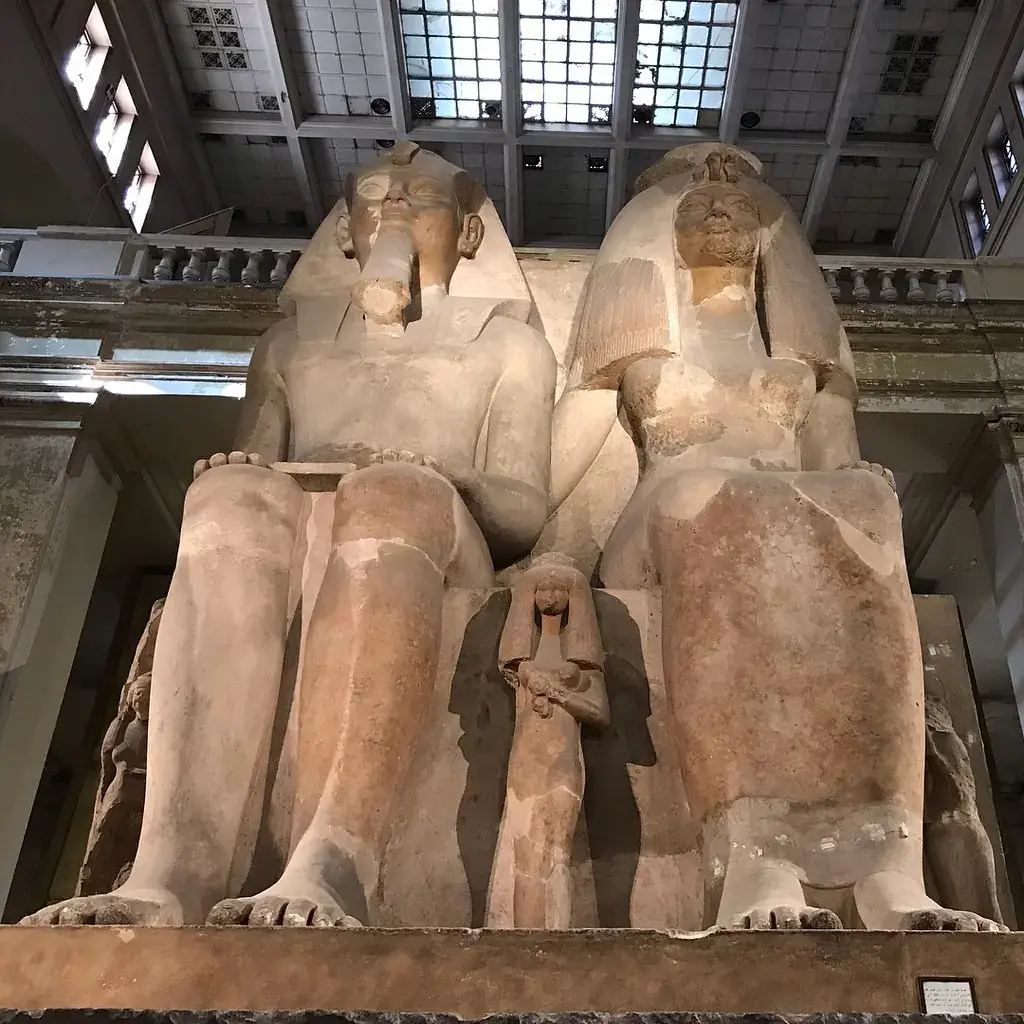
Queen Tiye was the Great Royal Wife of Amenhotep III and one of the most prominent royal women of the New Kingdom. Her importance is visible in royal imagery, inscriptions and objects that associate her closely with the king.
In addition, the colossal family group of Amenhotep III and Tiye, together with three of their daughters, is especially striking. The monument demonstrates the public prominence of the royal family within the visual language of the reign.
Among their children was Amenhotep IV, who succeeded his father and later adopted the name Akhenaten. Under him, the royal court moved to Akhetaten—modern Tell el-Amarna—where Akhenaten and Queen Nefertiti became central figures in the royal imagery of the Amarna Period.
Amenhotep III’s Monumental Building Program
The reign of Amenhotep III left one of the most ambitious architectural signatures of the 18th Dynasty. Importantly, he did not concentrate his projects in a single place: royal construction appeared at Thebes and in other regions under Egyptian control or influence.
For example, temples and colossal statues communicated devotion to the gods, royal legitimacy and the scale of the monarchy. At the same time, palaces and festival structures created settings for court life and ceremonies of royal renewal.
Luxor Temple
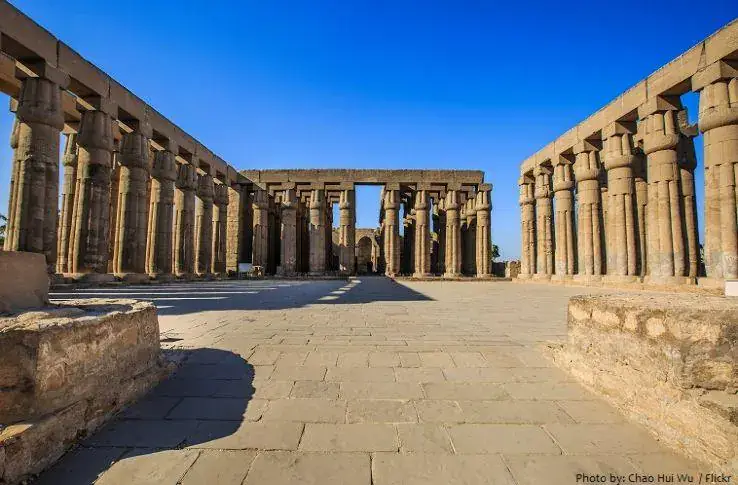
Amenhotep III built the principal surviving core of Luxor Temple and its monumental Great Colonnade. As a result, his work helped transform the sanctuary into a major ceremonial setting connected with the Opet Festival.
Kom el-Hettan
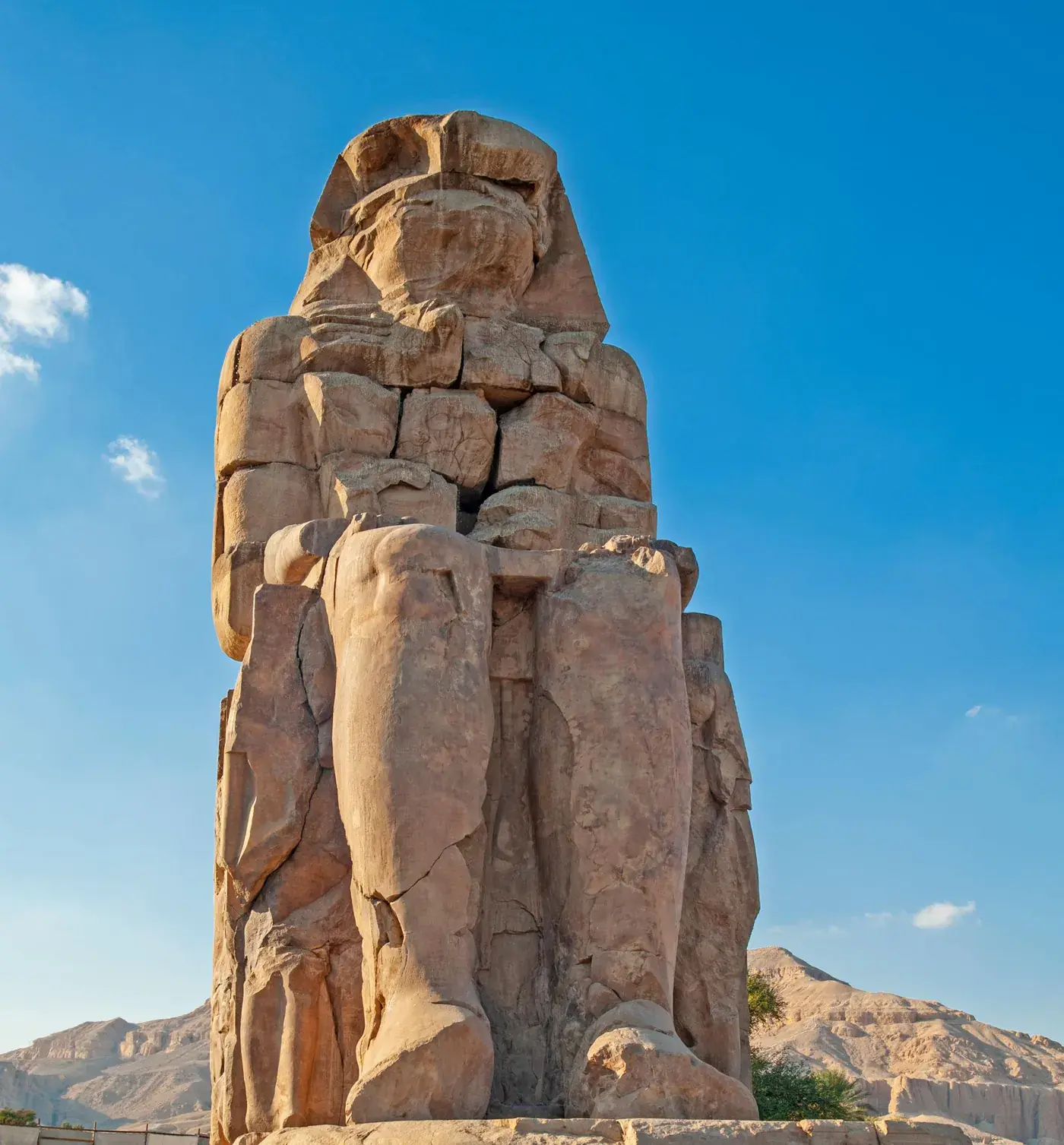
His enormous mortuary temple on the West Bank of Thebes stood behind the seated royal statues known today as the Colossi of Memnon.
Malkata
The royal palace and festival city on the West Bank became an important setting for the king’s later reign and his jubilee celebrations.
Soleb in Nubia
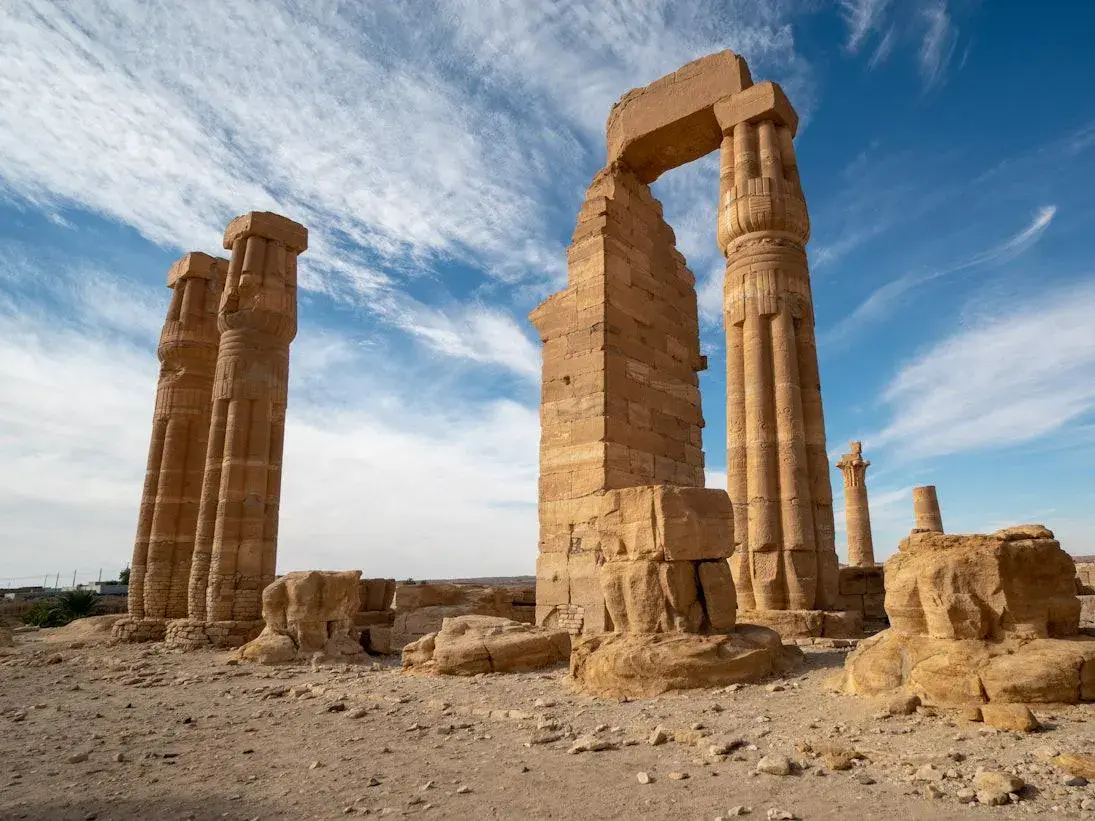
The monumental temple at Soleb demonstrates how royal architecture and ideology extended south into Nubia during Amenhotep III’s reign.
Amenhotep III and Luxor Temple
One of Amenhotep III’s greatest surviving architectural achievements stands in the heart of modern Luxor. Although Luxor Temple developed under several rulers, Amenhotep III constructed its main 18th-Dynasty core.
The Great Colonnade and Opet Festival
His work included a large columned courtyard and the monumental Great Colonnade. The colonnade consists of two rows of seven enormous open-papyrus columns, creating a ceremonial passage toward the inner temple.
Later rulers added important decoration to this setting. In particular, Tutankhamun and Horemheb completed much of the famous Opet Festival decoration associated with the colonnade. Therefore, Amenhotep III created the monumental architectural setting, while later kings contributed to its decorated history.
Luxor Temple was ceremonially connected with Karnak Temple, and the annual Opet Festival linked both sacred complexes through ritual procession.
The Mortuary Temple and Colossi of Memnon
Across the Nile from Luxor Temple, Amenhotep III created an immense royal mortuary complex at Kom el-Hettan. In antiquity it formed a monumental landscape of pylons, courts, columns, statues and ritual spaces.
Amenhotep III Behind the Name “Memnon”
Today, two enormous seated statues of the king still dominate the approach. Visitors know them as the Colossi of Memnon, although the statues actually represent Amenhotep III.
Over time, floods, stone reuse and other destructive processes severely damaged much of the temple. Nevertheless, archaeology and conservation continue to reveal its former scale. Excavations have uncovered royal statuary, images of the goddess Sekhmet, architectural remains and evidence connected with royal festival ceremonies.
The two surviving colossi therefore should not be understood as isolated statues. They were monumental guardians of a much larger sacred complex dedicated to the king’s enduring cult.
Malkata: The Palace City of Amenhotep III
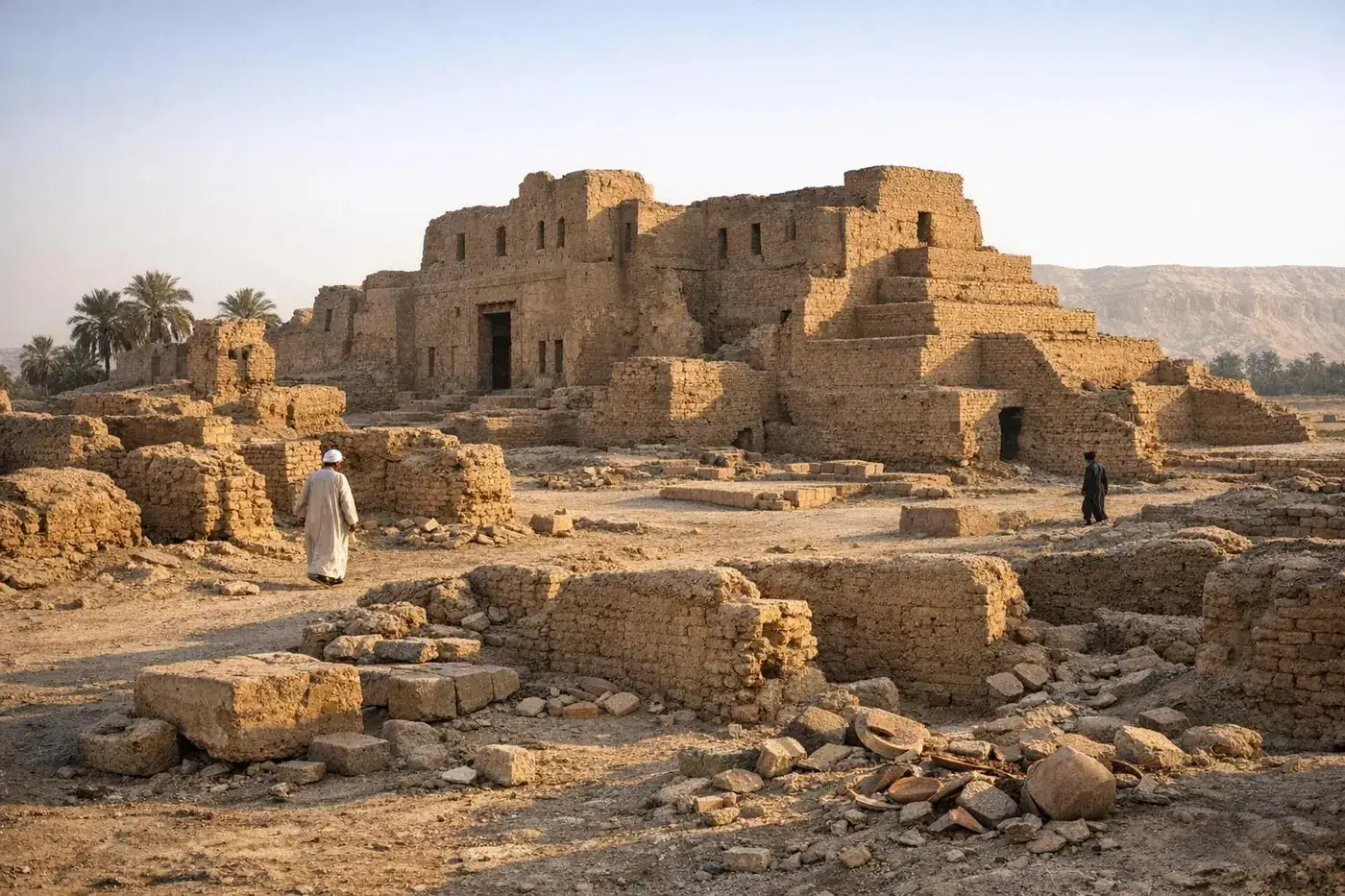
On the West Bank of Thebes, Amenhotep III developed a vast royal complex commonly known as Malkata or Malqata. It included palatial buildings, administrative areas and ceremonial structures associated particularly with the later years of his reign.
Moreover, the site became closely connected with the king’s Heb-Sed festivals—jubilee ceremonies centred on royal renewal. Archaeologists have found decorated architectural fragments, stamped mudbricks, faience objects and material bearing the king’s names at Malkata.
Birket Habu and the Wider Royal Landscape
In addition, a large artificial harbour or basin known today as Birket Habu formed part of the wider ceremonial landscape. Together, the palace city and harbour demonstrate that Amenhotep III’s architectural ambitions extended beyond stone temples into a carefully organised royal environment.
- Royal palaces and ceremonial spaces
- Administrative and service buildings
- Structures connected with the Heb-Sed festivals
- Decorated floors, walls and faience elements
- A wider landscape associated with Birket Habu
The Heb-Sed Festivals
The Heb-Sed was an ancient royal jubilee that symbolically renewed the pharaoh’s strength and ability to rule. Amenhotep III celebrated his first known Heb-Sed in the thirtieth year of his reign and held further jubilees during his later years.
However, these celebrations were not simply anniversaries in the modern sense. Through highly charged religious and political ceremonies, the court ritually renewed the pharaoh’s power.
A major royal jubilee associated with extensive ceremonial preparations at Malkata.
The king celebrated additional renewal festivals, with Malkata continuing to serve as an important ceremonial centre.
Art connected with the later reign often presents a rejuvenated royal image, expressing ritual renewal rather than functioning as a simple physical portrait.
Soleb and Amenhotep III in Nubia
Amenhotep III’s monumental programme reached far south of Thebes. For example, at Soleb, in present-day Sudan, he commissioned a major sandstone temple within the Egyptian-controlled Nubian landscape.
The monument reflects the close relationship between religion and royal authority. Its surviving columns, reliefs and inscriptions preserve evidence of the ideological reach of the Egyptian monarchy during the 18th Dynasty.
Nearby Sedeinga also contained a temple associated with Queen Tiye. Together, these monuments reveal how the royal court projected the couple’s image and religious significance well beyond Egypt’s traditional heartland.
Diplomacy and Egypt’s International World
Meanwhile, the reign of Amenhotep III belonged to an international age in which the great courts of the eastern Mediterranean and western Asia communicated through diplomatic correspondence, gifts and dynastic marriages.
Letters preserved in the broader Amarna correspondence illuminate relations between the Egyptian court and rulers in regions including Babylonia, Mitanni and other Near Eastern states. Significantly, some correspondence belongs to the later reign of Amenhotep III, while the archive also extends into the reign of Akhenaten.
These documents should not be read as modern diplomatic reports. They are royal communications shaped by court protocol, negotiation and political interests. Nevertheless, they provide extraordinary evidence for Egypt’s position within a network of powerful Bronze Age kingdoms.
Royal Correspondence
Foreign rulers exchanged formal messages with the Egyptian court concerning gifts, marriages and diplomatic relations.
Dynastic Marriage
Marriage alliances formed part of the diplomatic system connecting royal houses across the ancient Near East.
Prestige & Exchange
Luxury goods and precious materials were exchanged within a political language of status, reciprocity and royal friendship.
Statues and Artistic Style
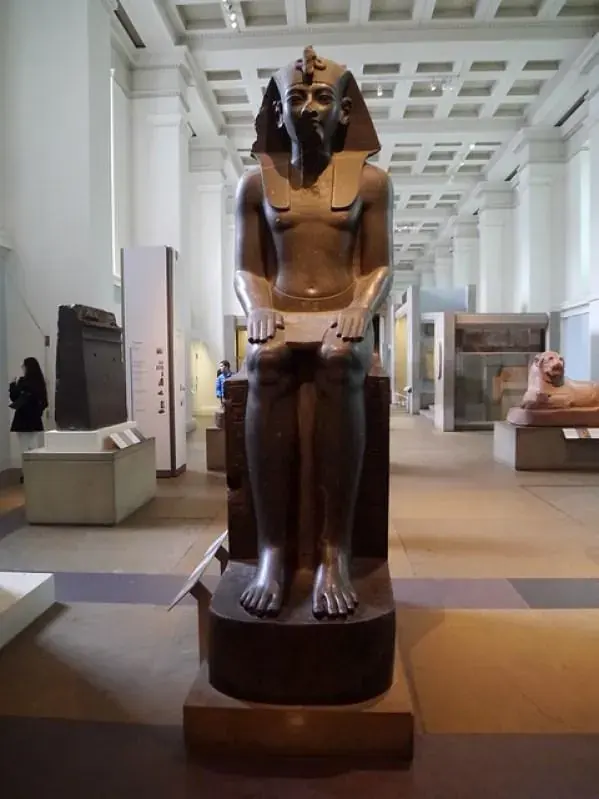
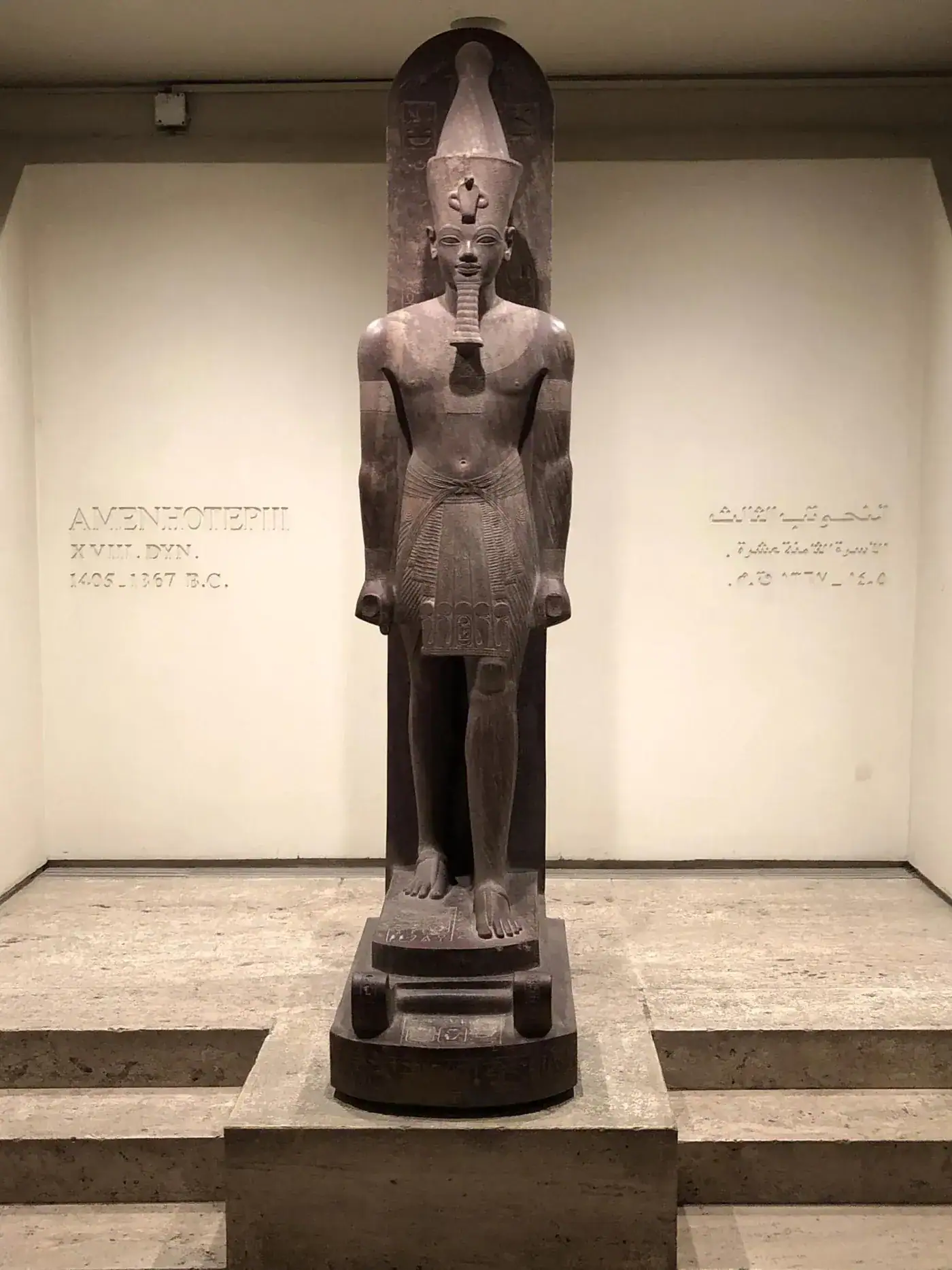
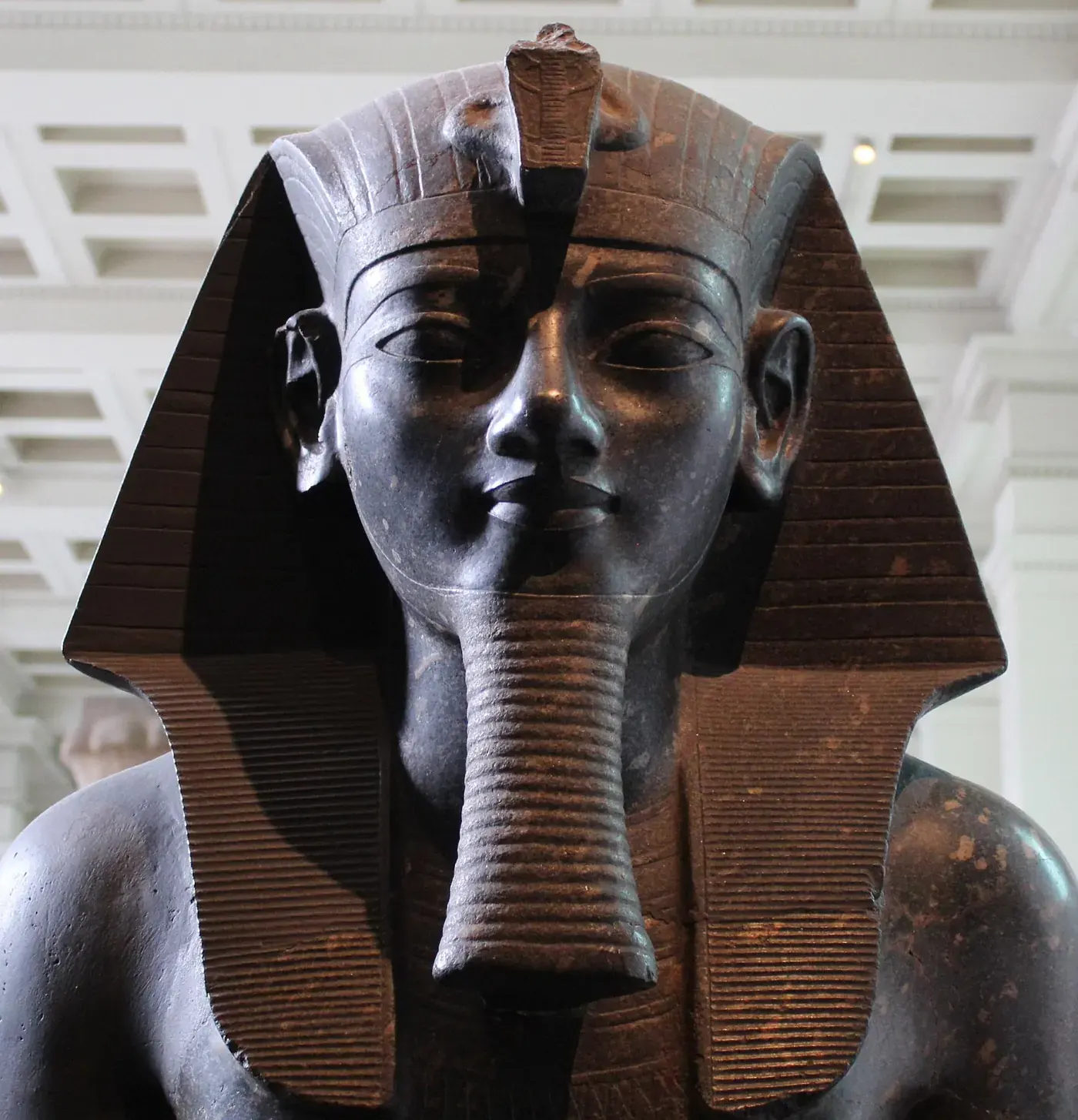
The reign of Amenhotep III produced an extraordinary range of royal sculpture. His image survives in colossal seated figures, standing statues, smaller sculptures and numerous fragments distributed among archaeological sites and museum collections.
However, Egyptian artists did not create these images merely as realistic portraits. Instead, royal art communicated kingship, divine protection, ritual identity and the ideal nature of the pharaoh.
Royal Rejuvenation in Art
During the later reign, some representations present Amenhotep III with noticeably youthful features. Scholars often connect such imagery with the idea of rejuvenation surrounding the Heb-Sed festivals.
His mortuary complex was also associated with extensive divine statuary, including numerous representations of Sekhmet, the powerful lioness goddess connected with protection and healing.
Religion During the Reign of Amenhotep III
Amun-Ra remained central to state religion, particularly at Thebes, while solar theology also occupied an important place in royal ideology. Amenhotep III’s monuments repeatedly connected the king with divine forces and with the concept of cosmic order.
However, we should not treat the religious developments of his reign simply as an early version of Akhenaten’s later revolution. Solar traditions had deep roots in Egyptian religion, whereas the dramatic elevation of the Aten under Akhenaten belongs to a distinct historical phase.
This distinction matters because Amenhotep III is sometimes presented as though he had already created the later Amarna religion. The evidence instead reveals a complex traditional religious environment in which Amun, solar deities and many other gods remained significant.
Amenhotep III and Akhenaten
Amenhotep III’s son Amenhotep IV succeeded him and later changed his name to Akhenaten. Consequently, the transition between their reigns became one of the most fascinating turning points in ancient Egyptian history.
From Thebes to Akhetaten
Amenhotep III expressed kingship through immense temples, royal jubilees and established divine traditions. By contrast, Akhenaten promoted the Aten with unprecedented intensity, founded the new royal city of Akhetaten at Tell el-Amarna and transformed official artistic and religious expression. Queen Nefertiti also appears prominently in the royal imagery from this new capital.
Scholars have long debated whether father and son shared a period of co-regency. Different interpretations of inscriptions, artistic evidence and chronology have produced competing reconstructions. Therefore, a lengthy co-regency should not be presented as an established fact.
Commemorative Scarabs and Royal Memory
Another distinctive feature of Amenhotep III’s reign is the use of large commemorative scarabs carrying inscriptions connected with royal events.
For instance, such objects helped circulate carefully constructed messages about the king and court. Some inscriptions refer to Queen Tiye, while others commemorate events or achievements associated with the reign.
These scarabs are especially valuable because they demonstrate that royal commemoration did not depend only on giant stone monuments. Portable inscribed objects could also carry royal identity and official memory across Egypt and beyond.
Death, Tomb and Legacy of Amenhotep III
Amenhotep III died after a reign of nearly four decades. His royal tomb, WV22, lies in the Western Valley, a branch of the wider Valley of the Kings landscape on Luxor’s West Bank.
A Legacy Across Luxor and the Amarna Age
Moreover, his legacy is unusually broad. He left monumental architecture, colossal sculpture, palace remains, inscriptions, diplomatic evidence and a royal family whose next generation would profoundly change Egypt.
Most importantly, the surviving monuments show that his reign cannot be reduced to the prelude to Akhenaten. Amenhotep III’s Egypt was a major historical world in its own right: wealthy, internationally connected, artistically innovative and deeply invested in the sacred image of kingship.
Today, visitors to Luxor still encounter that world directly. From the columns of Luxor Temple to the Colossi of Memnon and the archaeological remains of the West Bank, Amenhotep III remains physically embedded in the landscape of ancient Thebes.
Historical Sources & Further Reading
This guide draws on archaeological and museum evidence. For additional research, see the Egyptian Ministry of Tourism and Antiquities guide to Luxor Temple, the Ministry’s research and conservation information on the Temple of Amenhotep III and Colossi of Memnon, and The Metropolitan Museum of Art’s Amenhotep III collection research.
Amenhotep III FAQ
Quick answers to the most common questions about Amenhotep III, his family, monuments and reign.
Who was Amenhotep III?
Amenhotep III was the ninth pharaoh of Egypt’s 18th Dynasty. He ruled for almost four decades during the 14th century BCE and is remembered for a prosperous reign, international diplomacy, monumental architecture and exceptional royal art.
When did Amenhotep III rule Egypt?
A commonly used chronology places his reign around 1390–1352 BCE, although exact dates can vary slightly between modern chronological systems.
Who was the wife of Amenhotep III?
His Great Royal Wife was Queen Tiye, one of the most prominent queens of Egypt’s New Kingdom. She appears with the king in important monuments and royal objects.
Was Amenhotep III the father of Akhenaten?
Yes. Amenhotep IV, who later became Akhenaten, was a son of Amenhotep III and Queen Tiye and succeeded Amenhotep III as pharaoh.
What did Amenhotep III build?
His major projects included the principal 18th-Dynasty core of Luxor Temple, the Great Colonnade there, his vast mortuary temple at Kom el-Hettan, the royal complex at Malkata and major construction in Nubia including Soleb Temple.
Did Amenhotep III build the Colossi of Memnon?
The two statues known as the Colossi of Memnon represent Amenhotep III and originally stood at the entrance to his enormous mortuary temple on Luxor’s West Bank.
Why are the Colossi called Memnon?
The name comes from a later Greco-Roman association with Memnon, a figure from Greek tradition. The statues themselves are Egyptian royal monuments representing Amenhotep III.
What was Malkata?
Malkata was a royal palace and festival complex on the West Bank of Thebes. It became especially important during the later reign of Amenhotep III and was associated with his Heb-Sed jubilee celebrations.
Where was Amenhotep III buried?
His tomb is WV22 in the Western Valley, a western branch of the royal necropolis generally associated with the Valley of the Kings at Thebes.
Did Amenhotep III rule together with Akhenaten?
A co-regency between Amenhotep III and Akhenaten has been debated by scholars. The duration and even interpretation of the proposed overlap remain disputed, so it should not be treated as a settled historical fact.
Discover Ancient Thebes
Explore the temples and archaeological landscape connected with the world of Amenhotep III.
Walk Through the World of Amenhotep III
Explore Luxor’s temples, royal monuments and West Bank archaeology with a private Egyptologist guide and an itinerary designed around your interests.
Plan Your Private Egypt Tour