
The Egyptian Museum Cairo
The Egyptian Museum in Cairo: History, Highlights & Visitor Guide
Explore Cairo’s historic Egyptian Museum in Tahrir Square, from the Narmer Palette and Old Kingdom masterpieces to royal burials, Amarna art and the story of one of the world’s great collections of ancient Egyptian antiquities.
Tahrir Square landmark
Why The Egyptian Museum Still Matters Today
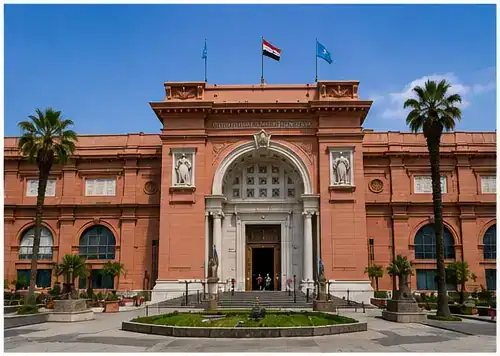
The Egyptian Museum in Cairo is one of the great historic museums of Egypt and a landmark of Downtown Cairo. Moreover, opened in 1902, it preserves an extraordinary collection spanning the Predynastic Period, the great pharaonic kingdoms and the Greco-Roman era.
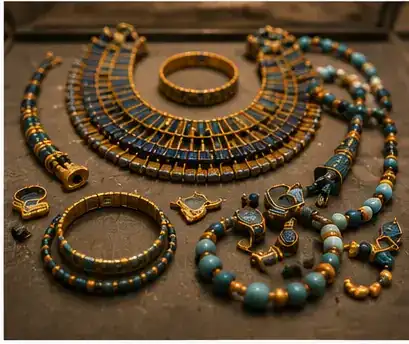
However, although major collections have moved to newer museums, the Tahrir museum remains essential. In particular, visitors can still discover the Narmer Palette, the burials of Yuya and Thuya, the treasures of Tanis, royal sculpture, papyri, jewelry, sarcophagi and many other masterpieces.
Is The Egyptian Museum still worth visiting after the opening of the GEM? Yes. In fact, the museum in Tahrir has its own historic collections and atmosphere, while the Grand Egyptian Museum and the National Museum of Egyptian Civilization complement it with other major collections.
Birth of modern Egyptology
History of The Egyptian Museum in Cairo
The story of the museum began before the Tahrir building itself. At that time, Egypt’s antiquities faced heavy pressure from uncontrolled collecting, export and looting. Therefore, the creation of an official Antiquities Service and a centralized museum became essential for protecting the country’s archaeological heritage.
First, Auguste Mariette established an important state collection at Boulaq. Then, the collection moved to Giza before a permanent purpose-built museum was created in central Cairo.
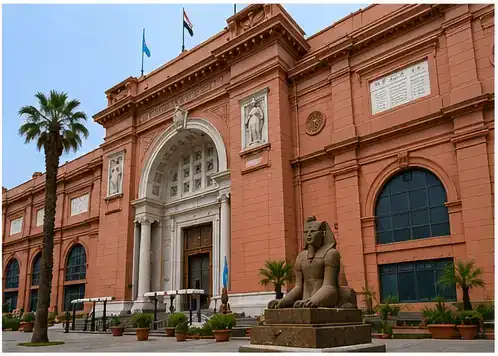
In 1895, an international architectural competition selected the design of French architect Marcel Dourgnon. Finally, the Egyptian Museum in Tahrir Square was inaugurated in 1902 by Khedive Abbas Helmy II.
For example, for official background and current information, see Egypt’s Ministry of Tourism and Antiquities page for The Egyptian Museum.
People behind the collection
Key Figures Behind The Egyptian Museum
Auguste Mariette
Importantly, the French Egyptologist founded Egypt’s Antiquities Service and developed the early centralized museum collection at Boulaq. His work helped establish the principle that Egyptian antiquities should be protected and studied in Egypt. Read more from Britannica.
Gaston Maspero
Afterwards, Maspero succeeded Mariette and played a major role in organizing Egyptological work and expanding the museum’s collections. His era was closely connected with important discoveries, including the royal mummy caches. See Gaston Maspero’s biography.
Marcel Dourgnon
Meanwhile, the French architect won the international competition to design the purpose-built museum in Tahrir Square. His monumental neoclassical building was specifically created to house Egypt’s national antiquities collection.
Chronological journey
Ground Floor of The Egyptian Museum
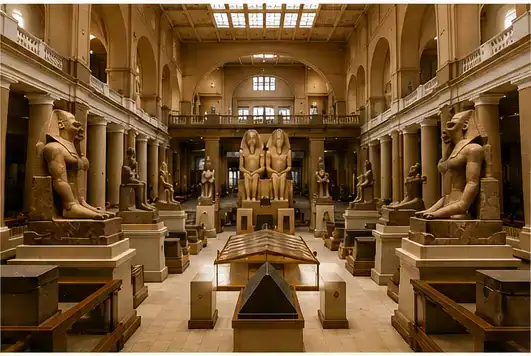
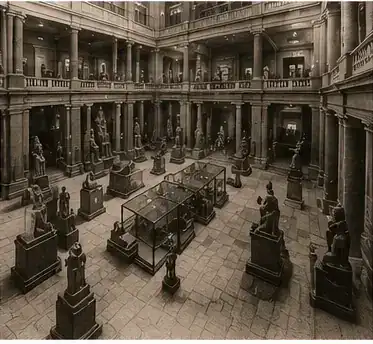
First, the ground floor is arranged mainly in chronological order. As a result, it provides a strong introduction to the development of Egyptian art from the earliest periods through the pharaonic age and into the Greco-Roman era.
- Predynastic and Early Dynastic Egypt: early pottery, tools and masterpieces connected with the formation of the Egyptian state.
- Old Kingdom: royal sculpture associated with pyramid builders such as Khufu, Khafre and Menkaure, together with funerary objects from major necropolises.
- Middle Kingdom: royal statues, jewelry and objects that reveal changing artistic styles and daily life.
- New Kingdom: monumental sculpture, funerary equipment and works from the age of Akhenaten and Ramesses II.
- Late and Greco-Roman Periods: objects showing the artistic and political changes of Egypt’s later ancient history.
A symbol of unification
The Narmer Palette at The Egyptian Museum
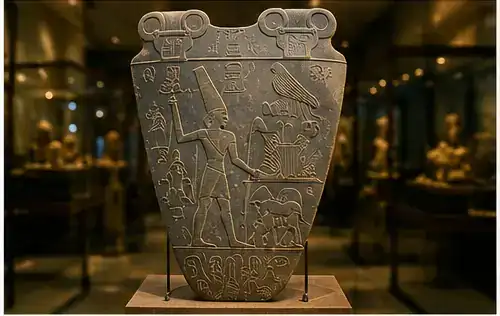
In particular, among the museum’s most important masterpieces is the Narmer Palette. Indeed, dating to the very beginning of dynastic Egypt, it is closely associated with the political unification of Upper and Lower Egypt under one ruler.
Moreover, its carved scenes are fundamental to the study of early royal imagery. Moreover, they show visual ideas that would remain central to Egyptian kingship for thousands of years.
For more detail, you can explore the object through the Egyptian Museum’s Narmer Palette collection page.
Masterpieces through the dynasties
Highlights to Look for During Your Visit
Khufu, Khafre and Menkaure
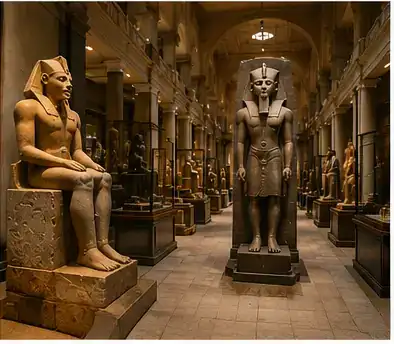
For example, royal sculpture from the Old Kingdom connects the museum directly with the pyramid age at Giza. The contrast between different materials and royal styles is one of the strongest parts of the collection.
Yuya and Thuya
Likewise, the exceptionally rich burial assemblage of Yuya and Thuya preserves coffins, funerary furniture and objects from one of the most important intact elite burials discovered before Tutankhamun.
Treasures of Tanis
In addition, the royal burials from Tanis include precious metalwork, jewelry and funerary equipment from the Third Intermediate Period. These treasures are among the great reasons to visit the Tahrir museum today.
Collections and themes
First Floor of The Egyptian Museum
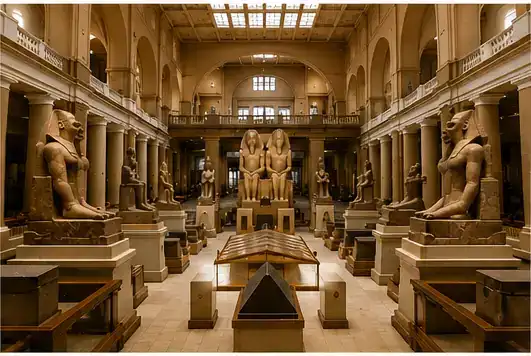
Unlike the largely chronological ground floor, the first floor is organized more by category, collection and archaeological group. Therefore, it is especially useful for visitors interested in funerary objects, jewelry, papyri and complete burial assemblages.
For example, highlights include the celebrated collections of Yuya and Thuya, the royal treasures from Tanis, coffins, sarcophagi, jewelry, daily-life objects and material from different excavation contexts.
Therefore, because the building has more than 100 display halls across its two main floors, so it is better to focus on major collections rather than trying to inspect every object in one visit.
Amarna revolution
Akhenaten and Amarna Art in The Egyptian Museum
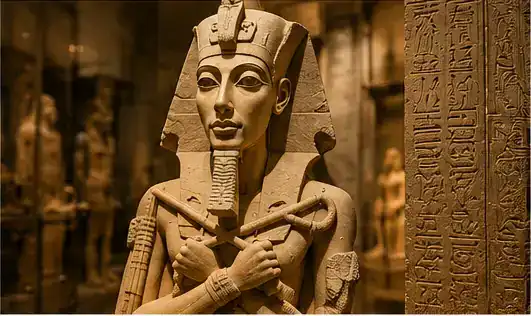
In particular, the Amarna period is one of the most visually distinctive chapters of ancient Egyptian history. Under Akhenaten, royal art changed dramatically, with elongated forms, intimate royal scenes and a new emphasis on the Aten.
Consequently, objects linked to this period help visitors understand the religious and artistic revolution that centered on Akhenaten’s new capital at Tell el-Amarna.
Moreover, for travelers interested in the period, combining the museum with our Tell el-Amarna guide gives useful archaeological context beyond Cairo.
Where are the famous collections now?
Collections Relocated from The Egyptian Museum
Royal Mummies → NMEC
Importantly, the royal mummies formerly displayed in Tahrir were transferred to the National Museum of Egyptian Civilization in Fustat. Today, NMEC has a dedicated Royal Mummies Gallery. Learn more about mummification in ancient Egypt.
Tutankhamun → GEM
Meanwhile, the Tutankhamun collection is now presented at the Grand Egyptian Museum near the Giza Pyramids. The official GEM visit includes dedicated Tutankhamun Galleries.
Khufu’s Boats → GEM
Finally, Khufu’s ancient boat collection has also moved to the Grand Egyptian Museum, where visitors can see it in the Khufu’s Boats Museum as part of the wider Giza context.
Important: Do not plan your Tahrir visit expecting the old Royal Mummy Room or the former Tutankhamun display. Those collections are now associated with NMEC and GEM respectively.
Three complementary museums
Egyptian Museum vs GEM vs NMEC
Importantly, these three museums are not duplicates. Instead, each offers a different experience. The Egyptian Museum in Tahrir is a historic museum built around the development of Egyptology and the national antiquities collection.
Meanwhile, the Grand Egyptian Museum focuses on monumental presentation close to the Giza Plateau and includes the Tutankhamun Galleries and Khufu’s Boats Museum. By contrast, NMEC tells the broader story of Egyptian civilization through many periods and houses the Royal Mummies Gallery.
Therefore, travelers with enough time can visit all three and gain a much richer understanding of Egypt’s archaeology and museum history.
Plan your visit
Visiting The Egyptian Museum in Cairo
Where is the museum?
Specifically, the Egyptian Museum stands directly on Tahrir Square in Downtown Cairo. It is easy to combine with central Cairo and other city attractions.
Opening hours
Currently, the Ministry lists daily opening hours of 9:00 AM to 5:00 PM, with the ticket window closing at 4:00 PM. Always recheck official information before travel.
How long should you allow?
Generally, allow around 2–3 hours for a focused visit. However, archaeology enthusiasts can easily spend half a day exploring the galleries.
How should you explore?
First, start on the ground floor for the chronological sequence. Afterwards, move upstairs for burial groups, jewelry, funerary collections and specialized displays.
What can you combine it with?
For example, combine the museum with Downtown Cairo, Islamic Cairo, Khan El Khalili or the Salah El-Din Citadel.
Where can I check official details?
Finally, use the Ministry of Tourism and Antiquities for current opening times, ticket prices and visitor policies.
Visitor tip: ticket prices and opening arrangements may change. Check the official Ministry page shortly before your visit rather than relying on an old guide or screenshot.
A practical route
How to Explore The Egyptian Museum Efficiently
First, begin with the earliest periods and Old Kingdom sculpture on the ground floor. As a result, this gives you a clear historical framework before you move into the New Kingdom and later periods.
Next, continue upstairs and choose a few major collections rather than attempting to see every showcase. In particular, the burials of Yuya and Thuya and the Tanis treasures are especially worthwhile.
Finally, if your Cairo itinerary includes more museum time, plan separate visits to the Grand Egyptian Museum and NMEC instead of expecting all famous collections to remain in Tahrir.
Tahrir Square, Downtown Cairo
Location of The Egyptian Museum in Cairo
Quick answers
Frequently Asked Questions About The Egyptian Museum
Is The Egyptian Museum in Cairo still open?
Yes. Moreover, the historic Egyptian Museum in Tahrir Square remains open and continues to display major collections of ancient Egyptian antiquities.
Is Tutankhamun still in The Egyptian Museum in Tahrir?
Instead, the dedicated Tutankhamun Galleries are now at the Grand Egyptian Museum near the Giza Pyramids, so visitors should plan GEM for the Tutankhamun collection.
Where are the royal mummies now?
Importantly, the royal mummies formerly displayed in Tahrir are now exhibited at the National Museum of Egyptian Civilization in Fustat.
What are the main highlights of The Egyptian Museum today?
For example, important highlights include the Narmer Palette, Old Kingdom royal sculpture, the complete burials of Yuya and Thuya, the Tanis treasures, papyri, coffins, sarcophagi and jewelry.
How long do you need at The Egyptian Museum?
Generally, most visitors should allow around 2–3 hours for a focused visit, although a longer stay is worthwhile for serious archaeology enthusiasts.
What is the difference between The Egyptian Museum and the GEM?
By contrast, the Tahrir museum is the historic national museum opened in 1902, while GEM is a newer museum near Giza with monumental galleries, the Tutankhamun Galleries and Khufu’s Boats Museum.
Can I visit The Egyptian Museum and Khan El Khalili on the same day?
Yes. In addition, they can be combined in a full Cairo day, especially with Downtown Cairo, Islamic Cairo or Al-Muizz Street depending on your schedule.
Explore Ancient Cairo
Discover The Egyptian Museum With a Private Cairo Itinerary
Finally, combine the historic museum in Tahrir with the Pyramids of Giza, GEM, Islamic Cairo or other major Cairo attractions on a private route designed around your interests.