
Queen Hatshepsut was one of the most remarkable rulers in ancient Egyptian history. Defying the conventions of her time, she reigned as Pharaoh during the 18th Dynasty, from about 1479 to 1458 BCE. Her rule brought stability, monumental architecture, prosperous trade and a carefully constructed image of divine kingship.
- Dynasty: 18th Dynasty
- Reign: c. 1479–1458 BCE
- Father: Thutmose I
- Most famous monument: Deir el-Bahari
Who Was Queen Hatshepsut?
Queen Hatshepsut was an 18th-Dynasty Egyptian ruler who first governed as regent for the young Thutmose III and then adopted the full titles of a king. She ruled for roughly two decades and is remembered for Deir el-Bahari, her Karnak obelisks, renewed long-distance trade and one of the most innovative artistic programs of the New Kingdom.
Queen Hatshepsut Timeline
- c. 1507 BCE: Hatshepsut is born into the royal family of Thutmose I and Queen Ahmose.
- Before 1479 BCE: She becomes the principal wife of Thutmose II and holds the prestigious title God’s Wife of Amun.
- c. 1479 BCE: After Thutmose II’s death, she becomes regent for the young Thutmose III.
- About seven years later: Hatshepsut assumes the titles and regalia of a king while retaining Thutmose III as co-ruler.
- During her reign: She commissions Deir el-Bahari, erects obelisks at Karnak and sponsors the Punt expedition.
- c. 1458 BCE: Hatshepsut dies; Thutmose III continues to rule for about another three decades.
- About 20 years later: A campaign begins to remove or replace many of her royal names and images.
Early Life and Royal Lineage of Queen Hatshepsut
Born around 1507 BCE to Pharaoh Thutmose I and his principal wife, Queen Ahmose, Hatshepsut grew up at the center of Egypt’s royal court. Her education prepared her for religious ceremonies, administration and court life. As the king’s daughter, she possessed a powerful claim to royal legitimacy.
She married her half-brother Thutmose II and became queen consort. Their daughter, Neferure, later held an important position at court. When Thutmose II died, his son by a secondary wife, Thutmose III, was still a child. Hatshepsut first acted as regent before gradually assuming the full titles and authority of a Pharaoh.
How Queen Hatshepsut Became Pharaoh
Hatshepsut’s rise was gradual and politically sophisticated. She adopted the traditional five royal names and presented herself as the ruler chosen by the god Amun. Temple inscriptions, especially at Deir el-Bahari, supported her claim through scenes of divine birth and coronation.
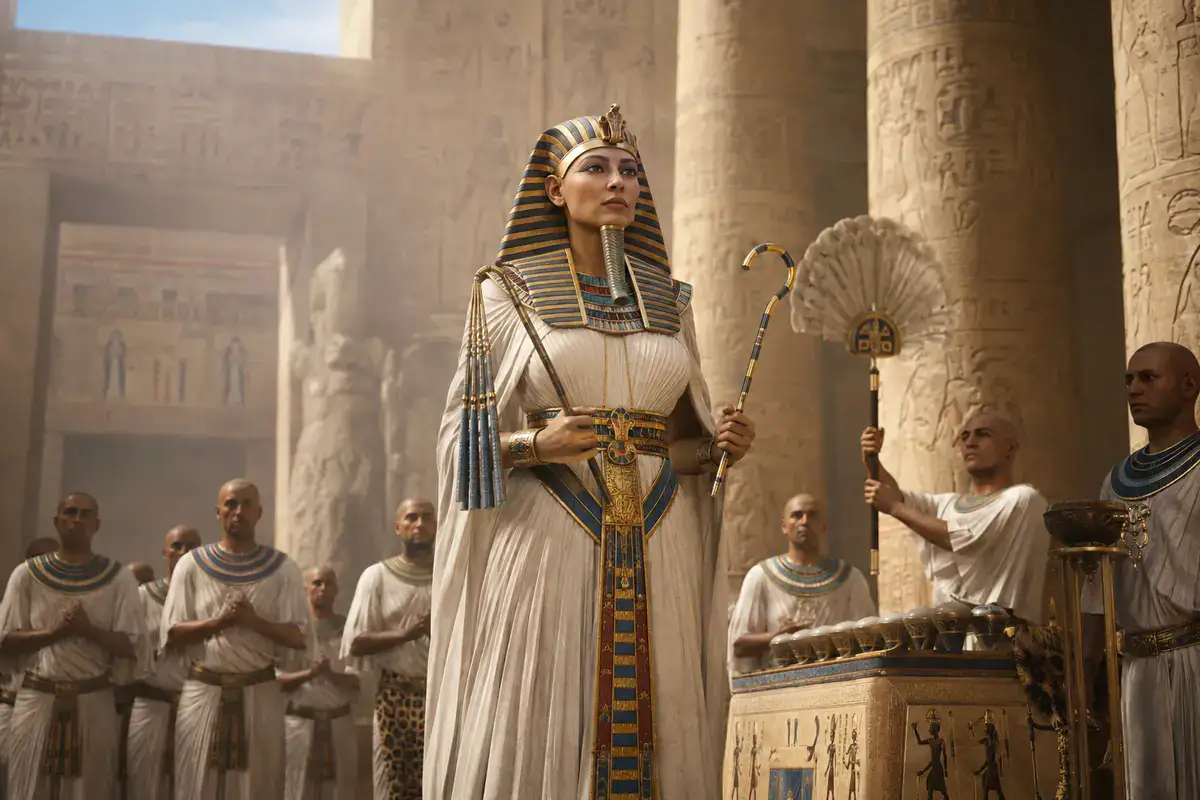
In official art, she could appear with the nemes headdress, royal kilt and ceremonial false beard. Yet other images retained feminine features. Thutmose III remained her co-ruler, helping to preserve dynastic continuity and political stability.
Why Did Hatshepsut Call Herself a King?
Ancient Egyptian kingship was expressed through an established visual and religious language. The office itself was traditionally male, so Hatshepsut used the titles, crowns, poses and ritual clothing expected of a Pharaoh. This did not mean that she tried to hide her sex. Some inscriptions used feminine grammar, while statues could combine a feminine body with royal male regalia. Her imagery evolved as her political position became stronger.
| Role | How Hatshepsut Presented Herself |
|---|---|
| King’s daughter and queen | A royal woman connected to Thutmose I, Thutmose II and the cult of Amun. |
| Regent | Protector and senior authority acting for the child king Thutmose III. |
| Pharaoh | King of Upper and Lower Egypt, using crowns, royal names and traditional regalia. |
| Divine ruler | The chosen daughter of Amun, whose birth and coronation were sanctioned by the gods. |
Queen Hatshepsut’s Monumental Architecture
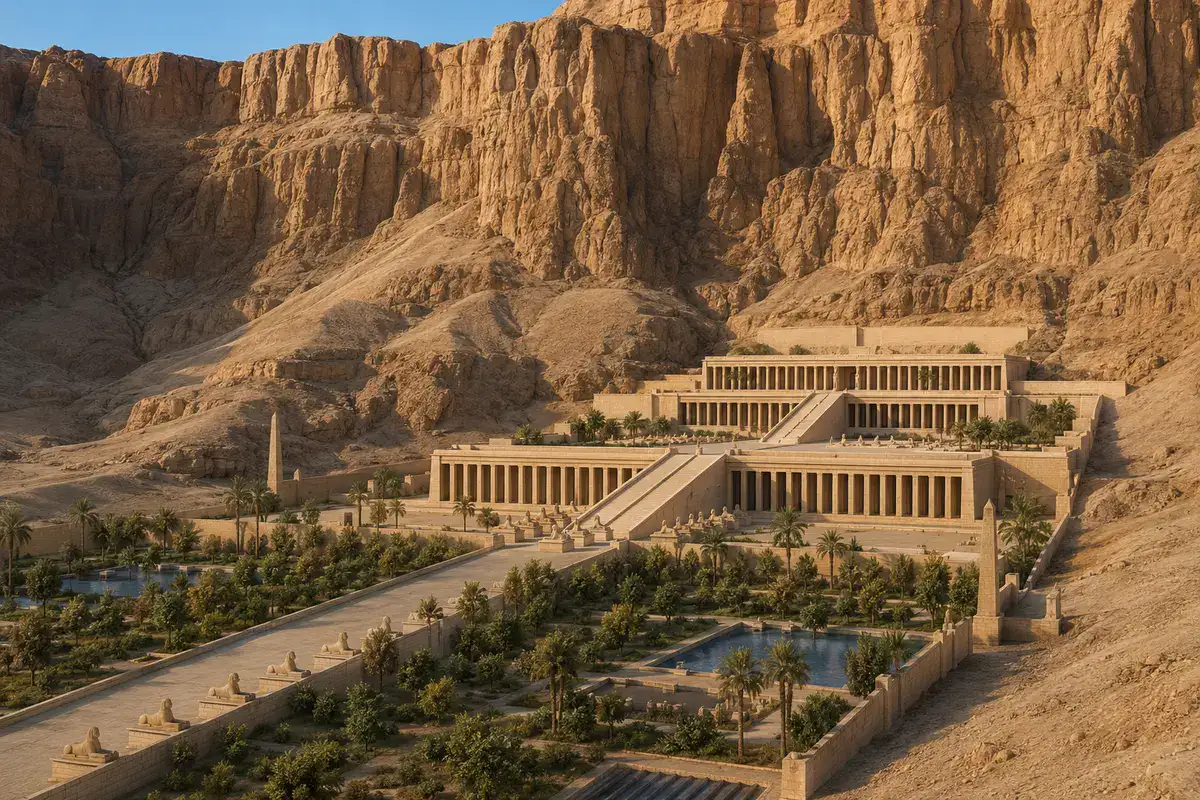
Queen Hatshepsut commissioned building projects throughout Egypt. Her masterpiece is the Mortuary Temple of Hatshepsut at Deir el-Bahari, designed under the supervision of her powerful official Senenmut. Set against the cliffs on the West Bank of Luxor, its terraces, ramps and colonnades form one of ancient Egypt’s most distinctive architectural compositions.
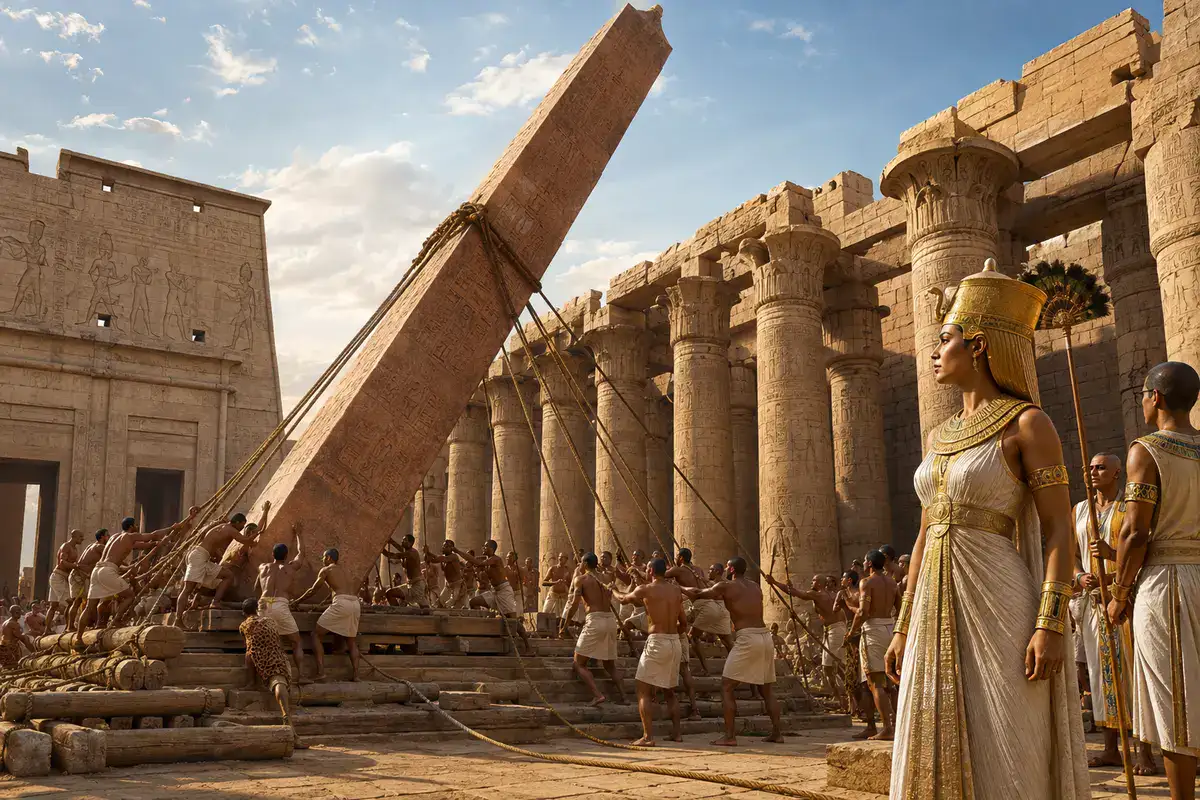
The temple’s reliefs record her divine birth, coronation and expedition to Punt. She also erected two red-granite obelisks at Karnak Temple; one remains standing and is the tallest surviving ancient obelisk in Egypt. Her projects also extended to the Temple of Pakhet near Beni Hassan.
Deir el-Bahari: A Temple Designed as a Royal Biography
Hatshepsut called her temple Djeser-Djeseru, usually translated as “Holy of Holies.” Its terraces rise toward the cliffs in a carefully balanced composition inspired in part by the neighboring temple of Mentuhotep II. In antiquity, the approach was far greener than it is today, with gardens, pools and trees contributing to the temple’s sacred landscape.
The Birth Colonnade presents Hatshepsut as the divine daughter of Amun. The Punt Colonnade records ships, foreign landscapes, trade goods and the people encountered by the expedition. Chapels dedicated to Hathor, Anubis, the royal cult, the solar cult and Amun made the complex both a memorial to the ruler and a functioning religious center.
The Obelisks of Queen Hatshepsut
Hatshepsut ordered monumental obelisks from the granite quarries of Aswan and erected them at Karnak in honor of Amun. Their inscriptions celebrated her devotion and royal legitimacy. Transporting, raising and finishing such monoliths required expert quarry workers, boat crews, engineers and large organized labor forces. Her surviving obelisk remains one of the clearest physical statements of her power.
Trade, Punt and Prosperity
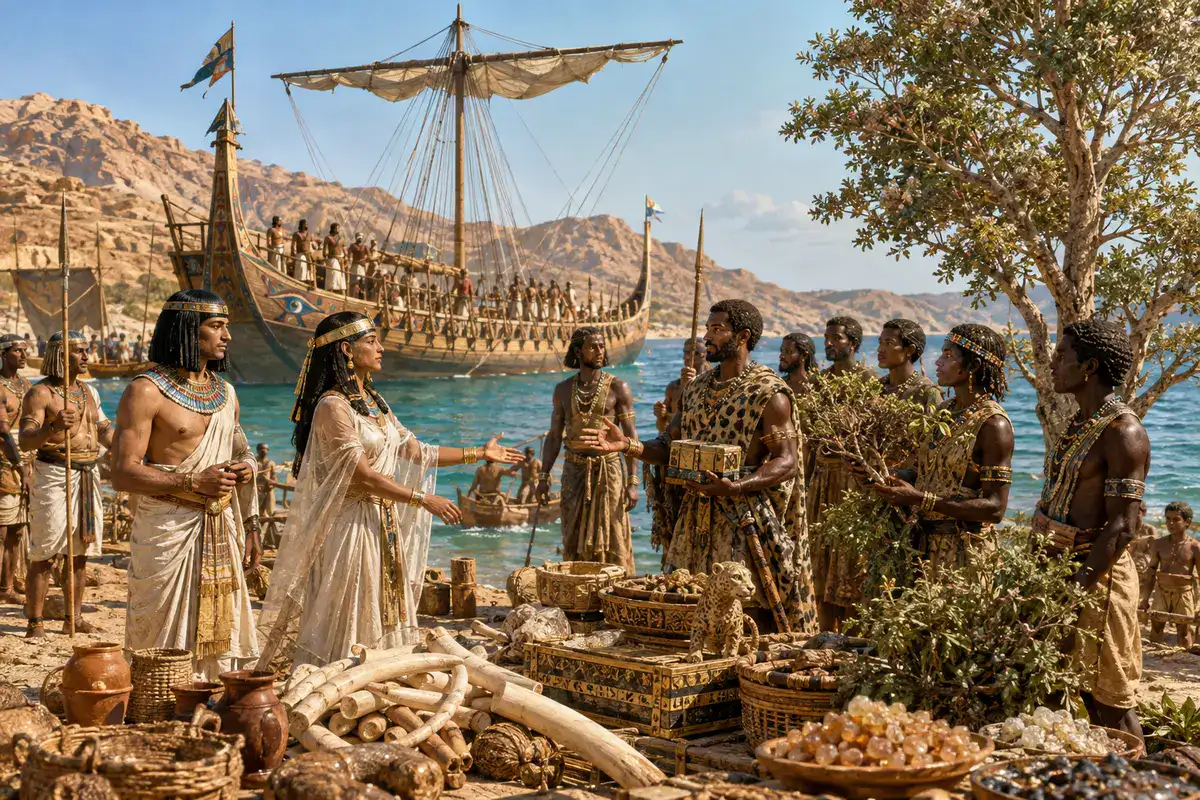
Hatshepsut revitalized Egypt’s international trade. Her best-known expedition sailed to the Land of Punt, probably located around the Red Sea region of modern Eritrea, eastern Sudan or nearby areas. The journey is vividly represented on the walls of her mortuary temple.
The expedition returned with incense, myrrh trees, ebony, ivory, gold and exotic goods. Egypt also maintained connections with Nubia and the eastern Mediterranean. These missions enriched the state and supported Hatshepsut’s image as a ruler who restored prosperity and divine order.
Where Was the Land of Punt?
The precise location remains debated. Most modern discussions place Punt somewhere around the southern Red Sea, possibly including parts of present-day Eritrea, eastern Sudan, Djibouti, Ethiopia or northern Somalia. Hatshepsut’s reliefs are valuable because they depict ships, houses, plants, animals, local leaders and imported goods. They are evidence of a trading world that connected the Nile Valley with northeast Africa and the Red Sea.
Was Hatshepsut Only a Peaceful Builder?
Her reign is famous for trade and construction, but it was not completely without military activity. Inscriptions and later evidence refer to campaigns or displays of force in Nubia and other regions. The best description is that her reign was comparatively stable and prosperous—not that Egypt abandoned military power.
Religious Authority and Royal Propaganda
Before becoming Pharaoh, Hatshepsut held the influential title God’s Wife of Amun. As ruler, she emphasized her devotion to Amun and described herself as his divinely chosen daughter. This religious message strengthened her political authority and connected her reign with Egypt’s sacred traditions.
Statues, inscriptions and temple reliefs were carefully designed to communicate legitimacy. Her imagery combined male symbols of kingship with feminine identity, allowing her to occupy a traditionally male office while remaining recognizably Hatshepsut.
Hatshepsut’s Five Royal Names
Like other Pharaohs, Hatshepsut adopted a complete royal titulary. Her throne name, Maatkare, linked her with Maat—the principle of truth, balance and cosmic order—and the sun god Ra. Names were not merely labels in ancient Egypt: they expressed the ruler’s sacred responsibilities and political program.
Senenmut, Neferure and the Royal Court
Senenmut, Hatshepsut’s chief steward, held numerous titles and supervised major royal projects. His close connection to the queen and to her daughter Neferure has inspired much speculation, although there is no direct evidence that he and Hatshepsut had a romantic relationship.
Other trusted officials, including the High Priest Hapuseneb, helped administer the state. This carefully selected circle allowed Hatshepsut to implement her policies and maintain continuity throughout her reign.
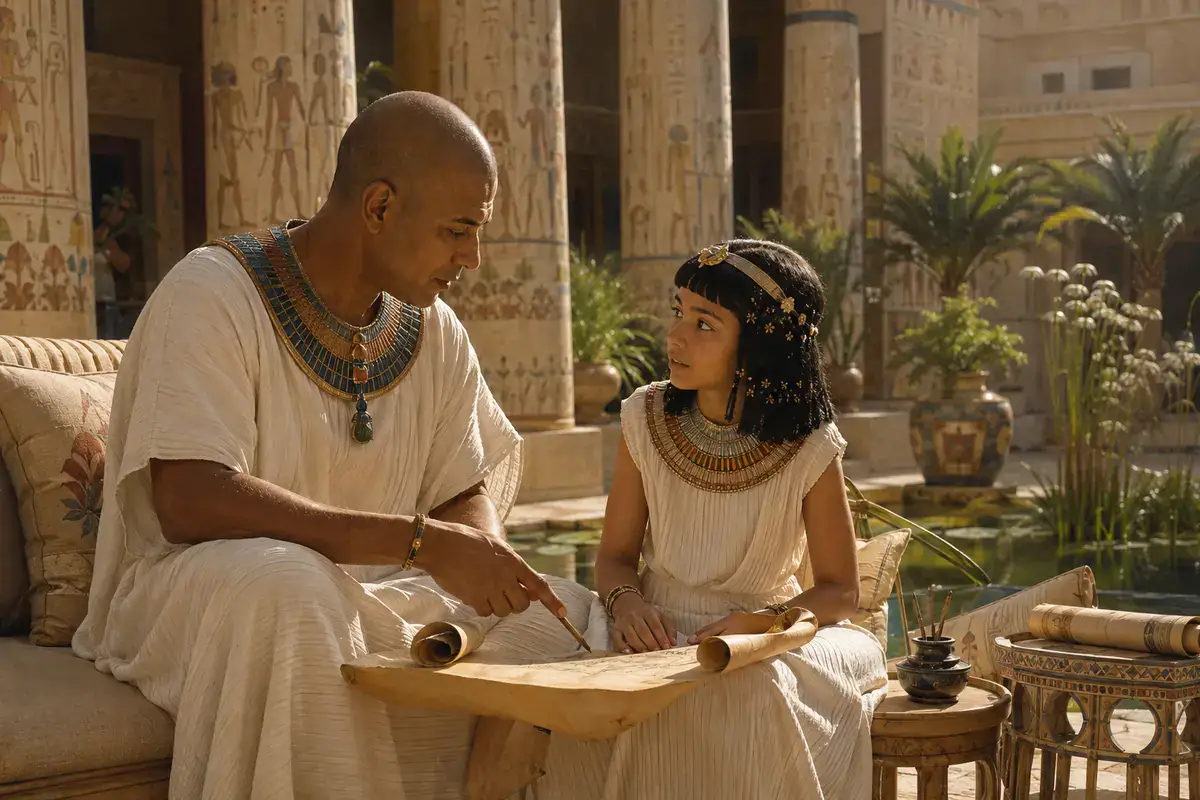
What Happened to Princess Neferure?
Neferure appears prominently during the earlier part of Hatshepsut’s reign and held important religious titles. Several statues show Senenmut protecting or tutoring her. She later disappears from the surviving record, and her fate remains uncertain. Claims that she married Thutmose III are possible but not securely proven.
Death, Burial and Rediscovery
Queen Hatshepsut died around 1458 BCE. She had expanded tomb KV20 in the Valley of the Kings, originally associated with her father. The precise cause of her death remains uncertain.
In 2007, Egyptian researchers announced that an unidentified royal mummy was probably Hatshepsut after comparing it with a tooth preserved in a box bearing her name. The identification attracted worldwide attention, although some details continue to be discussed by specialists.
Erasure and Modern Recognition
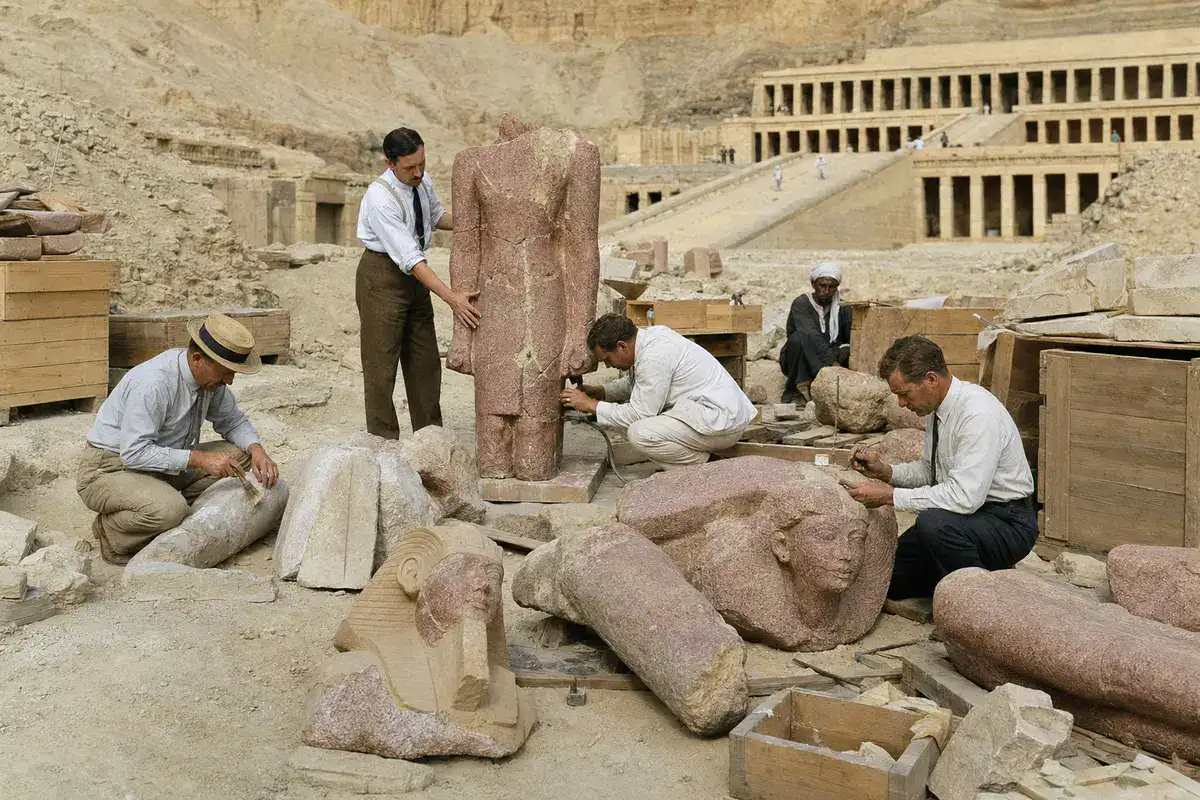
Years after Hatshepsut’s death, many of her names and images were removed or altered. The campaign was selective and probably reflected political and dynastic concerns rather than a simple act of personal revenge by Thutmose III.
Modern archaeology has restored her place in history. Today, Queen Hatshepsut is recognized as an exceptionally effective ruler and a powerful example of female leadership in the ancient world.
Why Was Queen Hatshepsut Erased?
The older explanation portrayed Thutmose III as an angry stepson taking revenge. The evidence is more complicated. The attacks began late, roughly two decades after her death, and were selective. Some scholars connect them with succession politics and the desire to present an uninterrupted male royal line. The campaign damaged her historical visibility, but it did not destroy every inscription or memory of her reign.
Queen Hatshepsut: Myths and Facts
| Popular Claim | What the Evidence Suggests |
|---|---|
| Hatshepsut was Egypt’s first female ruler. | She was one of several women who exercised royal power; Sobekneferu ruled before her. |
| She disguised herself as a man. | She used the traditional visual language of kingship, while some images and texts still acknowledged her female identity. |
| Her reign was completely peaceful. | It was comparatively stable, but evidence also points to military activity and Egyptian power abroad. |
| Thutmose III erased her immediately out of hatred. | The campaign began much later and was probably connected to dynastic and succession concerns. |
| Senenmut was certainly her lover. | The relationship is a modern hypothesis; no direct proof confirms it. |
Visiting Queen Hatshepsut’s Temple
- Location: Deir el-Bahari, West Bank of Luxor
- Main features: Terraces, colonnades, ramps and royal statues
- Highlights: Divine birth scenes and the Punt expedition reliefs
- Visitor tip: Arrive early for cooler weather and fewer crowds
Egypt Tours That Visit Hatshepsut Temple
These private itineraries include Hatshepsut Temple together with the Valley of the Kings and other essential Luxor monuments. They can also be tailored to your dates, preferred hotel category and travel pace.
Cairo and Luxor Tour
Fly from Cairo to Luxor for the West Bank, Hatshepsut Temple, royal tombs, Karnak and Luxor Temple.
View the 2-day tourCairo and Luxor Private Tour
Combine the Giza Pyramids and Cairo highlights with the Valley of the Kings and Hatshepsut Temple in Luxor.
View the 4-day tourCairo, Luxor and Alexandria Tour
Combine Cairo and Alexandria with Luxor’s Valley of the Kings, Hatshepsut Temple, Karnak and Luxor Temple.
View the 6-day tourEast and West Banks of Luxor
Visit Hatshepsut Temple and the Valley of the Kings, then cross to the East Bank for Karnak and Luxor Temple.
View the Luxor tourLuxor West Bank Full-Day Tour
Explore Hatshepsut Temple, royal tombs and major monuments across Luxor’s archaeological West Bank.
Explore the West BankLuxor Day Tour from Cairo
Fly to Luxor for a private guided visit to Hatshepsut Temple, the Valley of the Kings, Karnak and Luxor Temple.
View the flight tourFrequently Asked Questions About Queen Hatshepsut
Was Queen Hatshepsut a real Pharaoh?
Yes. She adopted the full titles, regalia and ritual duties of an Egyptian king and ruled as senior co-ruler with Thutmose III.
How long did Queen Hatshepsut rule Egypt?
Her regency and kingship together covered roughly two decades, approximately 1479–1458 BCE.
What is Queen Hatshepsut most famous for?
She is best known for her temple at Deir el-Bahari, her obelisks at Karnak, the Punt expedition and her exceptional position as a successful female Pharaoh.
Did Hatshepsut rule alone?
No. Thutmose III remained co-ruler, although Hatshepsut appears to have held the senior political position for much of their joint reign.
Why did Hatshepsut wear a false beard?
The ceremonial beard belonged to the traditional regalia of Egyptian kingship. Wearing it expressed her royal office rather than an attempt to conceal her identity.
Where is Queen Hatshepsut’s mummy?
A mummy identified by Egyptian researchers in 2007 as probably belonging to Hatshepsut is kept in Egypt. Some aspects of the identification remain subjects of scholarly discussion.
Can visitors enter Hatshepsut’s temple?
Visitors can explore the terraces, colonnades and accessible chapels of the temple at Deir el-Bahari with a valid site ticket. Access to particular areas can change for conservation reasons.
Historical image note: The reconstruction images in this article are modern artistic interpretations created to help readers visualize the period. They are not photographs of ancient events.
Sources and Further Reading
This article was checked against authoritative museum and heritage resources, including the Metropolitan Museum of Art’s Hatshepsut research, the Egyptian Ministry of Tourism and Antiquities and UNESCO’s Ancient Thebes listing.
Why Queen Hatshepsut Still Matters
- She overcame gender conventions to rule as Pharaoh.
- Her reign brought economic and cultural prosperity.
- She created some of Egypt’s most iconic monuments.
- Her rediscovery shows how archaeological evidence can transform history.
Queen Hatshepsut’s achievements continue to captivate visitors and historians. Her legacy, once deliberately obscured, now shines as one of ancient Egypt’s most remarkable chapters.
Plan Your Trip
Tell us your dates and travel wishes. Our local team will prepare a private Egypt itinerary for you.