
Ancient Egyptian Cats were more than charming companions. They guarded food stores, appeared beside families in tomb paintings and inspired a powerful connection with the goddess Bastet. Moreover, they inspired thousands of bronze offerings and carefully prepared animal mummies. Yet the popular claim that Egyptians worshipped every cat as a god hides a far more interesting story.
Why Were Cats Important in Ancient Egypt?
Cats mattered in Ancient Egypt because they hunted rodents near homes and grain stores, became familiar companions and represented alert protection in art. In addition, Egyptians connected them closely with Bastet. Egyptians worshipped gods—not every individual cat. During the Late and Ptolemaic Periods, worshippers offered bronze cat statues and mummified cats in temples and animal catacombs.
Where Did Ancient Egyptian Cats Come From?
The domestic cat descends mainly from the African and Near Eastern wildcat, Felis silvestris lybica. The relationship between people and cats did not begin in a single palace, temple or country. It developed gradually as early farming settlements attracted mice and rats, which in turn attracted wildcats.
Archaeological evidence shows that people formed close relationships with cats in the eastern Mediterranean before dynastic Egypt. In Egypt itself, early cat remains and later artistic evidence reveal a growing connection that became culturally extraordinary. Egypt did not simply “invent” the domestic cat, but it transformed the cat into one of the ancient world’s most recognizable companions and sacred animals.
What Ancient DNA Tells Us
Genetic research indicates that Near Eastern and Egyptian wildcat populations both contributed to the history of domestic cats. One wave of dispersal followed early farmers, while cats associated with Egypt became increasingly widespread through Mediterranean trade during later periods. The story is therefore one of multiple populations, long contact with humans and gradual movement along land and sea routes.
| Stage | What Happened | Why It Matters |
|---|---|---|
| Early farming communities | Stored grain attracted rodents; wildcats followed the prey. | Humans benefited from cats without needing to fully control them. |
| Early Egypt | Cats became increasingly familiar around settlements and households. | Practical cooperation developed into social and symbolic importance. |
| New Kingdom | Cats appeared prominently in tomb art and elite domestic scenes. | They became visible symbols of household order, hunting and protection. |
| Late and Ptolemaic Periods | Worshippers dedicated cat statuettes and mummified cats to Bastet on a vast scale. | Consequently, temple devotion created a major religious and economic system. |
| Classical Mediterranean | Cats linked with Egyptian populations spread along trade routes. | Egypt helped accelerate the cat’s movement across the wider ancient world. |
Ancient Egyptian Cats in Daily Life
Domestic cats lived close to Egyptian families for practical reasons before they acquired strong religious associations. Houses, workshops and farms attracted mice and rats, while the Nile landscape also contained snakes. A quick, patient hunter was therefore genuinely useful.
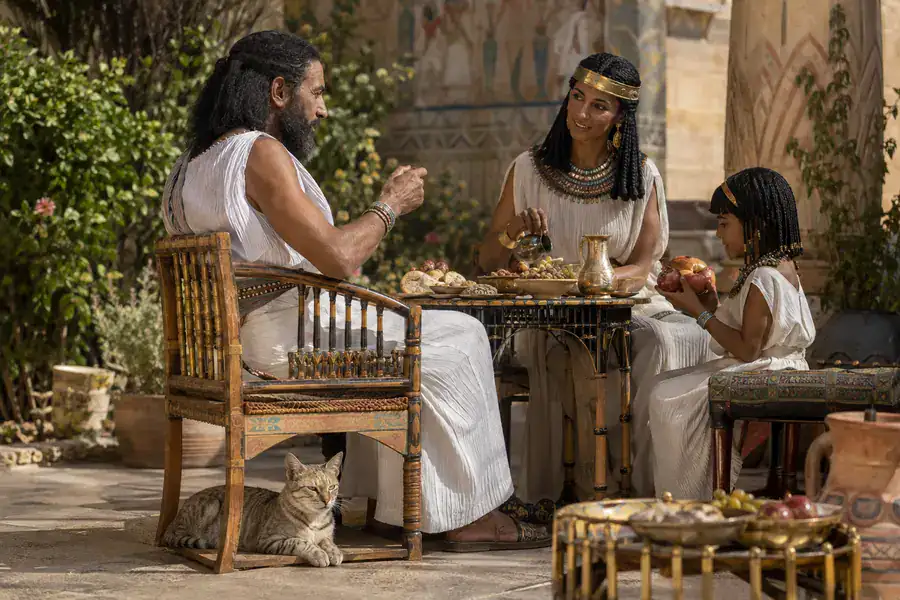
Egyptian art gradually began to show cats beneath chairs, beside food and accompanying people during leisure activities. These images suggest familiarity and affection. However, viewers should not read them exactly like modern family photographs. Instead, tomb scenes often expressed ideals: comfort, abundance, protection and a successful life that the deceased hoped to continue in the next world.
Were Cats Pets in Ancient Egypt?
Some cats clearly lived in close association with people and were fed, decorated or shown beneath chairs. Yet the modern category of “pet” does not perfectly describe every ancient relationship. A cat could be useful, affectionate, symbolically protective and partly free-ranging at the same time. Household cats probably moved between human spaces and the surrounding environment more freely than many indoor pets do today.
What Did Ancient Egyptian Cats Look Like?
Art often shows slender cats with long legs, pointed faces, upright ears and striped or spotted coats. These images resemble the African wildcat and early domestic forms more than many modern breeds. Artists followed conventions, so coat markings in a tomb scene cannot always be read as a precise biological portrait. Selective breeding into today’s many recognized breeds happened much later.
Why Cats Became Protectors of the Home
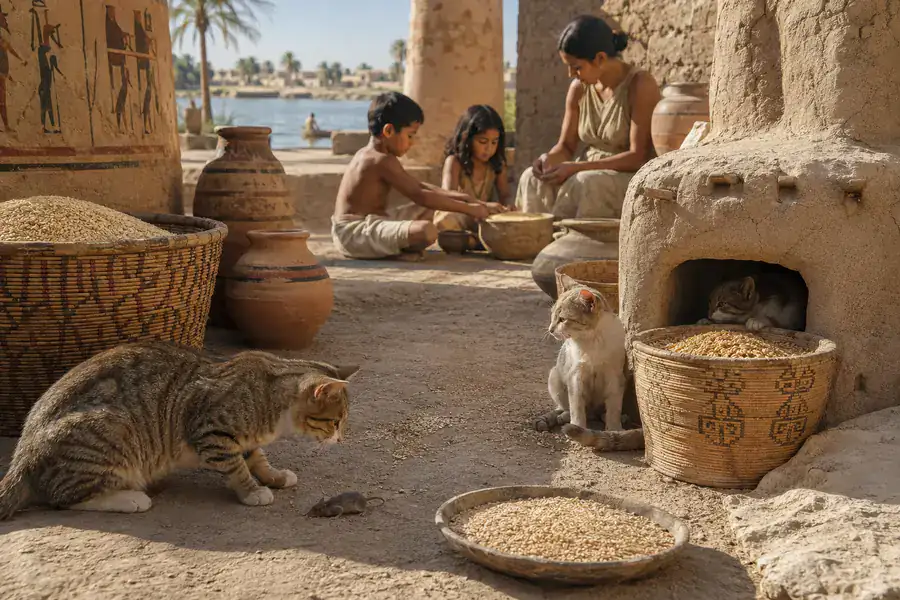
Grain was the foundation of Egypt’s economy. It fed families, paid workers and supported temples and the state. Rodents threatened that wealth, so cats earned a natural place near granaries and kitchens. Their ability to confront small snakes strengthened their image as alert guardians.
Did Cats Really Protect Egypt’s Grain?
Cats are capable hunters of mice and rats, so their presence around food stores was useful. However, grain protection depended on much more than cats: storage design, sealed containers, cleaning and human supervision all mattered. The image of the cat as “guardian of every granary” is plausible but often exaggerated. Their practical value helps explain human tolerance, while religious meaning developed through a much broader cultural process.
Cat Names, Sounds and Family Affection
Egyptologists commonly connect the words miw for a male cat and miwt for a female with the animal’s voice. This has encouraged the charming idea that Egyptians named cats simply by imitating a “meow.” However, people used the word as a normal term for the animal, while individual cats could also receive personal names.
One famous royal cat connected with Prince Thutmose carried the name Ta-Miu. Her decorated stone sarcophagus depicts her with offerings and divine figures, revealing that an elite animal could receive elaborate funerary treatment. Nevertheless, such exceptional evidence does not describe the experience of every household cat.
How Do We Recognize Affection in Egyptian Art?
Cats appear close to owners, beneath chairs or participating in leisure scenes. Jewelry and collars on cat images may signal beauty, protection and status. These details suggest affection, but tomb art represented an ideal eternal household rather than an ordinary snapshot. Archaeologists therefore combine art with burials, inscriptions and animal remains before drawing conclusions about daily behavior.
Bastet: The Goddess Behind the Sacred Cat
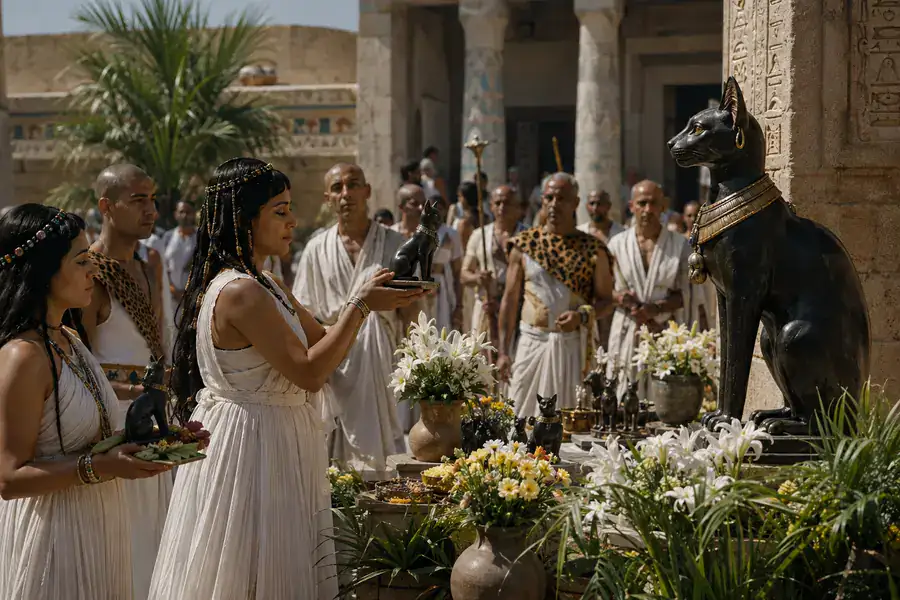
Bastet was a powerful goddess of Lower Egypt whose principal cult center stood at Per-Bastet, the city known to the Greeks as Bubastis. Her character developed over time. Earlier traditions could give her a lioness form and fierce protective power; later images more often presented her as a cat or cat-headed woman associated with protection, motherhood, fertility, music and celebration.
The gentler domestic cat did not erase the dangerous side of feline divinity. Bastet remained capable of defending the household and the king. Her relationship with the lioness goddess Sekhmet shows how Egyptians could imagine feline power as both nurturing and destructive.
The Egyptian cat symbolized a perfect balance: affectionate within the home, alert against danger and fierce when protection was required.
From Lioness to Domestic Cat
Bastet’s identity changed over Egypt’s long history. Earlier representations could emphasize lioness power, while later images increasingly presented her as a domestic cat or a cat-headed woman. This was not a simple replacement of a violent goddess with a gentle one. Bastet continued to protect the king, women, children and households, and protection could require dangerous force.
Bubastis and the Festival of Bastet
Bubastis, ancient Per-Bastet in the eastern Nile Delta, was the goddess’s principal cult center. Greek author Herodotus later described crowds traveling by boat to a famous festival with music, celebration and offerings. However, Herodotus viewed Egypt as an outsider, so readers should approach his account critically. Even so, it confirms the wide fame of Bastet’s cult.
Archaeological work at Bubastis has uncovered temple remains, statues and large quantities of animal material. Pilgrims could dedicate bronze figures or mummified cats as permanent acts of devotion. Similar practices took place at other religious centers, showing that Bastet’s influence extended far beyond one Delta city.
Bastet and Sekhmet: Were They the Same Goddess?
They were distinct goddesses but shared feline qualities and could overlap in theology. Sekhmet was usually lioness-headed and embodied destructive heat, warfare, disease and healing power. Bastet was strongly associated with Lower Egypt, protection, fertility, music and the home. Egyptian religion allowed deities to share attributes without becoming completely identical.
Ancient Egyptian Cats in Tomb Paintings
Some of the most memorable Egyptian images show a cat beneath its owner’s chair. In such scenes, the animal belongs within an ordered and prosperous household. Cats also appear in marsh-hunting scenes, where they may retrieve birds or leap among reeds.
One famous example comes from the Theban tomb of Nebamun, where a cat participates in a dynamic bird hunt. The image combines observation with symbolism: the cat is a skilled hunter, but its role may also reinforce the triumph of order over the chaotic forces of the marsh.
Travelers interested in these scenes can explore the artistic world of ancient Thebes through our Luxor travel guide and learn more about the royal necropolis in the Valley of the Kings.
The Cat in Nebamun’s Hunting Scene
The painted cat in the tomb-chapel of Nebamun is unusually dynamic. It catches birds among papyrus reeds while Nebamun dominates the marsh. The cat’s eye contains gilding, giving it extraordinary visual intensity. Whether the animal represents a real trained hunting companion, a symbol of solar or divine protection, or both remains debated.
Cats Beneath Chairs
In New Kingdom banquet and family scenes, a cat may sit beneath a woman’s chair. The placement connects the animal with domestic intimacy, femininity, fertility or protection. Sometimes the cat eats fish or looks outward attentively. Repeated artistic placement suggests meaning beyond decoration, but scholars remain cautious about assigning one universal interpretation.
Bronze Statues of Ancient Egyptian Cats
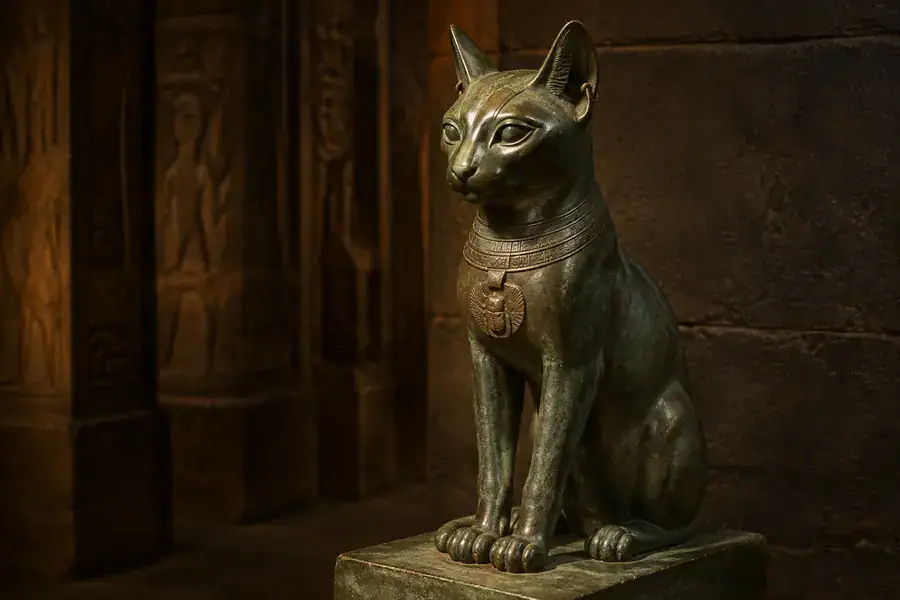
From the Late Period onward, bronze cat statuettes became common votive offerings. Many sit upright with the tail wrapped neatly along the body. Pierced ears once carried earrings, while collars and amulets emphasized beauty, prosperity and protection.
These objects were not simply decorative portraits of pets. Worshippers dedicated them in temples, sometimes to request divine help and sometimes to give thanks. The celebrated Gayer-Anderson cat at the British Museum is among the finest surviving examples.
How Were Bronze Cat Statues Made?
Craftspeople cast many figures in copper alloys using molds or lost-wax techniques. Next, they added engraved fur, collars, scarabs or protective amulets. They could also inlay the eyes and place metal earrings in pierced ears. Sizes ranged from small votive figures to large hollow statues that could contain animal remains.
The alert seated pose—with front legs straight and tail curled beside the body—communicated controlled power. These were ideal sacred cats, not casual portraits. Their decoration linked beauty with divine protection, while inscriptions could identify the donor or invoke Bastet.
Why Are So Many Cat Statues from Late Period Egypt?
Animal cults grew dramatically during the first millennium BCE. As a result, temples received enormous numbers of votive offerings from pilgrims. Workshops therefore produced cat statuettes at different levels of quality: some are masterpieces, while others served as affordable religious objects for dedication rather than elite display.
Why Did Egyptians Mummify Cats?
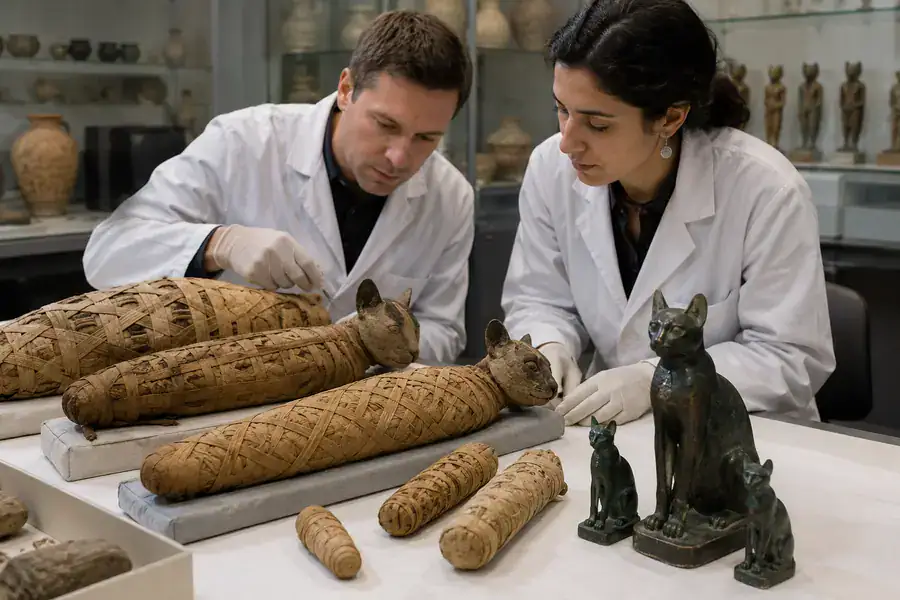
Archaeologists have discovered large numbers of cat mummies at sites such as Bubastis and Saqqara. Many functioned as votive offerings: a worshipper paid temple specialists to prepare and dedicate a mummified animal to Bastet. Therefore, the offering created a permanent act of devotion.
This practice supported temple workshops and breeding networks. Modern scanning has shown that not every bundle contains a complete cat; some contain partial remains or packing material. That variation reveals the enormous scale and complicated economy of the animal-mummy industry.
At Saqqara, animal catacombs form part of a much wider sacred landscape that includes pyramids, tombs and temples spanning thousands of years.
How Was a Cat Mummy Prepared?
Preparation varied. A cat might be dried, treated with resins or oils, wrapped in linen and arranged into a recognizable form. Some bundles display complex geometric bandaging and painted faces. Others are simple packages. The cost and care probably depended on period, workshop, purchaser and intended destination.
What CT Scans Revealed Inside Cat Mummies
X-rays and CT scans allow researchers to study bundles without unwrapping them. Some contain complete cats; others contain selected bones, more than one animal or mainly linen and packing. These variations do not all have the same explanation. They may reflect different grades of offering, limited supplies, workshop practices or deception within a large religious market.
Were Cats Killed for Mummification?
Evidence from age profiles and injuries indicates that temple suppliers deliberately bred and killed many cats to meet votive demand. This can disturb modern readers. However, the practice belonged to a religious system in which the animal became a sacred messenger and permanent offering. Not every cat mummy had the same history, so researchers assess each specimen separately.
The Temple Economy Behind Sacred Cats
Animal cults required breeders, food, embalmers, linen, resin, metalworkers, scribes, priests, sellers and catacomb workers. A pilgrim’s small offering therefore supported a large chain of labor. The millions of animal mummies known from Egypt reveal devotion on an industrial scale and show how religion shaped local economies.
How Egyptian Cats Spread Across the Ancient World
Ships carrying grain and other goods naturally attracted rodents, making cats useful travelers. Ancient DNA research suggests that cats connected with Egypt spread widely during the Classical period through maritime and terrestrial networks. Phoenician, Greek, Roman and other trading communities helped move cats around the Mediterranean and beyond.
This expansion did not mean that every European or Asian cat descended from one sacred Egyptian animal. Different wildcat populations contributed to domestic lineages. Egypt’s special role was cultural and biological: its cats achieved enormous prestige and became part of a later wave of dispersal.
Did Egyptians Ban the Export of Cats?
Popular stories claim that exporting cats was strictly forbidden and that officials were sent abroad to recover stolen animals. Ancient writers preserve dramatic tales about Egyptian reverence for cats, but modern retellings often present them as universal laws without enough evidence. Cats clearly did leave Egypt, whether through trade, transport, gifts or uncontrolled movement.
Ancient Egyptian Cats: Myths and Facts
Where Can You See Ancient Egyptian Cats Today?
Travelers can explore the wider world of sacred animals at Saqqara, where animal catacombs belonged to an enormous religious landscape. Bubastis in the Nile Delta preserves the setting of Bastet’s principal cult, although its remains are less visually complete than Egypt’s great stone temples.
The Egyptian Museum and the Grand Egyptian Museum hold objects that illuminate daily life, religion and animal symbolism. International collections—including the British Museum and The Metropolitan Museum of Art—display celebrated bronze cats, Bastet figures, mummy containers and related objects. Museum displays change, so visitors should check current galleries before traveling.
What to Notice in a Cat Statuette
- The upright ears and alert seated posture.
- The tail wrapped neatly along one side.
- Pierced ears that may once have held earrings.
- Collars, wedjat-eye pendants, scarabs and images of Bastet.
- Hollow construction that may once have contained animal remains.
- Incised stripes recalling the coat of a real cat.
Why Ancient Egyptian Cats Still Fascinate Us
Their story brings daily life, religion, art and archaeology together. Ancient Egyptian Cats guarded food, shared domestic spaces, embodied Bastet’s protective power and became offerings intended to last forever. They were not simply pets and not simply gods—they occupied a remarkable place between the household and the divine.
Frequently Asked Questions About Ancient Egyptian Cats
Why were cats important in Ancient Egypt?
They hunted rodents, lived close to families and appeared in art. Moreover, Egyptians strongly connected them with the protective goddess Bastet.
Did Ancient Egyptians worship cats?
Egyptians worshipped deities such as Bastet, who could take feline form. They valued ordinary cats highly and sometimes considered them sacred; however, they did not worship every cat as an individual god.
Why did Egyptians make cat mummies?
Worshippers purchased cat mummies and dedicated them to Bastet as votive offerings in temples and animal necropolises.
Did Ancient Egypt domesticate the cat?
Egypt played a major role in the cat’s cultural importance and later spread. Nevertheless, domestication developed gradually from Near Eastern and North African wildcat populations.
Which goddess took the form of a cat?
Later artists commonly showed Bastet as a cat or cat-headed woman. Furthermore, Egyptians connected her with protection, prosperity, fertility, music and celebration.
Did Egyptians kill cats to make mummies?
Evidence indicates that suppliers deliberately bred and killed many cats for the votive-mummy industry. However, individual mummies have different histories.
What did ancient Egyptian cats look like?
Art frequently shows slender, long-legged cats with pointed faces and striped or spotted coats resembling African wildcats and early domestic cats.
Where can visitors see Ancient Egyptian cat art?
Egyptian and international museums display cat statues and tomb scenes. Meanwhile, Saqqara and Bubastis preserve important archaeological contexts.
Research and Further Reading
- The Gayer-Anderson Cat — British Museum
- Late Period cat statuette — The Metropolitan Museum of Art
- Cat-headed Bastet — The Metropolitan Museum of Art
- Cat statuette intended to contain a mummy — The Met
- The palaeogenetics of cat dispersal in the ancient world — Nature Ecology & Evolution
- Genetics of randomly bred cats and domestication — Heredity
Plan Your Trip
Tell us your dates and travel wishes. Our local team will prepare a private Egypt itinerary for you.