
Imagine visiting a hospital more than 3,000 years ago. There are no microscopes, X-rays, antibiotics or modern surgical equipment. Yet patients are examined, wounds are treated, broken bones are set and medical cases are carefully recorded. This is a glimpse into the remarkable world of Ancient Egyptian Medicine.
Was Ancient Egyptian Medicine Advanced?
Ancient Egyptian medicine was advanced for its time because physicians recorded symptoms, examined patients, classified injuries, prepared medicines and recognized when a condition could not be treated. It was not modern science: effective observation existed beside remedies that were symbolic, ineffective or potentially harmful. Its real importance lies in the combination of written case studies, practical experience and religious healing.
The World’s First Known Physicians
Ancient Egypt produced some of the earliest named physicians in history. Medicine developed into a specialized profession: surviving records refer to doctors concerned with eye diseases, digestive disorders, dental problems and conditions of the head.
Imhotep, better known as the architect associated with the Step Pyramid at Saqqara, was later remembered as a healer and scholar. His reputation became so powerful that later generations honored him as a divine patron of medicine.
Different Kinds of Healers
The surviving titles reveal a medical world more varied than a single profession. A swnw is usually translated as physician. Other healers included priests of Sekhmet and specialists associated with Serqet, the goddess invoked against snake and scorpion venom. The boundaries between these roles were probably flexible: practical treatment, medicine preparation and protective words could all belong to the same healing encounter.
Some physicians carried senior titles such as “chief physician,” suggesting organization and professional rank. Texts also mention specialists connected with the eyes, teeth, abdomen and other parts of the body. We should not imagine a modern hospital department, but specialization shows that Egyptian healers recognized the value of concentrated experience.
Was Peseshet the First Female Doctor?
Peseshet, who lived during the Old Kingdom, held a title often translated as “overseer of female physicians.” She is frequently celebrated online as the world’s first named female doctor. The inscription is important evidence for women and healing, but its exact meaning remains debated. It may identify her as a physician, an administrator of women healers or both. The safest conclusion is that women participated in healthcare even though official titles preserve only a small part of their work.
How Did Ancient Egyptian Doctors Learn?
Medical knowledge was transmitted through apprenticeship, written instructions and institutions connected with temples. Egyptian sources mention the Per Ankh, or “House of Life,” a center where scribes copied and preserved religious, scholarly and technical texts. Not every House of Life was a medical school in the modern sense, but these institutions helped protect specialist knowledge.
A trainee needed more than the ability to memorize recipes. Medical case texts demonstrate habits of observation: look at the patient, ask questions, touch the injury, note movement or pain, identify the condition and choose a response. Experience with wounds, childbirth, animals, plants and food also contributed to practical knowledge that was not always written down.
Ancient Egyptian Medicine Written on Papyrus
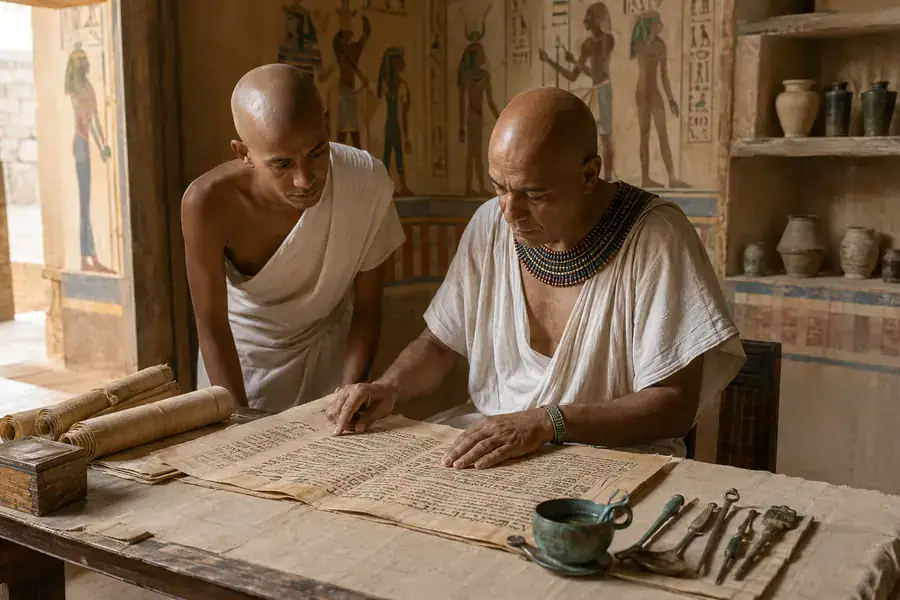
The Ebers Papyrus contains hundreds of prescriptions for digestive complaints, skin conditions, parasites and other illnesses. The Edwin Smith Papyrus is even more striking because it describes traumatic injuries through a practical sequence: examination, diagnosis, prognosis and treatment.
The Most Important Ancient Egyptian Medical Papyri
| Medical Text | Main Subjects | Why It Matters |
|---|---|---|
| Edwin Smith Papyrus | Head, neck and upper-body injuries; fractures and wounds | Preserves 48 cases organized around examination, diagnosis, prognosis and treatment. |
| Ebers Papyrus | Internal complaints, skin, eyes, digestion, parasites and hundreds of remedies | One of the largest surviving collections of Egyptian medical knowledge. |
| Kahun Gynecological Papyrus | Fertility, pregnancy and women’s health | Provides rare evidence for the diagnosis and treatment of female health concerns. |
| Hearst Papyrus | Urinary problems, bites, wounds and prescriptions | Shows how recipes circulated and overlapped between different manuscripts. |
| London Medical Papyrus | Skin conditions, burns, eye complaints and pregnancy | Clearly demonstrates the close relationship between remedies and incantations. |
These papyri were not all written at the same moment, and the surviving copies may preserve knowledge that is much older than the manuscripts themselves. They also do not represent every healer or every region of Egypt. Their value comes from allowing us to hear the logic of ancient practitioners in their own technical language.
Examination, Diagnosis and Prognosis
The Edwin Smith Papyrus is compelling because it often reads like a practical manual rather than a list of mysterious cures. A case may begin by identifying an injury, continue with instructions for examining it, describe what the physician feels or observes, name the condition and end with treatment or prognosis.
Cases were grouped into three broad outcomes: an ailment the physician would treat, an ailment the physician would fight or manage, and an ailment for which nothing could be done. That final category is especially revealing. It shows that Egyptian practitioners sometimes recognized the limits of intervention instead of promising a cure for every patient.
What Did a Medical Examination Include?
- Observing the wound, swelling, color and position of the body.
- Touching an injury to identify heat, movement, hardness or pain.
- Asking the patient to move limbs or report symptoms.
- Checking breathing, consciousness and—in some contexts—the pulse.
- Watching the condition over several days before changing treatment.
This was not laboratory medicine, but it was disciplined bedside observation. The method is one reason the papyrus remains important in the history of trauma care.
Surgery and the Birth of Trauma Medicine
Egyptian physicians treated cuts, drained abscesses, stabilized fractures and managed severe injuries suffered by farmers, builders, sailors and soldiers. Archaeology has revealed knives, probes, hooks and other instruments that could support practical procedures.
The Edwin Smith Papyrus describes skull fractures, neck injuries and spinal trauma in remarkable detail. Meanwhile, healed fractures observed in mummies show that many patients survived serious accidents after their bones had been stabilized with splints and bandages.
Observation came first: examine the injury, identify its severity, then decide whether to treat, monitor or acknowledge that nothing more could be done.
What Could Egyptian Healers Actually Do?
They could clean and dress wounds, bring wound edges together, use linen bandages, stabilize broken bones and apply preparations intended to control bleeding or protect damaged tissue. Some tools resemble knives, probes and forceps, but identifying an object as “surgical” does not prove exactly how it was used. Claims about complex operations should therefore be treated cautiously.
Surviving bodies sometimes show fractures that healed with reasonable alignment. This does not prove that every patient received expert care, but it demonstrates that recovery from serious injury was possible. Construction sites, farms, boats and military campaigns created constant demand for trauma treatment.
The Secret Power of Honey
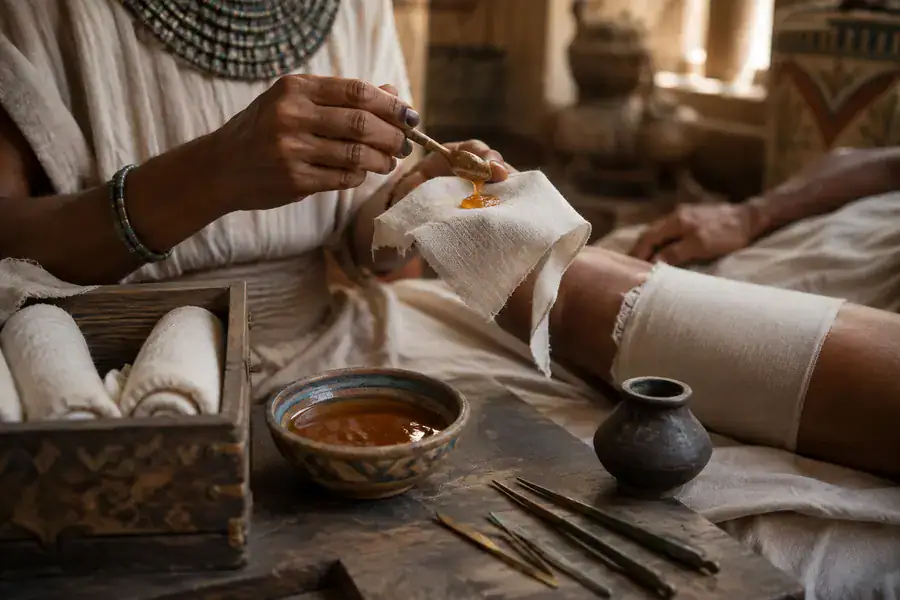
Egyptian healers frequently applied honey to wounds. Modern science helps explain why: honey’s low water activity, acidity and other properties can restrict the growth of certain bacteria. The ancient treatment was not a modern antibiotic, but it could create a more protective environment for healing.
Plants, Minerals, Animal Products and Beer
Egyptian prescriptions drew on the world around them. Ingredients included honey, oils, fats, resins, natron, salts, herbs, fruits and plant fibers. Beer, wine, milk or water could serve as a liquid base. A remedy might be swallowed, rubbed on the skin, placed on a wound, used as a wash or inhaled as vapor.
Some ingredients had useful properties. Honey can inhibit certain bacteria; linen created a physical dressing; willow contains compounds related to later pain-relieving drugs; and pomegranate root contains substances that can affect intestinal worms. Other recipes were unlikely to work, and a few ingredients may have caused irritation, infection or poisoning.
How Were Prescriptions Measured?
Medical texts give instructions for grinding, mixing, heating, straining and administering ingredients. Quantities could be expressed as fractions of a standard measure. This indicates repeatable preparation, although variations in plant strength, contamination and dosage would have made results unpredictable. The presence of a precise recipe should not automatically be mistaken for proof of effectiveness.
Women’s Health, Pregnancy and Childbirth
Women’s healthcare appears in papyri concerned with fertility, pregnancy, menstruation, contraception and childbirth. The Kahun Gynecological Papyrus organizes complaints and remedies related to women’s health. Some treatments were physical preparations, while others relied on ritual protection or theories that linked symptoms in different parts of the body to the womb.
Pregnancy tests described in later traditions included watering barley and emmer with urine and observing whether the grain sprouted. Modern experiments have produced mixed interpretations, so this should not be presented as a reliably accurate ancient laboratory test. Its importance lies in the attempt to use an observable physical response to answer a medical question.
Childbirth Was Both Medical and Sacred
Pregnancy and delivery were dangerous. Women could rely on experienced attendants, household knowledge, amulets and deities such as Taweret and Bes. Birth bricks may have supported a squatting position during labor and also carried protective imagery. Practical assistance and religious protection were not competing systems; families could use both at the same time.
Ancient Egyptian Dentistry: Pain Hidden in Bread
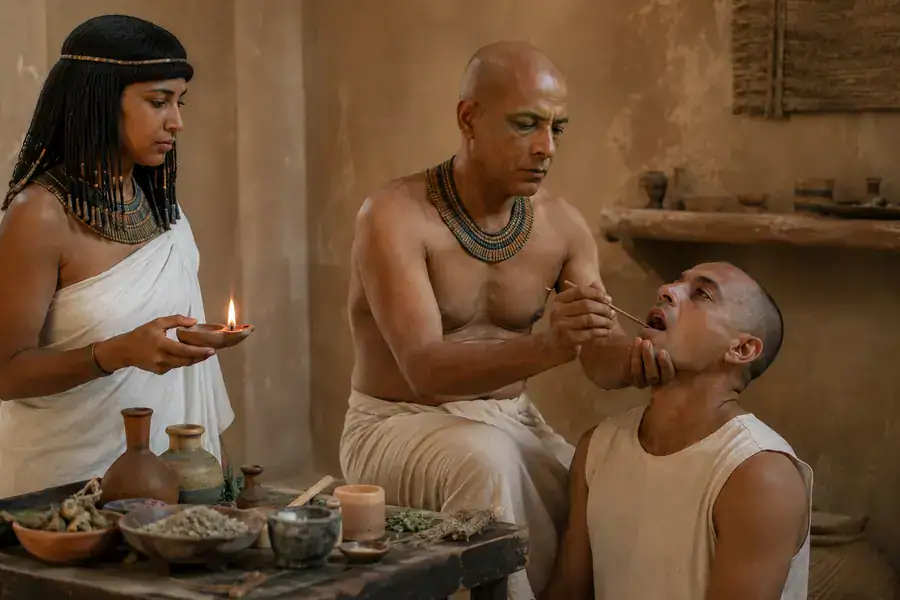
Bread was central to Egyptian life, but grinding grain on stone introduced tiny particles of sand and grit into flour. Over many years, this abrasive material wore down teeth. Mummies reveal severe tooth wear, abscesses, gum disease and tooth loss.
Medical texts describe mixtures of honey, herbs and minerals intended to ease pain and inflammation. They could not replace modern dentistry, yet they show that healers recognized oral disease and attempted to relieve suffering.
Could Ancient Egyptians Fill Teeth?
Popular articles sometimes describe sophisticated dental fillings or routine dental surgery, but the evidence is limited and disputed. Dental disease is abundant in mummies, while clear evidence for successful operative dentistry is rare. Egyptian healers probably focused more often on easing pain, treating inflammation and managing damaged tissue than repairing teeth in the modern sense.
Disease, Parasites and the Risks of Daily Life
The Nile made Egyptian civilization possible, but river and irrigation environments also exposed communities to parasites and infections. Modern examination of mummies and ancient biological material has identified evidence of parasitic disease, while medical texts describe symptoms that may relate to intestinal worms and urinary illness. Retrospective diagnosis must remain cautious because an ancient description rarely matches a modern disease name perfectly.
Daily work created other health problems. Farmers suffered cuts, back strain and contact with animals. Stone workers inhaled dust and risked crushing injuries. Soldiers faced arrows, blades and fractures. Stone-ground flour introduced grit into bread, accelerating tooth wear. Smoke from lamps and cooking fires may have irritated eyes and lungs.
Diet: Nourishment and Disease
Bread and beer supplied much of the daily diet, supported by vegetables, dates, figs, fish and occasional meat depending on wealth and location. Malnutrition affected some communities, yet elite Egyptians could also suffer from excessive weight and cardiovascular disease. Ancient Egypt therefore presents no single picture of health: occupation, status, age, sex and local environment all shaped the body.
Mummification and Knowledge of the Human Body
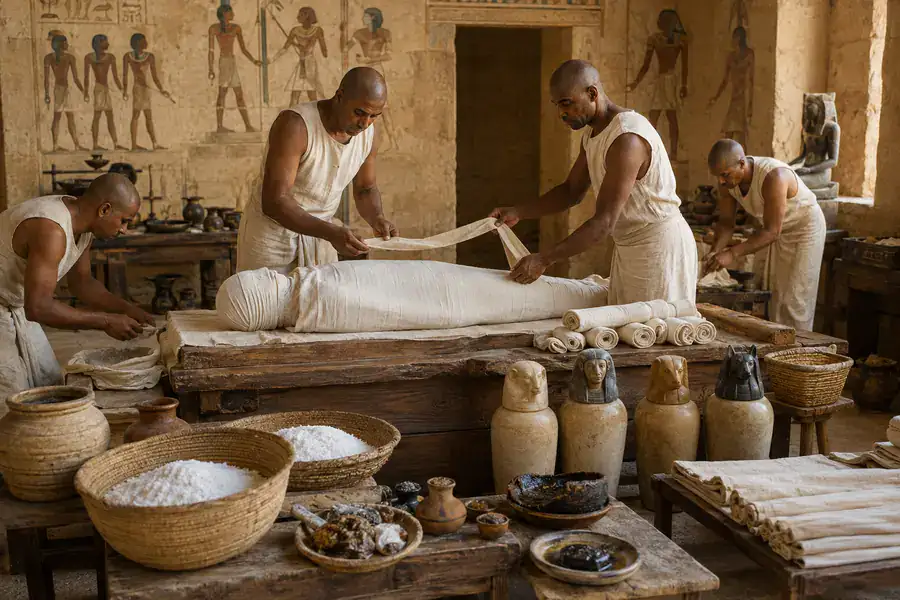
Mummification in Ancient Egypt placed embalmers in direct contact with the human body. They removed selected organs, dried the body with natron and used resins and linen to preserve it. However, embalmers and physicians did not necessarily belong to the same profession, so historians avoid claiming that mummification automatically created a modern understanding of anatomy.
Even so, preserved bodies now provide extraordinary medical evidence. Teeth, bones, arteries and tissues allow researchers to study ancient injuries and diseases thousands of years later. Travelers can explore the process, tools and materials more closely at the Mummification Museum in Luxor.
The Heart, Pulse and the Egyptian Map of the Body
Egyptian medical thought placed great importance on the heart. Some texts connect the pulse felt in different parts of the body with the heart’s activity. This was an impressive observation, but Egyptians did not possess a modern understanding of blood circulation.
They described networks called metu, a word translated in different contexts as vessels, channels, cords, muscles or tendons. These channels could carry blood, air, tears, urine, semen or harmful substances in ancient theory. The concept combined real anatomical observation with ideas that do not match modern physiology.
Why Was the Heart Left Inside the Mummy?
The heart was central not only to life but also to identity, memory and moral judgment. During mummification it was normally left in the body because the deceased needed it for the judgment of the afterlife, when the heart was weighed against the feather of Maat. Medical and religious meanings therefore overlapped around the same organ.
Eye Disease and Protective Cosmetics
Eye complaints were common enough to attract specialist attention. Dust, sunlight, insects and infection all threatened vision. Medical papyri contain washes and ointments for the eyes, while kohl cosmetics had social, religious and practical roles. Dark eye paint reduced glare, and some mineral mixtures may have offered limited antimicrobial effects, although unsafe preparations could also damage the eye.
The Eye of Horus became one of Egypt’s most powerful protective symbols. An eye treatment could therefore combine an applied remedy with spoken protection. To an Egyptian patient, the physical and sacred actions belonged to one complete system of healing.
Medicine and Magic Working Together
Ancient Egyptians did not separate practical medicine and spiritual belief in the way many people do today. A wound might receive honey and linen while protective words were spoken. Physical and supernatural explanations could coexist in the same treatment.
This does not make every remedy scientific. Nevertheless, the clinical observations preserved in several papyri prove that careful examination and experience also played a major role in healing.
What Modern Science Has Discovered
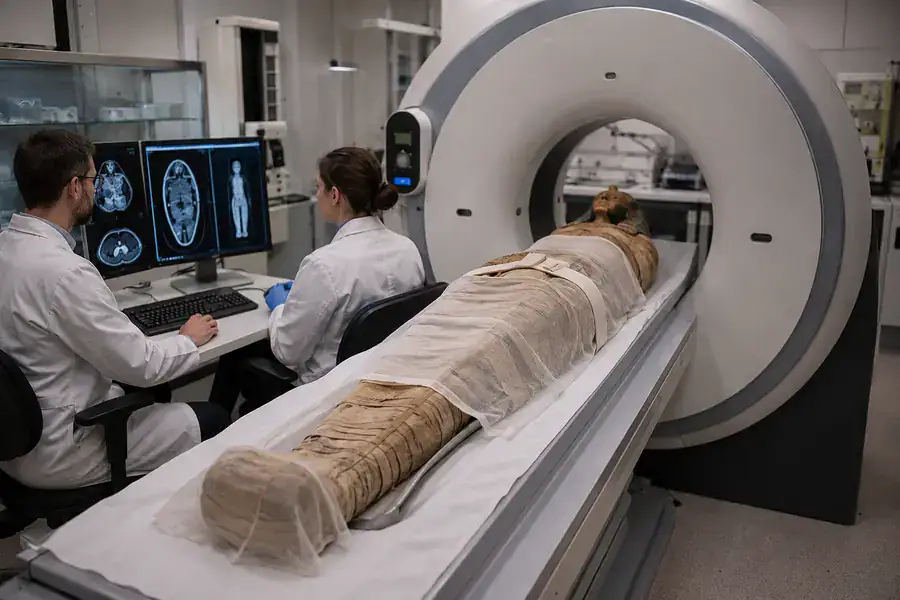
CT scanning, medical imaging and laboratory analysis now allow specialists to examine mummies non-invasively. Researchers have identified evidence of fractures, arthritis, dental disease, infections, parasites and cardiovascular conditions.
These discoveries let historians compare ancient descriptions with physical evidence. They also show that disease was not simply a modern phenomenon: Egyptian patients faced complex health problems, and their physicians developed thoughtful responses with the knowledge available to them.
How Scientists Study Ancient Egyptian Health
Researchers combine archaeology, translated papyri, skeletal analysis, microscopy, chemical testing and medical imaging. CT scans reveal bones, teeth, calcified arteries and some preserved organs without unwrapping a mummy. DNA and pathogen research can be valuable but faces serious challenges from contamination and the preservation conditions of ancient material.
No single method tells the whole story. A papyrus records what a scribe believed or copied; a mummy records changes in one individual’s body; an artifact shows the tools or substances available. Strong conclusions emerge when several forms of evidence agree.
Ancient Egyptian Medicine: Myths and Facts
The Legacy of Egyptian Medicine
Egyptian healing knowledge continued to circulate during the Late, Ptolemaic and Roman periods. In multicultural centers such as Alexandria, Egyptian traditions existed beside Greek medical theory and practice. It is difficult to trace every remedy directly from one culture to another, but Egypt’s written medical heritage formed part of the wider ancient Mediterranean search for explanations and treatments.
The most important legacy is not the claim that Egyptians invented modern medicine. It is the evidence that healers more than three millennia ago recorded cases, compared symptoms, used specialist knowledge and distinguished between conditions they could treat and those they could not. That disciplined attention to the patient remains recognizable today.
Was Ancient Egyptian Medicine Ahead of Its Time?
Not every treatment worked, and religion remained deeply involved in healing. Yet specialization, written case studies, trauma assessment, splints, wound care and careful observation were remarkable achievements. Ancient Egyptian Medicine was not modern medicine—but in several important ways, it was unquestionably ahead of its time.
Frequently Asked Questions About Ancient Egyptian Medicine
Who were the doctors in Ancient Egypt?
Egyptian physicians included general healers and specialists associated with particular conditions or parts of the body. Imhotep later became the most celebrated medical figure in Egyptian tradition.
Did Ancient Egyptians perform surgery?
They treated wounds, used sutures, managed fractures and described traumatic injuries. Their procedures were limited compared with modern surgery, but their clinical observations were remarkable.
Why did Egyptian doctors use honey?
Honey was applied to wounds. Modern research confirms that honey can restrict the growth of some bacteria and help create a protective environment for healing.
Did mummification teach Egyptians anatomy?
Embalmers handled internal organs, but they were not necessarily physicians. Mummification provides important evidence about the body, although historians avoid claiming it created modern anatomical science.
What were the most important Egyptian medical papyri?
The Edwin Smith, Ebers, Kahun, Hearst and London medical papyri are among the most important surviving sources. They cover trauma, prescriptions, internal complaints, women’s health and ritual healing.
Did Ancient Egyptians have medical specialists?
Yes. Surviving titles refer to physicians connected with particular organs or conditions, as well as chief physicians, priests of Sekhmet and healers associated with venomous bites.
Was Peseshet the first female doctor?
Peseshet held a title often translated as overseer of female physicians. She is important evidence for women in healing, but scholars continue to debate whether the title identifies her as a practicing physician, an administrator or both.
Which ancient Egyptian remedies actually worked?
Honey, linen dressings and some plant ingredients could have useful effects. However, effectiveness depended on preparation and dosage, and many remedies were ineffective, symbolic or potentially harmful.
Research and Further Reading
- The Edwin Smith Papyrus: a clinical reappraisal — NIH
- Traditional Ancient Egyptian Medicine: a review — NIH
- CT scanning the mummy of Nesmin — The Metropolitan Museum of Art
- Canopic jars and mummification — The Metropolitan Museum of Art
- The Art of Medicine in Ancient Egypt — The Metropolitan Museum of Art
- Healing titles in Ancient Egypt — UCL Digital Egypt
Plan Your Trip
Tell us your dates and travel wishes. Our local team will prepare a private Egypt itinerary for you.