
Mummification in Ancient Egypt was a changing combination of craft, ritual and theology developed over thousands of years to preserve the dead and transform them for eternal life. Egyptian embalmers removed moisture, treated vulnerable tissues, applied oils and resins, wrapped the body in linen and performed ceremonies that restored the deceased’s divine identity. The familiar “seventy-day process” describes a complete elite funeral schedule rather than one rigid recipe followed in every century or for every person.
How Did Ancient Egyptian Mummification Work?
In its best-documented form, embalmers washed the deceased, removed selected organs, usually left the heart in place, dehydrated the body with natron, treated and packed the cavities, anointed the skin with complex balms, wrapped the body with linen and protective amulets, then placed it in coffins. Priests completed funerary rites such as the Opening of the Mouth. Methods varied by period, wealth, region and the condition of the body, so no single sequence describes every Egyptian mummy.
Mummification in Ancient Egypt at a Glance
| Primary goal | Preserve and ritually transform the deceased for continued existence in the afterlife |
|---|---|
| Best-known divine protector | Anubis, associated with embalming and the necropolis |
| Usually preserved in the body | The heart, treated as the center of thought, identity and moral judgment |
| Usually removed in elite New Kingdom practice | Brain, lungs, liver, stomach and intestines, although methods varied |
| Main drying material | Natron, not ordinary table salt |
| Protective materials | Linen, resins, oils, waxes, amulets, masks, coffins and ritual texts |
| Key caution | There was no unchanged universal recipe for all Egyptians or all periods |
What Was Mummification in Ancient Egypt?
The English word “mummy” ultimately derives through Latin and Arabic from a term associated with bitumen, a dark substance once wrongly assumed to explain every mummy’s black appearance. However, ancient Egyptians did not define a mummy simply as a dried corpse. Their procedures aimed to create an enduring, ritually effective body in which the deceased could regain identity, receive offerings and participate in divine life.
Therefore, preservation mattered because death separated parts of the person and threatened the integrity of the body. Embalming reversed that disorder. Embalmers purified, dried, reassembled, protected and wrapped the corpse until it resembled a sacred image. Texts and rituals identified the deceased with Osiris, the god whose murder, restoration and regeneration promised renewed life. Consequently, mummification was both practical treatment and a religious transformation.
Moreover, not every preserved body resulted from the full elite procedure. Egypt’s hot, dry sand could desiccate shallow burials naturally. Later embalmers deliberately reproduced and controlled dehydration while adding complex ritual layers. Archaeologists therefore distinguish natural preservation, intentional mummification and the many intermediate treatments found across Egyptian history.
History of Mummification in Ancient Egypt
Predynastic Origins and Early Experiments
Preserved bodies appear in Egypt long before the pyramids. Initially, Predynastic communities buried the dead in contracted positions in shallow desert graves, where direct contact with dry sand could remove moisture quickly. Moreover, scientific analysis has detected complex embalming substances on prehistoric Egyptian funerary textiles, showing that intentional treatments began earlier than older textbook timelines suggested.
Later, during the Early Dynastic Period and Old Kingdom, tomb architecture increasingly separated bodies from drying sand. Craftspeople experimented with linen, plaster modeling, resins and evisceration. Results were uneven. Old Kingdom remains may preserve an impressive external shape while the tissues inside survived poorly.
Meanwhile, Middle Kingdom embalmers expanded organ treatment, wrapping and resin use, although quality still varied. By the New Kingdom—especially the 18th to 21st Dynasties—royal and elite mummification reached extraordinary technical sophistication. The body could be carefully reshaped, skin treated, cavities packed, facial features restored and each finger or limb wrapped separately.
Subsequently, Later Period practitioners continued to innovate. Some placed organs back inside the body as wrapped packages, used more resin or bitumen, and created elaborate cartonnage cases. During Ptolemaic and Roman rule, external presentation could become exceptionally ornate even when internal preservation was less meticulous. Painted mummy portraits in Roman Egypt joined an Egyptian funerary tradition with Mediterranean portrait styles.
Why Preserve the Body? Ka, Ba, Name and Akh
For example, popular summaries often say that the body was “the permanent home of the ka.” However, Egyptian ideas were more complex. In addition, a person consisted of interconnected aspects. The ka represented life force and received nourishment through offerings. Similarly, the ba, often shown as a human-headed bird, expressed mobility and personality and could move between tomb and living world. Finally, the akh was an effective, transfigured state achieved through correct burial, ritual and moral order.
In addition, the name, shadow, heart and physical remains also preserved identity. Tomb inscriptions repeated names because destruction of a name threatened remembrance. Images and statues could serve as alternative bodies, while food offerings sustained the dead symbolically and ritually. Mummification belonged to this larger system rather than working alone.
Most importantly, the heart had special importance because Egyptians linked it with thought, memory, character and conscience. In the famous judgment scene from the Book of the Dead, the judgment scene shows divine powers weighing the heart against the feather of Maat. This helps explain why embalmers usually left it in the chest or restored it if displaced, while the brain did not receive comparable funerary emphasis.
Who Performed Mummification in Ancient Egypt?
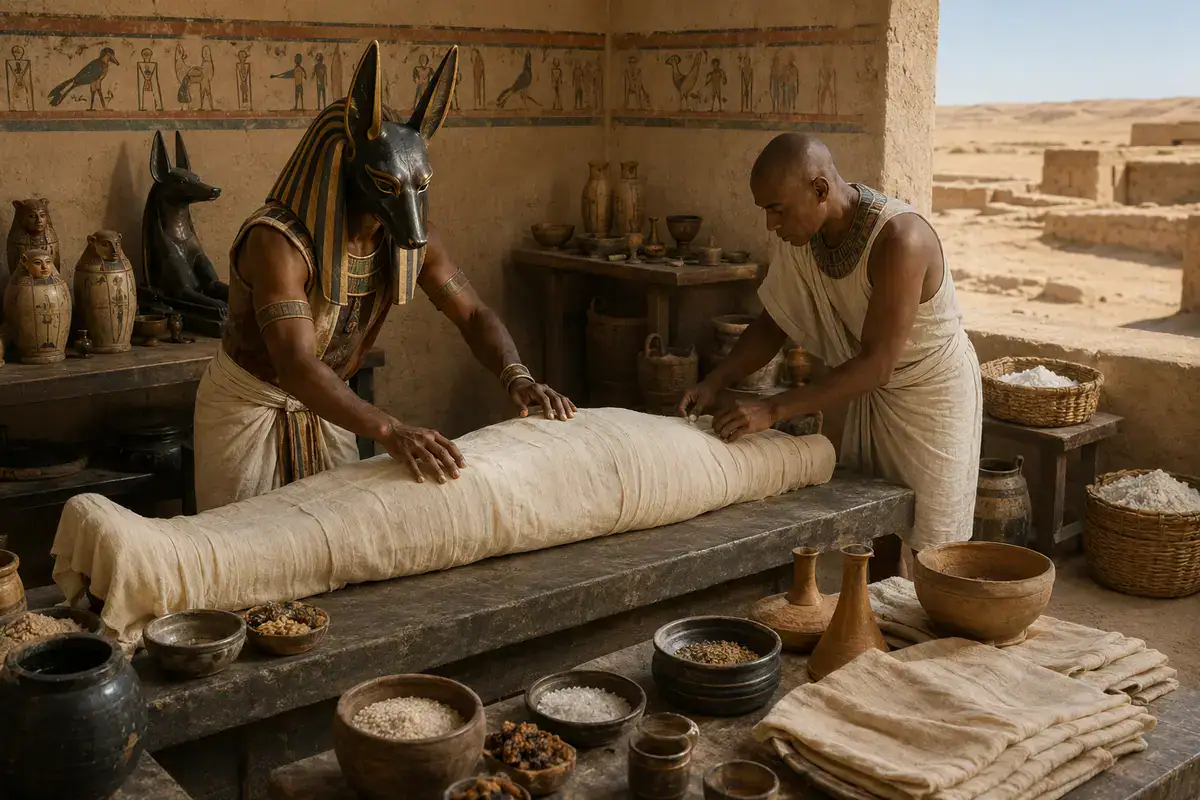
In practice, specialists combined manual skill with priestly knowledge. Furthermore, sources mention titles connected with purification, sealing, bandaging and ritual recitation. The hery-sesheta, “master of secrets,” held a senior role and monuments could show wearing or using the identity of Anubis. The wet-priest and other assistants handled practical and ceremonial tasks, although titles and responsibilities changed over time.
Meanwhile, embalming probably took place in purpose-built installations near desert cemeteries rather than in a “House of Life.” The Per-Ankh, or House of Life, was mainly an institution of scribal, ritual and scholarly knowledge. Terms such as wabt, a place of purification, and per-nefer, associated with embalming, are more appropriate for the funerary workspace, though their exact architecture and functions remain debated.
Notably, excavations at Saqqara have uncovered embalming facilities and labeled vessels that connect particular substances with procedures and body parts. These discoveries reveal organized supply networks, recipes and professional knowledge. Embalmers needed linen, natron, imported resins, oils, containers, tools, amulets and access to ritual texts—making a high-quality funeral an important economic undertaking.
Mummification in Ancient Egypt: The Process Step by Step
To begin with, much of the familiar sequence comes from archaeological evidence, medical imaging and Greek writers such as Herodotus and Diodorus, who described Egyptian practices from their own periods. Nevertheless, their accounts are valuable but researchers cannot project unchanged onto every dynasty. The following reconstruction best fits well-equipped elite embalming, particularly in the New Kingdom and later.
Reception, Purification and Planning
First, the body entered the embalming place, where specialists washed and purified it. Next, the family selected a level of treatment, coffin equipment and funerary services. Meanwhile, ritual mourning and preparation began while craftspeople produced or completed objects for the burial.
Removal of the Brain
First, in many later elite mummies, embalmers inserted an instrument through the nose, perforated the thin ethmoid region and disrupted brain tissue for removal. However, CT scans show that techniques varied: some brains were incompletely removed, approached through different routes or left in place. Claims about sophisticated suction pumps go beyond surviving evidence.
Evisceration Through the Left Flank
Next, a cut commonly made in the left abdomen allowed removal of organs that decayed quickly. In addition, the lungs, liver, stomach and intestines received separate treatment. However, the kidneys were often left, perhaps because of their deep location. Embalmers generally preserved the heart in the body.
Cleaning the Body Cavities
Embalmers cleaned and treated the chest and abdomen. For example, ancient accounts mention palm wine and spices, while chemical evidence reveals changing mixtures of fats, oils, waxes and resins. Nevertheless, we should avoid imagining a modern sterile operation; the goal was dehydration, fragrance, ritual purity and protection against decomposition.
Dehydration with Natron
Embalmers placed natron around—and probably within—the body to draw out water. Specifically, a commonly cited period is about forty days of drying within a total seventy-day funeral schedule, although individual mummies and textual sources show variation. Consequently, the dry body became lighter, darker and more resistant to microbial decay.
Packing and Reconstructing the Body
Next, after dehydration, specialists removed residual natron and restored volume with linen, resin-soaked materials, sawdust, mud, plant matter or other packing, depending on period and status. For instance, artificial eyes, pads beneath the skin and carefully arranged limbs could recreate a lifelike appearance.
Anointing with Balms and Resins
Then, embalmers applied substances that perfumed, sealed and protected tissues. However, recipes varied greatly. For example, plant oils, animal fats, beeswax, Pistacia resin, conifer resins and, especially in later periods, bitumen are among materials identified scientifically.
Wrapping with Linen and Amulets
Next, workers wrapped limbs and body in many layers, sometimes coating linen with resin to secure it. Meanwhile, priests recited spells while placing protective amulets at meaningful locations. A mask or modeled face helped preserve identity.
Coffining, Ritual and Burial
Finally, the mummy entered one or more coffins and sometimes a stone sarcophagus. Subsequently, funerary ceremonies culminated near the tomb, and offerings, shabtis, vessels and other equipment supported the deceased’s transformed existence.
Organs and Canopic Jars in Mummification in Ancient Egypt
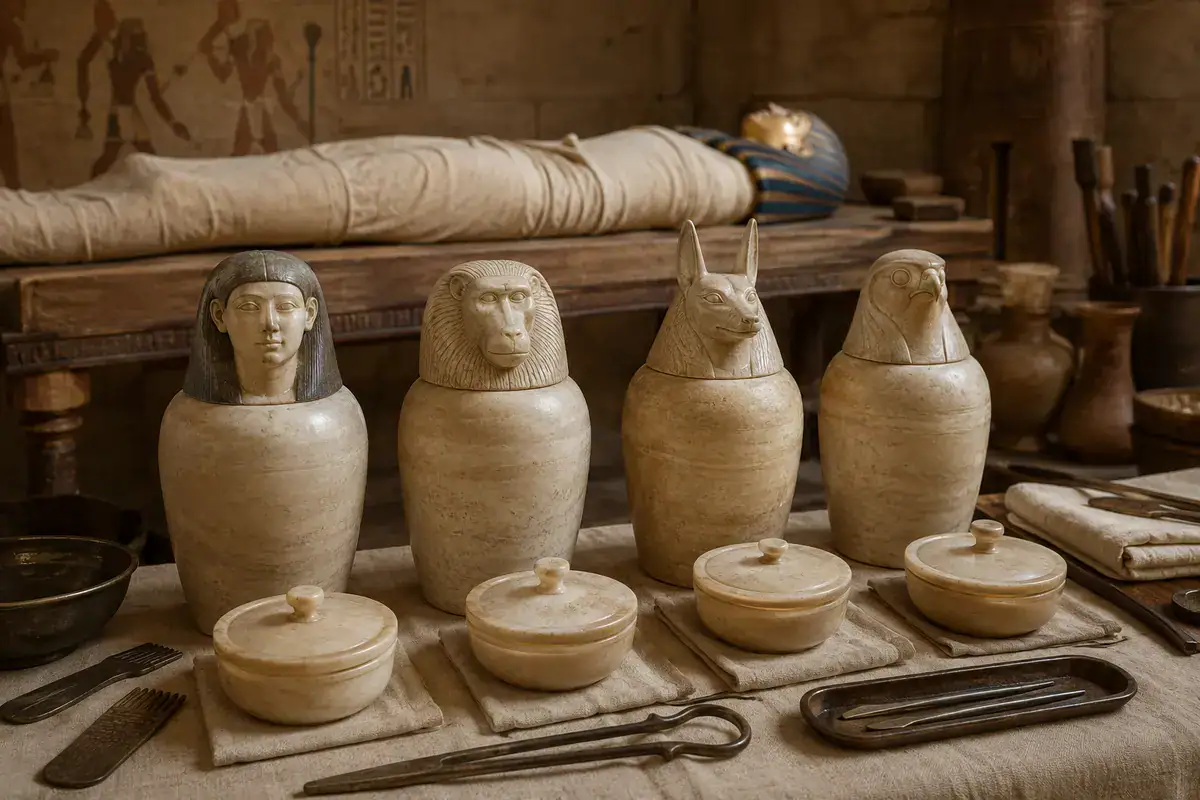
Importantly, the organs did not simply become medical waste. They remained necessary parts of the deceased and received preservation, wrapping and divine protection. For example, from the New Kingdom, canopic jar lids commonly represented the four Sons of Horus, each linked with an organ and a protective goddess.
| Son of Horus | Typical Head | Protected Organ | Protective Goddess |
|---|---|---|---|
| Imsety | Human | Liver | Isis |
| Hapy | Baboon | Lungs | Nephthys |
| Duamutef | Jackal | Stomach | Neith |
| Qebehsenuef | Falcon | Intestines | Selket |
However, the system was not static. At first, canopic equipment had different forms. Later, during the 21st Dynasty, embalmers often returned individually wrapped organ packages to the body while still supplying symbolic or “dummy” jars. Therefore, the presence of four jars does not always prove that they contained organs.
By contrast, the heart normally remained because it embodied intellect and moral identity. Heart scarabs sometimes carried a spell asking the heart not to testify against its owner at judgment. By contrast, the brain was usually discarded after removal, although some mummies retained all or part of it.
Natron in Mummification in Ancient Egypt
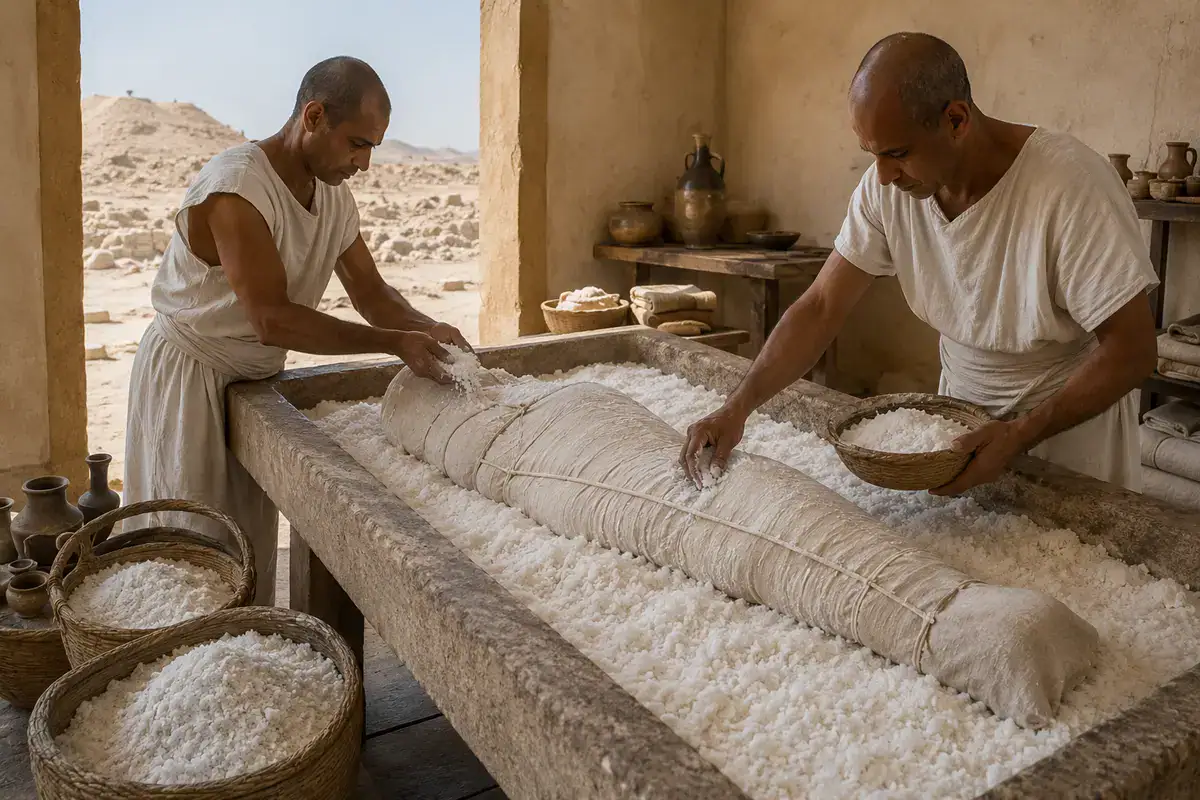
Chemically, natron is a natural evaporite mixture dominated by sodium carbonate and sodium bicarbonate, with sodium chloride and sodium sulfate. Deposits formed in dry lake environments such as Wadi Natrun. Its alkaline, moisture-absorbing properties made it far more useful than ordinary salt for preserving tissues.
As a result, dehydration limits the water required by microorganisms and slows the chemical processes of decay. Moreover, natron helped dissolve fats and create an alkaline environment unfavorable to many microbes. Embalmers applied dry natron rather than preserving the body in a liquid bath—the image of soaking a corpse in “natron solution” is generally misleading for the classic process.
However, the entire funeral is traditionally given as seventy days, a duration supported by textual traditions. Yet that does not mean seventy days under natron. For example, some reconstructions assign roughly forty days to dehydration and the remaining time to anointing, wrapping, ritual and preparation. Nevertheless, individual evidence ranges, and modern writers should present exact day-by-day schedules cautiously.
The Chemistry of Mummification in Ancient Egypt
Above all, ancient embalmers did not rely on one secret formula. For example, chemical analyses identify mixtures selected for scent, ritual value, antibacterial or antifungal properties, flexibility, adhesion and sealing. Therefore, ingredients changed with date, workshop, status and trade access.
| Material | Possible Practical Role | Important Qualification |
|---|---|---|
| Plant oils and animal fats | Carried aromatic ingredients and conditioned tissues | Exact botanical source is often difficult to determine after centuries of degradation |
| Beeswax | Sealing, water resistance and symbolic associations | Used in selected contexts, not necessarily on every mummy |
| Pistacia and conifer resins | Fragrance, antimicrobial action and adhesive sealing | Some resins came through long-distance trade |
| Bitumen | Dark protective coating and sealing | Especially common in later periods; it did not create every mummy’s dark color |
| Gums and aromatic substances | Binding, scent and ritual purification | Ancient words do not always map neatly onto modern chemical names |
A 2023 biomolecular study of residues from the embalming workshop of Saqqara matched labeled vessels with mixtures containing juniper or cypress products, cedar, Pistacia, animal fats and other ingredients. In addition, another study of 18th Dynasty noblewoman Senetnay’s canopic equipment identified exceptionally complex balms and demonstrated Egypt’s access to materials from beyond the Nile Valley.
Consequently, these findings reveal skilled empirical knowledge and international trade, but calling the process “advanced chemistry” should not imply modern molecular theory. Embalmers learned through accumulated craft, observation, ritual tradition and workshop transmission.
Linen Wrapping, Amulets and Mummy Masks
First, wrapping physically held the treated body together and ritually recreated wholeness. For instance, linen came from clothing, household textiles, temple supplies and cloth produced for burial. Notably, some wrappings bear laundry marks or inscriptions, reminding us that textiles were valuable and frequently reused.
Furthermore, methods ranged from simple shrouds to intricate bandaging. Elite mummies might have fingers and toes wrapped individually, pads added to model contours, resin applied between layers and a final shroud secured with bands. Later mummies sometimes display geometric patterns made with narrow strips.
In addition, amulets protected vulnerable parts and supplied divine powers. The wedjat eye offered healing and completeness; the djed pillar conveyed stability; scarabs supported rebirth; Egyptians associated the tyet knot with Isis; and heart scarabs addressed judgment. Placement, material and spell could matter as much as shape.
Finally, masks and coffins preserved the idealized face and name. A famous gold mask such as Tutankhamun’s was exceptional, not typical. Most people who received masks used cartonnage, wood, plaster or other materials appropriate to their means.
The Opening of the Mouth and Other Funerary Rituals
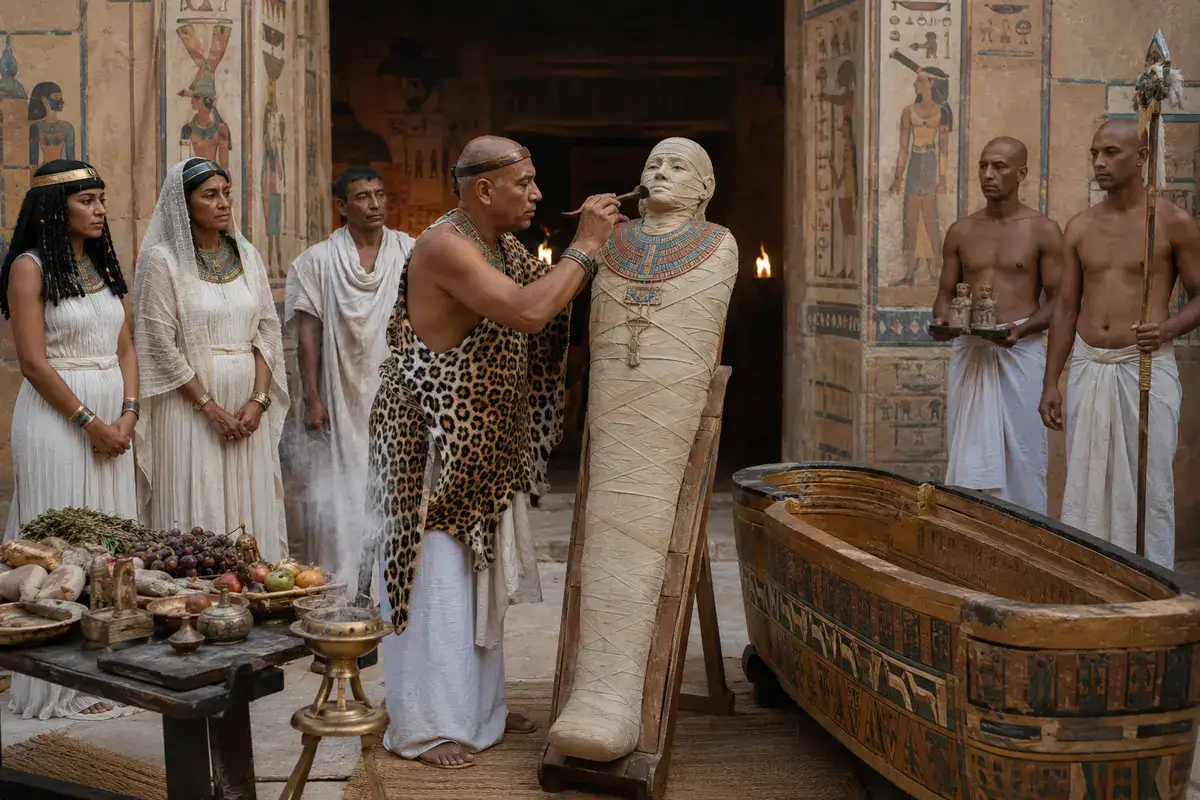
At the end of the process, the Opening of the Mouth ceremony restored the deceased’s capacity to breathe, speak, see, hear and receive offerings. A sem-priest and other ritualists touched the mummy or statue with specialized implements, including an adze-shaped tool, while reciting prescribed words. Moreover, the rite drew on temple practices used to animate divine images.
Meanwhile, mourning women could embody Isis and Nephthys, who protected and restored Osiris. In addition, incense purified the space; libations cooled and refreshed; food offerings maintained the ka. Finally, processions carried the coffin toward the tomb, sometimes crossing the Nile to the western necropolis, where sunset symbolized entry into the realm of the dead.
Furthermore, Books of the Dead were not one fixed book but selections of spells adapted for individuals. Earlier Pyramid Texts and Coffin Texts had served royal and elite contexts. Spells helped the dead navigate dangers, transform into powerful forms, join the solar cycle and emerge by day.
Embalming preserved tissue; ritual transformed that preserved body into a participant in eternal, divine life.
Why Did Egyptians Mummify Animals?
Beyond human burials, millions of animal mummies came from Egyptian sites. They served different purposes that we should not collapse into the idea of “pets buried with owners.” For example, some beloved pets did receive careful burials. In addition, other animals represented sacred individuals maintained in temples, such as the Apis bull. Finally, vast numbers served as votive offerings presented to gods associated with a species.
Specifically, ibises and baboons related to Thoth, cats to Bastet, crocodiles to Sobek, raptors to Horus and Anubis-related canids appeared in temple cults. However, X-rays and CT scans reveal whole animals, partial animals and packages containing selected bones, feathers or plant material. Variation may reflect price, ritual convention, availability or ancient fraud, depending on context.
Today, animal mummies help researchers study ecology, breeding, trade, pilgrimage and temple economies. Isotope and DNA studies can investigate where animals lived and how populations changed. The British Museum’s research emphasizes that these remains are not curiosities but major evidence for Egyptian religious and social life.
Famous Egyptian Mummies and What They Teach Us
Royal Mummies and Historical Identification
- Ramesses II: his mummy, found in the royal cache DB320, preserves an elderly ruler and became central to scientific and conservation studies.
- Hatshepsut: Egyptian researchers identified KV60A as the likely mummy of Hatshepsut, partly through a tooth associated with a box bearing her name. The identification is influential but writers should still describe as probable rather than beyond all dispute.
- Tutankhamun: discovered in KV62 in 1922, his mummy remained in its tomb. CT imaging and genetic studies transformed discussion of his health, family and death, although some conclusions remain contested.
- Seqenenre Taa: CT studies documented severe head wounds, illuminating the violent conflict preceding the expulsion of the Hyksos.
- The “Screaming Woman” and other unidentified mummies: imaging can reveal age, disease and embalming choices even when a historical name is uncertain.
- Priests of Amun and elite families: caches and cemeteries show how methods changed across generations and how ancient priests moved royal mummies to protect them from robbery.
Today, ethical standards increasingly emphasize respectful terminology, minimal disturbance and the humanity of the deceased. Mummies are human remains, not merely museum objects. Non-invasive imaging allows researchers to learn while reducing physical intervention.
How Modern Science Studies Egyptian Mummies
First, radiography allowed researchers to see bones and amulets without unwrapping. Next, CT scanning creates detailed slices and 3D reconstructions of skeleton, soft tissues, teeth, packing materials and injuries. In addition, endoscopy can inspect limited internal areas, while conservation imaging maps surfaces and hidden layers.
Furthermore, histology examines tissue microscopically. Similarly, stable isotopes contribute evidence about diet and geographic origin. However, ancient DNA can explore biological relationships and pathogens, although Egyptian heat, contamination and earlier handling make reliable recovery difficult. Finally, chemical methods such as gas chromatography–mass spectrometry identify oils, fats, waxes, resins and bitumen.
Together, these technologies reveal atherosclerosis, dental disease, healed fractures, arthritis, parasites and traumatic injuries. However, scans rarely provide a single certain “cause of death.” However, many diseases leave no skeletal mark, and postmortem damage can imitate injury. Therefore, responsible studies separate observation from diagnosis and probability from proof.
Ancient Egyptian Mummification: Myths and Facts
Common Misconceptions About the Mummification Process
| Popular Claim | What the Evidence Supports |
|---|---|
| Mummification began in the Old Kingdom. | Natural preservation and intentional treatments have much earlier Predynastic roots. |
| Every mummy took exactly seventy days to make. | Seventy days describes a traditional funerary period; stages and durations varied. |
| The body soaked in liquid natron for seventy days. | Classic elite practice used dry natron for dehydration, likely for only part of the total schedule. |
| Embalmers worked in the House of Life. | The House of Life was a learned institution; wabt and per-nefer are more relevant embalming terms. |
| Embalmers used an advanced pump to remove the brain. | Instruments disrupted and removed brain tissue through the nose in many cases; surviving evidence does not securely demonstrate specific suction technology. |
| Embalmers kept the heart because it contained the soul. | The heart embodied thought, memory and moral identity and was important at judgment; Egyptian concepts of the person included several components. |
| All organs always went into canopic jars. | Practices changed; embalmers could return organs to the body, while jars could become symbolic. |
| Embalmers coated all black mummies only with bitumen. | Resins, oxidation and aging also darkened tissues; bitumen use varied and became more common later. |
| Egyptians mummified only pharaohs. | People across social levels received different forms of preservation according to resources and period. |
| A mummy’s appearance reveals an exact cause of death. | Modern imaging can identify conditions and injuries, but many causes remain uncertain. |
| A mummy’s curse killed tomb explorers. | No scientific evidence supports supernatural curses; the legend grew through media and popular culture. |
Timeline of Mummification in Ancient Egypt
| Period | Development |
|---|---|
| Predynastic Period | Desert sand naturally preserves bodies; evidence indicates early intentional use of embalming mixtures on textiles. |
| Early Dynastic Period | Wrapping and body treatments develop as tomb architecture reduces direct contact with sand. |
| Old Kingdom | Elite practitioners experiment with evisceration, linen, resin and modeling; results vary. |
| Middle Kingdom | Organ preservation, masks and wrapping traditions expand. |
| New Kingdom | Royal and elite embalming reaches exceptional technical sophistication; classic canopic forms and elaborate reconstruction flourish. |
| Third Intermediate Period | Embalmers often return organ packages to the body and use extensive internal packing and restoration. |
| Late and Ptolemaic Periods | Resinous coatings, elaborate bandaging and mass production of human and animal funerary equipment increase. |
| Roman Period | Egyptian mummification continues in changing forms; painted portraits and decorated shrouds become prominent in some communities. |
| Modern era | CT, chemistry, isotopes and DNA replace destructive unwrapping as preferred research methods. |
Where Can You See Egyptian Mummies Today?
Museums and Trusted Research Collections
Because collections and displays change, so travelers should confirm current locations before visiting. In Egypt, major institutions present royal and non-royal mummies alongside coffins, canopic equipment and funerary texts.
- National Museum of Egyptian Civilization, Cairo: the Royal Mummies Hall presents a major group of New Kingdom kings and queens in a controlled, respectful setting.
- Grand Egyptian Museum, Giza: extensive funerary collections illuminate royal burial, preservation and material culture; check the current gallery program.
- Egyptian Museum, Cairo: its historic collection includes coffins, masks, papyri and objects essential for understanding the development of funerary practice.
- Mummification Museum in Luxor: a focused collection of embalming tools, materials, coffins, amulets and human and animal mummies.
- British Museum, London: the Egyptian death and afterlife galleries combine human remains with imaging and burial equipment.
- Metropolitan Museum of Art, New York: mummies, coffins, funerary models and online scholarship place preservation within Egyptian religion and art.
Therefore, a good museum visit goes beyond looking at a preserved face. Compare the body, wrappings, coffin, texts, organ containers and offerings as one funerary system. Each object explains how Egyptians imagined identity, protection and rebirth.
Trusted Sources for Mummification in Ancient Egypt
For further research, start with museum and university collections that publish evidence, object records and current interpretation. First, explore the British Museum’s Egyptian death and afterlife gallery. In addition, UCL’s Digital Egypt project explains the changing history of mummification in later Egyptian periods. Finally, its academic guide to canopic jars and preserved organs provides useful archaeological context.
Moreover, these sources show why researchers avoid one universal recipe. Workshops, materials and religious choices changed across time. Therefore, readers should compare archaeological evidence with scientific imaging and chemical analysis before accepting dramatic claims about a particular mummy.
Mummification in Ancient Egypt: Preserving a Person for Eternity
Ultimately, Egyptian mummification was never simply a method for stopping decay. It joined dehydration, anatomical knowledge, imported materials, skilled craftsmanship, prayer, mourning and theology to rebuild a person after death. Its techniques changed across three millennia and differed sharply between individuals, yet the underlying ambition remained remarkably durable: protect identity, restore wholeness and make eternal life possible. That union of material science and sacred purpose explains why Egyptian mummies continue to transform our understanding of the ancient world.
Frequently Asked Questions About Mummification in Ancient Egypt
Beliefs, Timing and Embalming Materials
Why did ancient Egyptians mummify the dead?
They sought to preserve and ritually transform the body so the deceased could retain identity, receive offerings and live effectively in the afterlife.
How long did Egyptian mummification take?
The traditional elite funerary period was seventy days, but dehydration itself probably occupied only part of that schedule and practices varied.
What is natron?
Chemically, natron is a naturally occurring mixture of sodium salts whose moisture-absorbing and alkaline properties helped dehydrate and preserve the body.
Which organs did embalmers remove?
In many elite mummies, embalmers removed the brain, lungs, liver, stomach and intestines. They usually left the heart, while kidneys often remained.
Why was the heart left inside?
Egyptians associated the heart with thought, memory, character and moral judgment. Divine powers weighed it against the feather of Maat in the afterlife.
What were canopic jars used for?
They protected preserved organs under the guardianship of the four Sons of Horus. In some periods the jars became symbolic after embalmers returned organs to the body.
Organs, Social Differences and Modern Research
Did embalmers remove the brain through the nose?
Many mummies show transnasal removal: a tool passed through the nasal cavity to disrupt and extract tissue. Methods varied, and some brains remained.
Did all Egyptians get mummified?
No. Treatment ranged from elaborate professional embalming to simple wrapping or natural desert preservation, depending on period, place and wealth.
What oils did Egyptian embalmers use?
Scientific studies identify changing mixtures of plant oils, animal fats, beeswax, Pistacia and conifer resins, aromatic substances and sometimes bitumen.
What was the Opening of the Mouth ceremony?
It was a funerary rite intended to restore the deceased’s senses and ability to breathe, speak and receive offerings in the afterlife.
Can scientists determine how every mummy died?
No. CT scans and other tests reveal disease and injury, but many causes of death leave no clear evidence and some diagnoses remain uncertain.
Where can I see royal mummies in Egypt?
The National Museum of Egyptian Civilization in Cairo is the principal home of the Royal Mummies Hall. Always check current museum displays before visiting.
See Ancient Egypt’s Mummies and Royal Tombs
Explore Cairo’s museums, Luxor and the Valley of the Kings with a private itinerary designed by our local Egyptologist team.