
Ancient Aswan Granite Quarries
The Unfinished Obelisk: History, Size & Visitor Guide
Discover the Unfinished Obelisk in Aswan, an extraordinary ancient engineering project that still reveals quarrying marks, fissures and the scale of Egypt’s largest planned obelisk.
A monument frozen in time
Why the Unfinished Obelisk Is Essential to Understanding Ancient Egypt
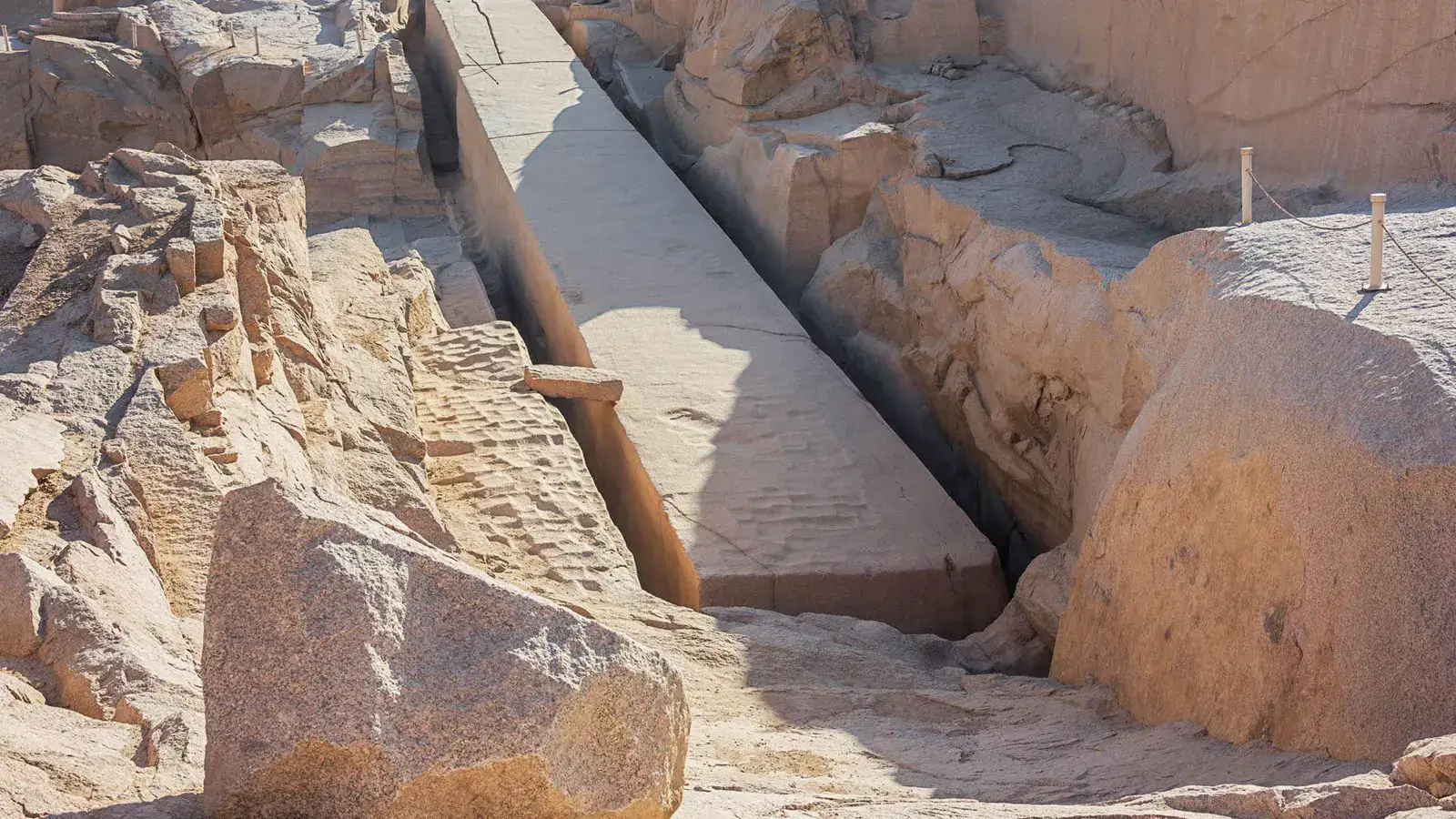
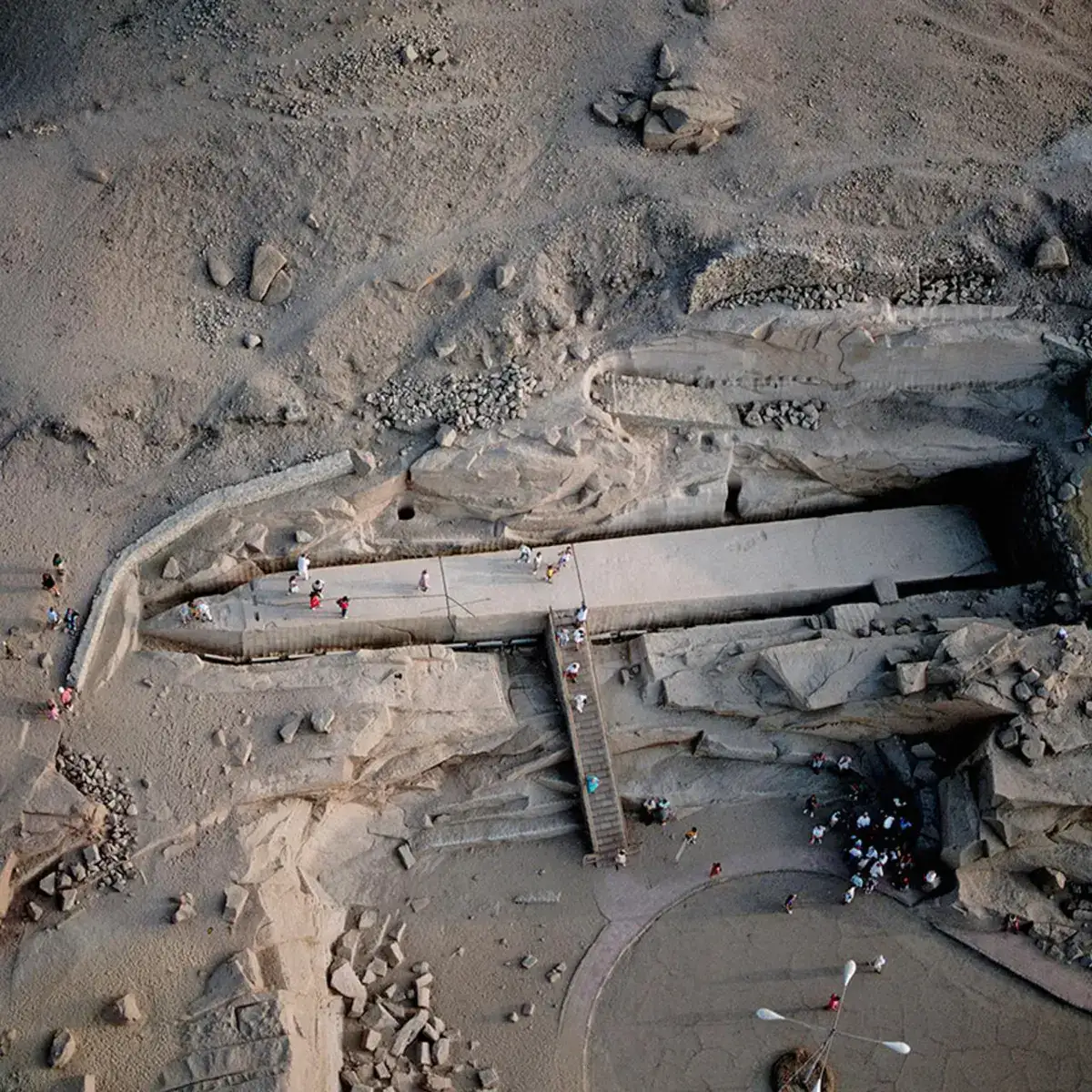
The Unfinished Obelisk lies in the northern granite quarries of Aswan. Unlike a completed monument standing before a temple, it remains attached to the bedrock where ancient workers began shaping it thousands of years ago.
Consequently, the site offers rare physical evidence for studying how Egyptians selected stone, cut trenches and shaped enormous red-granite monuments. Tool marks and fractures preserve stages of work that would normally disappear after extraction and polishing.
Why was the Unfinished Obelisk abandoned? Ancient workers stopped because flaws and several fissures appeared in the granite. Finishing or moving the cracked monolith would no longer have been practical.
The Eighteenth Dynasty
History of the Unfinished Obelisk in Aswan
The monument is generally believed to have been commissioned during the reign of Queen Hatshepsut, one of the most important rulers of Egypt’s Eighteenth Dynasty. The official Egyptian monument guide connects the project with the Temple of Amun at Karnak Temple.
Aswan’s quarries supplied durable red granite for statues, sarcophagi, architectural blocks and obelisks used throughout Egypt. Therefore, the site belonged to a much wider production landscape rather than an isolated experiment.
Sand later covered the abandoned monument for centuries. It was uncovered in the early twentieth century and remains in its original quarry today.
For official background, see the Egyptian Ministry of Tourism and Antiquities guide.
An unprecedented project
How Big Is the Unfinished Obelisk?
Had the monument been completed, it would have stood at approximately 42 metres and weighed an estimated 1,168 tonnes. In other words, it would have been taller than any other known ancient Egyptian obelisk.
Its extraordinary dimensions reveal the ambition of royal building projects during the New Kingdom. They also help visitors understand the immense challenges involved in cutting, releasing, transporting and erecting a single piece of granite.
The monument’s failure is precisely what makes it valuable: it preserves an unfinished stage of production that completed obelisks cannot show.
Ancient engineering
How Ancient Egyptians Carved the Unfinished Obelisk
Selecting the Granite
Workers first chose a suitable area of solid Aswan granite large enough for the planned monolith.
Cutting Trenches
They created deep channels around the sides, allowing teams to work progressively along the monument’s outline.
Dolerite Hammerstones
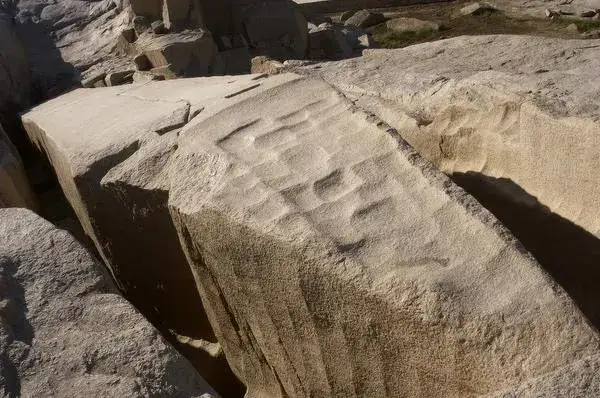
Hard dolerite pounders were used repeatedly against the granite, leaving characteristic depressions and working marks.
Monitoring the Stone
Flaws in a monolith of this scale could compromise the entire project and make later transport dangerously impractical.
Releasing the Base
A successful obelisk would eventually need to be separated underneath before leaving the quarry.
Transport and Erection
Completed monuments were moved toward the Nile and transported to temple projects such as Karnak.
Evidence on the stone
Tool Marks Around the Unfinished Obelisk
Rows of rounded depressions remain visible around the granite. These marks are commonly associated with pounding by hard dolerite stones, examples of which have been found in ancient quarry contexts.
Rather than slicing through granite in a single action, workers gradually removed material through repeated blows. Therefore, the surviving surface records an intensely physical and carefully organised process.
For visitors interested in ancient construction, this evidence makes the quarry an important complement to finished monuments described in our Ancient Egyptian Temples guide.

Why work stopped
Why Was the Unfinished Obelisk Never Completed?
Several fissures and flaws developed in the granite while the obelisk was being shaped. Because an obelisk depended on the strength of one continuous stone, a serious crack could not simply be repaired without weakening the monument.
Consequently, workers abandoned the project before fully releasing it from the bedrock. The damaged stone remained where it had been carved, preserving both the intended shape and the channels around it.
The visible fracture also gives modern visitors a direct explanation for the monument’s unfinished state, rather than leaving its abandonment to speculation.
From quarry to temple
How Would the Obelisk Have Left Aswan?
The exact route planned for this abandoned monument cannot be reconstructed with certainty. Nevertheless, completed granite monuments had to be moved from the quarry toward the Nile, loaded onto specially prepared vessels and transported to their destination.
This wider relationship connects Aswan’s stone landscape with temples farther north. At Karnak, surviving granite obelisks demonstrate what successful quarrying, transport and erection could achieve.
Visitors can combine the quarry with Philae Temple and the Aswan High Dam to compare ancient stoneworking, sacred architecture and modern engineering in one day.
Sun, kingship and sacred architecture
What Did Obelisks Mean in Ancient Egypt?
Temple Entrances
Obelisks commonly stood before temple gateways, announcing royal devotion and sacred power.
Solar Symbolism
The form was associated with solar creation and the benben, the primeval mound connected with the sun god.
Royal Commemoration
Kings inscribed obelisks with names and dedications that connected their rule with the gods.
Plan your visit
Visiting the Unfinished Obelisk in Aswan
Where is it?
The quarry lies within Aswan city, making it easy to combine with other principal attractions.
Opening hours
Hours and ticket prices can change. Check the official Ministry listing before travelling.
How long should you allow?
Most visitors allow approximately 45–60 minutes to walk around the quarry and examine the stone.
What can you combine it with?
Combine the site with Philae Temple and the High Dam on a private guided Aswan tour.
What should you wear?
Wear sturdy walking shoes because the quarry includes uneven granite surfaces, steps and exposed areas.
When should you visit?
An early visit is more comfortable in warm weather because much of the archaeological area is exposed to the sun.
Official information: Opening hours, ticket prices and visitor arrangements may change. Confirm the latest details on the Egyptian Ministry of Tourism and Antiquities page.
Ancient Granite Quarries, Aswan
Location of the Unfinished Obelisk
Quick answers
Frequently Asked Questions About the Unfinished Obelisk
Who commissioned the Unfinished Obelisk?
It is generally believed to have been commissioned by Queen Hatshepsut during Egypt’s Eighteenth Dynasty, possibly for the Temple of Amun at Karnak.
Why was the Unfinished Obelisk abandoned?
Work stopped after flaws and multiple fissures appeared in the granite, making the enormous monolith unsuitable for completion and transport.
How big is the Unfinished Obelisk?
Had it been completed, it would have stood around 42 metres high and weighed an estimated 1,168 tonnes.
Is the Unfinished Obelisk still attached to the rock?
Yes. The monument remains partly attached to the original granite bedrock inside the ancient Aswan quarry.
What tools were used to carve the granite?
Ancient workers used hard dolerite pounding stones to remove granite gradually, leaving characteristic marks visible around the monument.
How long does a visit take?
Most visitors allow about 45–60 minutes, depending on walking pace and how closely they want to study the quarrying evidence.
Can I visit the obelisk with Philae Temple and the High Dam?
Yes. These three attractions combine naturally in a private Aswan sightseeing tour with transport, guiding, tickets and the boat to Philae.
Explore Ancient Aswan
Visit the Quarry, Philae Temple and the High Dam
See the Unfinished Obelisk with a private Egyptologist, then continue to Aswan’s most important ancient and modern landmarks.