
The Dendera Zodiac is one of the most extraordinary surviving images of the ancient sky. Ancient artists carved this circular sandstone relief for an Osiris chapel within the Temple of Hathor at Dendera. Remarkably, it combines the twelve signs of the zodiac with planets, Egyptian deities, constellations and celestial events. Moreover, its design reveals how ancient Egyptians connected astronomy, religion and the divine order of the universe. The relief dates to the late Ptolemaic period. In 1821, workers removed the original from its temple setting, and it eventually entered the Louvre in Paris. However, its story still begins at Dendera in Upper Egypt, north of Luxor.
What Is the Dendera Zodiac?
The Dendera Zodiac is a circular sandstone ceiling relief from the Temple of Hathor at Dendera in Egypt. Dating to around 50 BCE, it presents the sky through a remarkable fusion of Egyptian religious imagery and zodiacal astronomy. Ancient artists created it for the Eastern Chapel of Osiris on the temple roof. Today, the Louvre Museum in Paris houses the original relief.
Dendera Zodiac: An Ancient Egyptian Map of the Heavens
The Dendera Zodiac, sometimes called the Denderah Zodiac, is a circular bas-relief that once formed part of a temple ceiling. However, it does not function like a modern star chart. Instead, it presents the heavens through the visual and religious language of ancient Egypt.
Human figures, animals, divine beings, zodiac signs and celestial symbols fill the circular composition. As a result, the artist transformed the sky into a sacred world in which astronomy and religion work together.
Why Is the Dendera Zodiac Unique?
Most importantly, the relief preserves the twelve zodiac constellations within an unmistakably Egyptian religious setting. For example, familiar forms such as Taurus, Leo, Scorpio and Capricorn appear beside Egyptian gods and celestial figures. Therefore, the monument provides an exceptional view of cultural exchange during the Ptolemaic period.
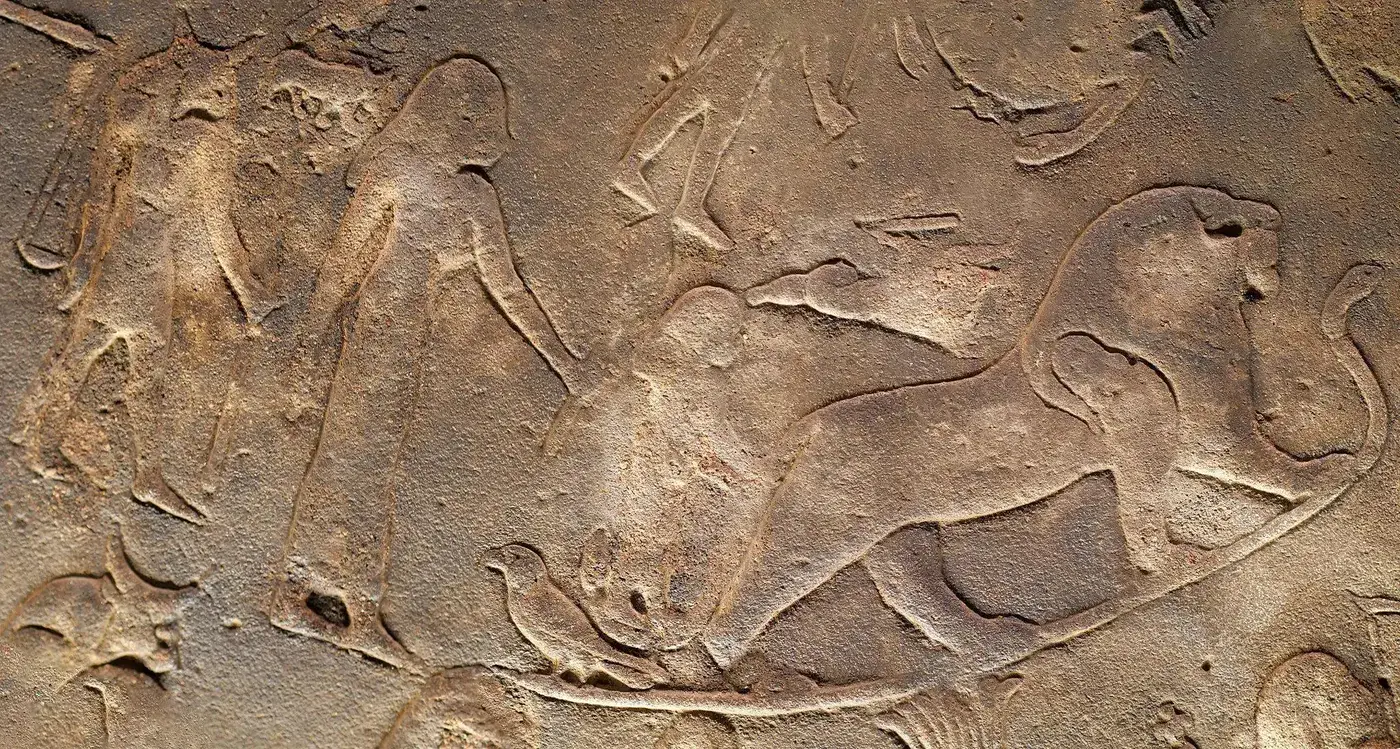
The Temple of Hathor at Dendera
To understand the Zodiac, we first need to understand its original setting. The Temple of Hathor at Dendera ranks among Egypt’s best-preserved temple complexes and stands as one of the great monuments of Upper Egypt.
Dendera lies in modern Qena Governorate, north of Luxor. Although the sacred site has a much longer history, builders created most of the surviving main temple during the Ptolemaic and Roman periods.
Who Was the Goddess Hathor?
The temple honored Hathor, one of ancient Egypt’s most important goddesses. Egyptians associated her with the sky, music, joy, motherhood, love and divine femininity. Consequently, Dendera became one of her principal cult centers.

A Temple Filled with Images of the Sky
Astronomical imagery extends far beyond the famous circular Zodiac. In fact, the ceilings and walls of Dendera contain extensive representations of stars, deities, celestial cycles and ritual scenes.
Therefore, the temple provides a much broader context for understanding the Zodiac. Ancient Egyptian religion treated the movement of the heavens as part of the divine order of the universe. Furthermore, the daily journey of the sun, the appearance of stars and the cycles of the moon connected divine power with time, rebirth and ritual.

Where Was the Dendera Zodiac Originally Located?
The original Dendera Zodiac did not occupy the main hypostyle hall. Instead, ancient builders placed it on the ceiling of a room in the Eastern Chapel of Osiris on the roof of the Temple of Hathor.
| Detail | Dendera Zodiac |
|---|---|
| Original country | Egypt |
| Original site | Temple of Hathor, Dendera |
| Original position | Eastern Chapel of Osiris on the temple roof |
| Material | Sandstone |
| Date | Late Ptolemaic period, around 50 BCE |
| Removed | April–May 1821 |
| Current location | Musée du Louvre, Paris, France |
What Remains at Dendera Today?
Today, visitors can climb toward the rooftop chapels and understand the architectural setting that once held the ancient ceiling. Moreover, a replacement marks the position of the original relief. Therefore, visiting Dendera still provides essential context that a museum display cannot reproduce.
How Old Is the Dendera Zodiac?
Scholars generally date the Dendera Zodiac to approximately 50 BCE, near the end of the Ptolemaic period. Therefore, artists created it during the final decades before Rome turned Egypt into a province of the Roman Empire.
Why Did Scholars Debate Its Age?
Early European scholars once debated whether the Zodiac might be vastly older. At that time, researchers could not yet read Egyptian hieroglyphs fully. Consequently, they tried to calculate the monument’s age by interpreting its astronomical imagery.
Later archaeological, textual and astronomical research provided much stronger evidence. As a result, scholars now place the circular relief securely in the late Ptolemaic period.
What Does the Dendera Zodiac Show?
The Dendera Zodiac presents an extraordinary visual interpretation of the heavens. However, its importance does not come from functioning as a modern scientific chart. Instead, it shows how ancient artists translated astronomical concepts into Egyptian sacred art.
The Twelve Zodiac Constellations
The relief contains the twelve constellations associated with the zodiac. Several remain recognizable to a modern viewer, although Egyptian artists adapted their forms to the temple’s visual language.
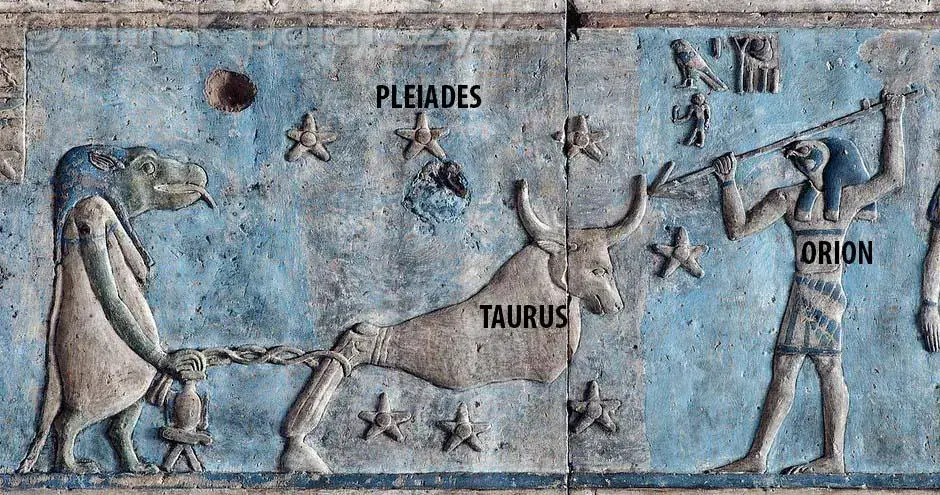
The Five Known Planets
In addition, the composition contains representations associated with the five planets visible to the naked eye and known in antiquity: Mercury, Venus, Mars, Jupiter and Saturn.
Ancient observers noticed that these wandering lights behaved differently from the fixed stars. Consequently, planets held a special place in ancient interpretations of the night sky.
Solar and Lunar Eclipses
The Zodiac also contains features that researchers interpret as a solar eclipse and a lunar eclipse. Moreover, these astronomical clues have helped scholars investigate the period in which artists designed the composition.
The Dendera Zodiac is remarkable because its heavens are not empty space: stars, planets, gods, animals and cosmic cycles all belong to one sacred universe.
Astronomy, Religion and the Egyptian Cosmos
At first, it may seem natural to view the Dendera Zodiac only as an ancient scientific object. However, that interpretation misses much of its original meaning.
For ancient Egyptians, observing the sky connected directly with religion, calendars, temple ritual and cosmic order. Therefore, celestial cycles represented more than physical movements in the heavens. They also expressed a universe governed by divine forces.
Why Does Osiris Matter?
The Zodiac stood in a chapel associated with Osiris, whose mythology centered on death, regeneration and renewed life. Consequently, celestial cycles gained additional meaning in this setting because the stars, sun and moon also followed recurring patterns of disappearance and return.
Why Are Egyptian and Greek Traditions Mixed Together?
The monument belongs to Ptolemaic Egypt. During this period, a dynasty of Macedonian Greek origin ruled Egypt, while traditional Egyptian temples, priesthoods and religious practices continued to flourish.
As a result, the Zodiac reflects a world of cultural interaction. Zodiacal forms familiar from the wider Hellenistic world appear inside an Egyptian temple. At the same time, Egyptian deities and sacred symbols surround them.
Therefore, we should not classify the relief simply as “Greek” or “Egyptian.” Instead, it demonstrates how ancient communities could adopt ideas, transform them and give them new meaning within the intellectual and religious environment of Ptolemaic Egypt.
Is the Dendera Zodiac the Oldest Zodiac in the World?
Many websites describe the Dendera Zodiac as the world’s oldest zodiac. However, that statement needs qualification.
Babylonian astronomers developed zodiacal traditions before artists created the Dendera relief. Therefore, Dendera did not invent the zodiac.
What Makes Dendera Different?
Instead, Dendera stands out because it preserves a remarkable circular monumental representation of the zodiac inside an Egyptian temple. Moreover, the relief combines zodiacal imagery with Egyptian gods and temple theology.
Consequently, it is more accurate to describe the Dendera Zodiac as one of antiquity’s most famous and important surviving representations of the complete zodiac rather than claiming that the zodiac itself began at Dendera.
The Dendera Zodiac and Napoleon’s Expedition to Egypt
European awareness of the Zodiac expanded dramatically during the French expedition to Egypt at the end of the eighteenth century.
According to the Louvre’s collection history, members of the French expedition encountered the relief at Dendera on 24 January 1799. Afterwards, Dominique-Vivant Denon published a drawing of the monument. Consequently, the strange circular ceiling quickly attracted attention across Europe.
Why Did European Scholars Become Obsessed with It?
At that time, scholars had not yet fully deciphered Egyptian hieroglyphs. Therefore, researchers hoped that recognizable astronomical symbols might offer another method for determining the age of Egyptian monuments.
As a result, the Dendera Zodiac became the center of arguments involving astronomy, archaeology, religion and biblical chronology. Moreover, its fame increased before scholars even understood many of the inscriptions surrounding it.
How Did the Dendera Zodiac Leave Egypt?
The Zodiac’s departure from Dendera remains one of the most controversial chapters in its modern history.
In 1820, French publisher and antiquities enthusiast Sébastien Louis Saulnier sent Jean-Baptiste Lelorrain to Egypt to obtain the relief and transport it to France.
The 1821 Authorization and Removal
According to the Louvre’s documented history, Muhammad Ali’s administration granted authorization through a firman dated 27 January 1821. Afterwards, workers extracted the Zodiac from the temple in April–May 1821.
Consequently, the operation permanently separated the original ancient relief from the architectural and ritual space for which Egyptian artists had created it.
Was the Dendera Zodiac Stolen?
Modern repatriation campaigns frequently describe the Dendera Zodiac as “stolen” or “looted.” However, the historical record requires more careful wording because the Louvre records an authorization for its removal in 1821.
Nevertheless, critics argue that nineteenth-century permissions do not settle today’s ethical debate. In particular, they question whether authorities should have allowed anyone to remove a monumental part of an ancient Egyptian temple.
From a Temple Ceiling in Egypt to the Louvre: The Timeline
Why Did the Dendera Zodiac Cause Such a Sensation in Europe?
The Zodiac reached Europe at a moment when ancient Egypt fascinated scholars and the public. However, researchers had only begun to understand hieroglyphs.
Consequently, many scholars looked toward astronomy for answers. If they could date the positions of celestial objects, they hoped to determine the age of the relief and perhaps establish a chronology for Egyptian civilization independently of traditional biblical calculations.
A Monument at the Center of a Chronology Debate
As a result, an Egyptian temple ceiling became the focus of a major intellectual controversy. Scholars proposed dramatically different dates, and the debate reached far beyond archaeology.
Champollion and the Date of Dendera
Meanwhile, progress in deciphering Egyptian writing transformed the discussion. Jean-François Champollion argued for a much later date than some early astronomical theories had proposed.
Eventually, researchers could combine inscriptions, archaeology and astronomical evidence. Therefore, modern scholarship places the Zodiac in the late Ptolemaic period, around the middle of the first century BCE.
Has Egypt Asked for the Dendera Zodiac Back?
Today, the Dendera Zodiac forms part of the wider international debate about the restitution of major Egyptian antiquities in European museums.
For example, Egyptian archaeologist and former antiquities minister Zahi Hawass has publicly campaigned for the return of the Zodiac alongside other iconic Egyptian objects abroad. In addition, public petitions and cultural campaigns have called for its repatriation.
Public Campaigns vs. a Formal Government Request
However, we need to distinguish public campaigns from a formal state restitution request. Recent reporting states that researchers have not verified a formal Egyptian government request specifically for the Dendera Zodiac. Likewise, the Louvre has said that, to its knowledge, it has not received such an official request.
Nevertheless, the wider debate continues. It involves legal ownership, nineteenth-century acquisition practices, colonial history, museum collections and cultural identity. Moreover, it raises an important ethical question: should monumental objects removed from ancient sites return to the places for which their creators originally made them?
Why Is the Dendera Zodiac So Valuable?
Calling the Dendera Zodiac “the most valuable ceiling ever taken from Egypt” creates a powerful image. However, this phrase describes its cultural significance rather than a verified financial valuation.
In reality, no market price can adequately represent its historical importance. Instead, several qualities combine to make the monument exceptional.
Astronomical and Scientific Value
First, the Zodiac preserves a sophisticated representation of constellations, planets and celestial phenomena. Therefore, historians can use it to study how people in Ptolemaic Egypt represented the sky.
Religious and Artistic Value
Second, the Zodiac belonged to a sacred Osiris chapel. Furthermore, its artists transformed astronomical concepts into an intricate composition of gods, animals and celestial symbols.
Historical and Cultural Value
Finally, the relief documents intellectual and cultural interaction in Ptolemaic Egypt. At the same time, its removal and current location have turned it into a symbol in modern debates over Egyptian heritage and the restitution of antiquities.
Can You Still See the Dendera Zodiac in Egypt?
You cannot see the original sandstone Zodiac at Dendera because the Louvre holds it in Paris. However, visiting the Temple of Hathor remains essential for understanding the monument.
At Dendera, visitors can explore the architecture, rooftop chapels, astronomical ceilings, Hathor columns, crypts and religious environment from which the Zodiac came. Therefore, the temple provides something the museum cannot: the original architectural context.

What Should You Look for at Dendera?
- The monumental façade with its Hathor-headed columns.
- The richly decorated hypostyle hall.
- The surviving blue astronomical ceilings.
- The rooftop chapels associated with Osiris.
- The architectural location connected with the original Zodiac.
- Images of Nut and other celestial deities.
- The crypts and ritual spaces of the Temple of Hathor.
- The famous relief traditionally known as the Dendera Light.
Visiting Dendera from Luxor
Travelers staying in Luxor can reach Dendera by road. Moreover, many travelers combine Dendera with Abydos for one of Upper Egypt’s most rewarding temple journeys.
How to Read the Dendera Zodiac
At first glance, the composition can appear crowded and confusing. However, you should not try to read it like a modern horoscope wheel. Instead, look at it as several overlapping astronomical and religious systems.
1. Look for the Zodiac Signs
First, identify familiar forms such as the bull of Taurus, the lion of Leo and the scorpion of Scorpio. Their presence connects the monument with the wider zodiacal tradition of the ancient Mediterranean and Near East.
2. Look Beyond the Familiar Signs
Next, notice the specifically Egyptian figures. Gods, sacred animals and celestial beings place the wider zodiacal framework inside an Egyptian religious universe.
3. Remember the Temple Context
Most importantly, this was not an astronomical illustration in a book. Instead, ancient artists carved it into the ceiling of a sacred chapel. Therefore, a person standing beneath it literally stood below an image of the ordered heavens.
4. Think in Cycles
Finally, consider the recurring movements of the sun, moon, planets and stars. Egyptian religion repeatedly connected natural cycles with renewal, divine order and rebirth. Consequently, a celestial ceiling made particular sense in a chapel associated with Osiris.
Dendera Zodiac: Myths and Facts
Dendera Zodiac vs. the Astronomical Ceilings Still in Egypt
The circular Zodiac attracts enormous attention because of its unusual form and its history in Europe. However, it should not overshadow the extraordinary astronomical decoration that remains at Dendera.
Visitors can still stand beneath vast ceiling scenes filled with stars, divine figures and celestial cycles. Moreover, these surviving decorations provide crucial context because they preserve the Zodiac’s broader cultural environment.
Why the Original Temple Context Matters
Seeing these ceilings in person makes one point especially clear: ancient artists never intended the Dendera Zodiac to exist as an isolated museum object. Instead, they designed it as part of a much larger sacred landscape of architecture, ritual and images of the cosmos.
Therefore, Dendera and the Louvre offer two very different experiences. The Louvre allows visitors to examine the original relief closely. In contrast, Dendera allows visitors to understand the sacred architecture and celestial imagery that originally surrounded it.
The Dendera Zodiac: A Piece of the Egyptian Sky Far from Home
The Dendera Zodiac is far more than a beautiful ancient ceiling. It connects astronomy with religion, Egyptian tradition with the Hellenistic world, and archaeology with modern debates about cultural heritage. Ancient artists created it around 50 BCE for a sacred chapel at the Temple of Hathor. Then, in 1821, workers removed it from Dendera, and the relief eventually reached the Louvre. Nevertheless, its story remains inseparable from Egypt. Today, it continues to raise questions about how ancient people understood the heavens and where masterpieces of the past belong. Above all, anyone who wants to understand the Zodiac completely should also experience Dendera itself and look upward at the extraordinary celestial world that still survives on the temple’s ceilings.
Frequently Asked Questions About the Dendera Zodiac
What is the Dendera Zodiac?
The Dendera Zodiac is a circular sandstone ceiling relief from an Osiris chapel at the Temple of Hathor in Dendera, Egypt. It depicts the zodiac, planets and other celestial imagery within an Egyptian religious setting.
How old is the Dendera Zodiac?
The circular Dendera Zodiac dates to the late Ptolemaic period, approximately 50 BCE.
Where is the original Dendera Zodiac today?
Today, the Musée du Louvre in Paris, France, holds the original sandstone relief.
Where was the Dendera Zodiac originally located?
Ancient artists created it for the ceiling of the Eastern Chapel of Osiris on the roof of the Temple of Hathor at Dendera in Upper Egypt.
When did the Dendera Zodiac leave Egypt?
According to the Louvre, workers extracted the Dendera Zodiac from the Temple of Hathor in April–May 1821 after authorities issued an authorization dated 27 January 1821.
Who removed the Dendera Zodiac?
Sébastien Louis Saulnier sent Jean-Baptiste Lelorrain to Egypt to obtain the relief and transport it to France.
Does the Dendera Zodiac show the twelve zodiac signs?
Yes. The composition includes the twelve zodiac constellations together with planets, Egyptian deities and other celestial figures.
Does the Dendera Zodiac show eclipses?
Yes. Researchers identify imagery associated with a solar eclipse and a lunar eclipse within the astronomical composition.
Is the Dendera Zodiac the oldest zodiac ever made?
No. Zodiacal traditions existed earlier, especially in Mesopotamia. However, Dendera remains particularly important as a monumental circular representation of the complete zodiac within an Egyptian temple.
Can I visit Dendera Temple from Luxor?
Yes. Dendera lies north of Luxor, and travelers can reach it by road. Moreover, many visitors combine the Temple of Hathor with Abydos on a full-day excursion.
Can I see the original Zodiac at Dendera?
No. The Louvre holds the original. However, visitors can explore its original temple setting and see many other remarkable astronomical ceiling scenes that remain at Dendera.
Has Egypt officially demanded the return of the Dendera Zodiac?
Prominent public campaigns have called for the return of the Dendera Zodiac, including campaigns associated with Egyptian archaeologist Zahi Hawass. However, recent reporting has not identified a verified formal Egyptian government restitution request for this specific object.
Research and Further Reading
Plan Your Trip to Dendera
Want to see the Temple of Hathor and the original setting of the Dendera Zodiac? Tell us your dates and travel plans. Our local team can include Dendera, Abydos and Luxor in a private Egypt itinerary.