

Bibliotheca Alexandrina
Bibliotheca Alexandrina: History, Architecture & Visitor Guide
Explore the modern Library of Alexandria—from its ancient inspiration and award-winning architecture to its vast reading room, museums, planetarium and practical visitor information.
Past, present and future
Bibliotheca Alexandrina Guide: History, Architecture & Highlights
The Bibliotheca Alexandrina is Alexandria’s modern library and cultural center, created to revive the intellectual spirit—not reconstruct the vanished building—of the ancient Library of Alexandria. It stands beside the Mediterranean in Alexandria, linking the city’s celebrated scholarly past with contemporary research, culture and public learning.
Moreover, the complex is much more than a library. It brings together a monumental reading room, museums, exhibitions, specialist libraries, research facilities, conservation programs and a planetarium. Consequently, it works equally well as a major cultural institution and as one of Alexandria’s most distinctive visitor attractions.
Why is the Bibliotheca Alexandrina important? It transforms the memory of the ancient Library of Alexandria into a living 21st-century institution devoted to knowledge, cultural exchange, research and public education.
The idea that inspired a revival
Ancient Library of Alexandria and the Bibliotheca Alexandrina Legacy
The ancient Library of Alexandria developed under the early Ptolemies as part of the city’s scholarly institutions. In addition, it became closely associated with the Mouseion and with Alexandria’s ambition to collect, study and organize knowledge from across the Mediterranean world and beyond.
Ancient and later sources give different estimates for the size of its collections, and modern historians debate the famous figures. Likewise, the library did not simply disappear in one universally agreed fire. Instead, evidence points to a more complicated decline across centuries. For example, political upheaval, institutional change and episodes of destruction all played a role.
Therefore, the modern Bibliotheca Alexandrina does not claim to reproduce a lost ancient building. Rather, it revives Alexandria’s idea of a universal center for scholarship and exchange.
From an international idea to a landmark
How the Modern Library of Alexandria Was Revived
International Vision
First, Egypt, Alexandria University, UNESCO and international partners helped turn the idea of reviving Alexandria’s library into a major cultural project.
1989 Competition
Next, an international architectural competition attracted hundreds of entries. Snøhetta won first prize with a bold circular design that avoided imitating ancient architecture.
Opening in 2002
Finally, after years of planning and construction, Egypt officially inaugurated the Bibliotheca Alexandrina on 16 October 2002. Soon afterwards, it opened to the public. The official Bibliotheca Alexandrina website remains the best source for current visitor information.
The central idea: revive Alexandria’s role as a meeting place for knowledge and cultures while creating a modern institution designed for future generations.

A modern icon on the Corniche
Bibliotheca Alexandrina Architecture and Design
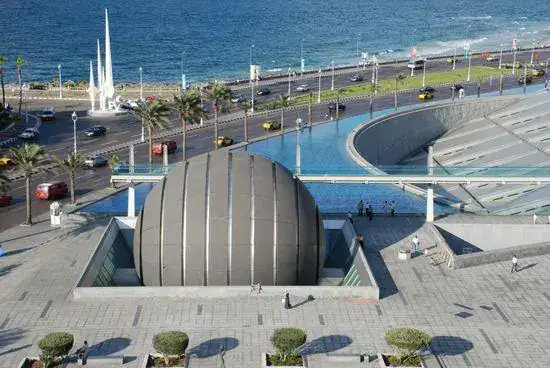
Snøhetta designed the building as a vast tilted circular form beside Alexandria’s ancient harbor. The structure spans roughly 160 meters in diameter and rises to about 32 meters while also extending below ground. As a result, the building feels monumental without resembling a conventional tower.
Most importantly, the sloping roof admits controlled northern light into the reading areas. Meanwhile, the exterior stone wall uses Egyptian granite and carries thousands of carved signs representing writing systems, symbols, musical notation, mathematics, Braille and other forms of recorded communication.
Thus, the architecture turns writing itself into public art. The reflecting pool, circular geometry and Mediterranean setting reinforce the building’s identity as a contemporary symbol of knowledge.
Inside the library
Bibliotheca Alexandrina Main Reading Room
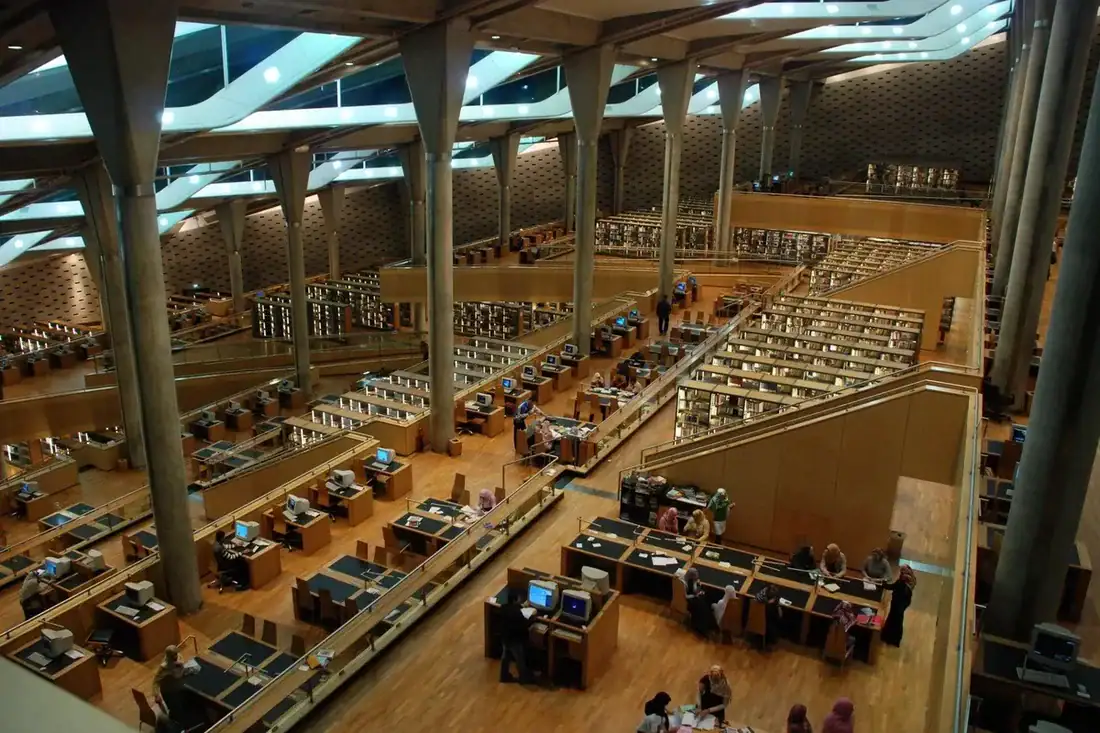
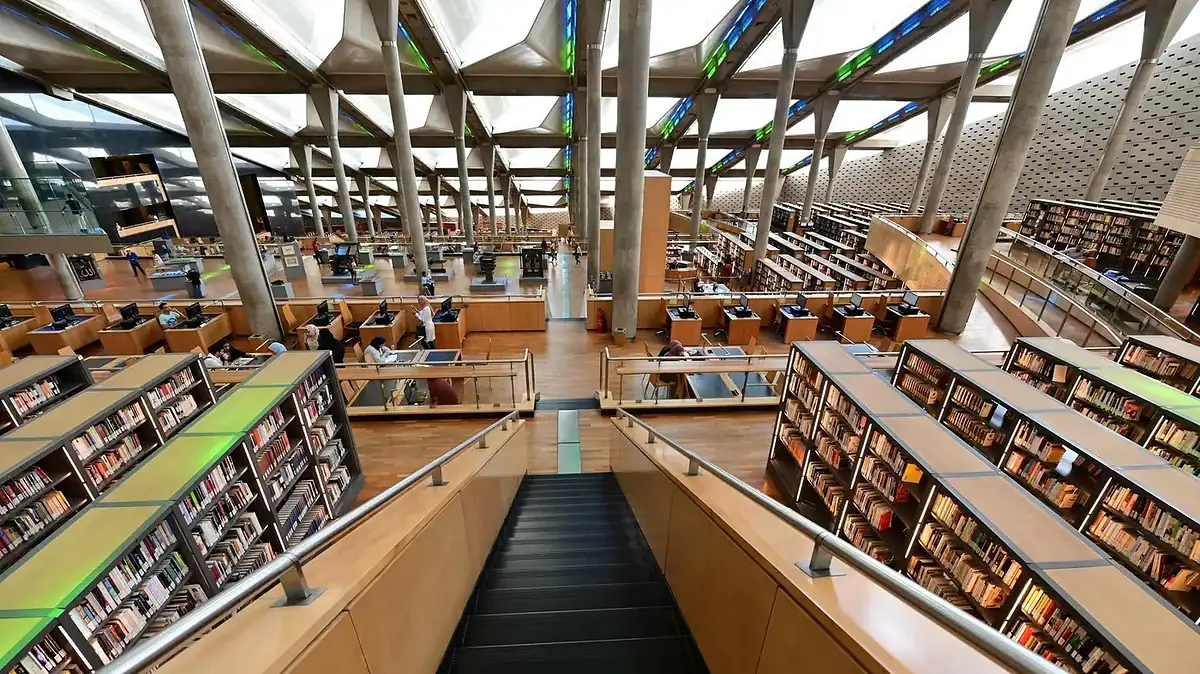
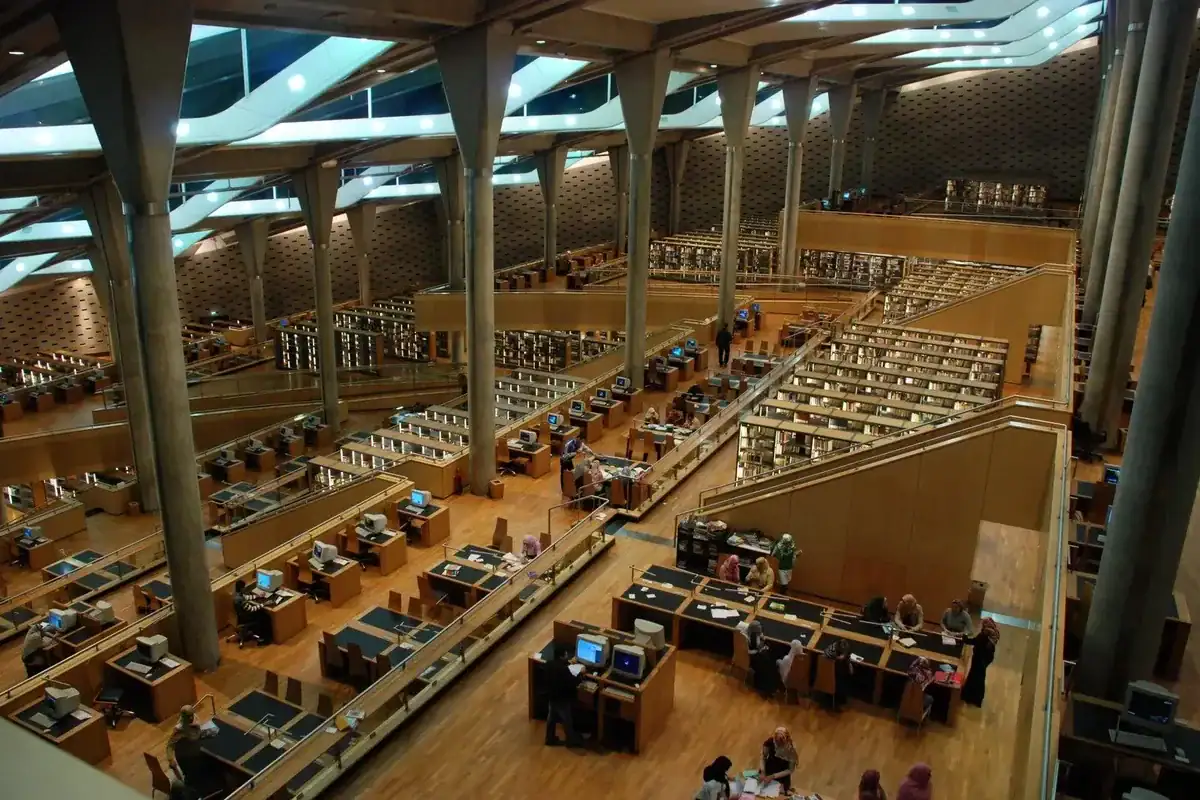
The spectacular open reading room covers about 20,000 square meters and accommodates around 2,000 readers. Moreover, seven stepped terraces organize desks, shelves and circulation while preserving long views across the interior.
Furthermore, north-facing skylights provide indirect daylight and help protect books from harsh direct sun. The result resembles a vast intellectual amphitheater in which architecture, natural light and collections work together.
The building initially provides capacity for millions of volumes and can expand through compact storage. However, the institution’s role extends far beyond printed books through digital resources, research, preservation and public programming.
More than books
Bibliotheca Alexandrina Museums, Exhibitions & Planetarium
Antiquities Museum
The museum presents objects from different periods of Egyptian history. Notably, part of its collection connects directly with archaeological discoveries made during construction of the modern library.
Manuscripts & Heritage
Specialist collections and conservation work support the study, preservation and digitization of manuscripts and documentary heritage.
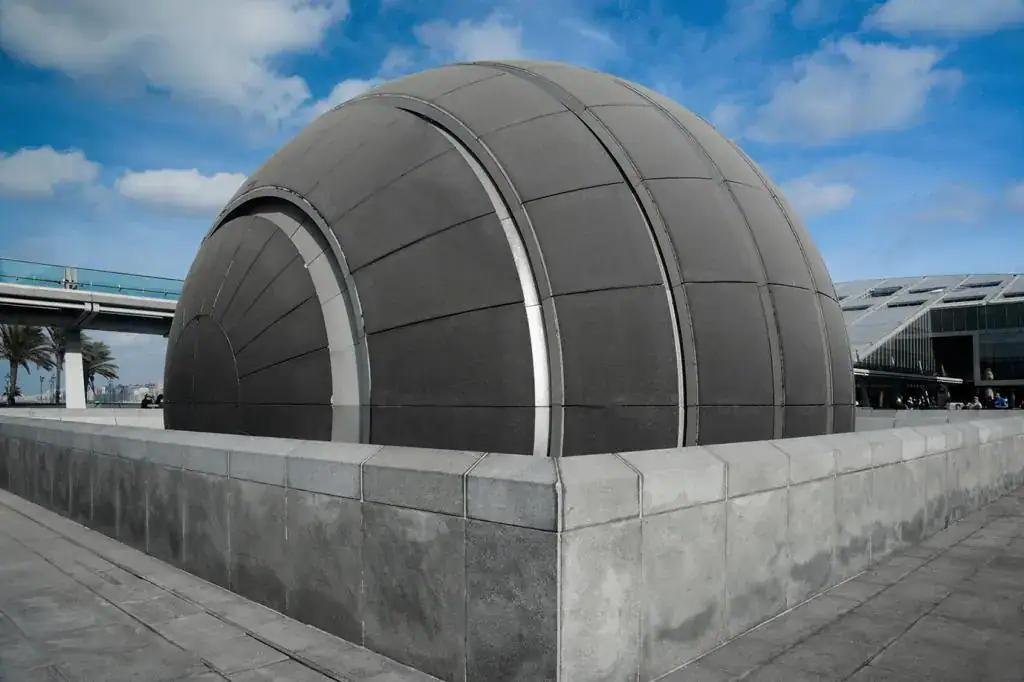
Planetarium Science Center
The science center and planetarium add an interactive educational dimension, making the complex especially valuable for families, students and younger visitors.
Knowledge for different audiences
Bibliotheca Alexandrina Research and Digital Heritage
The Bibliotheca Alexandrina supports scholarship through research centers, manuscript work, digital archiving and documentation projects. In addition, specialized libraries serve children and young people as well as readers with visual disabilities. Therefore, the institution reaches audiences far beyond traditional academic researchers.
Meanwhile, conferences, lectures, exhibitions and cultural events turn the complex into an active public forum rather than a static monument. As a result, visitors encounter both a celebrated building and a working knowledge center.
Consequently, the library’s strongest connection with ancient Alexandria lies in its mission—collecting, studying, preserving and sharing knowledge across cultures.
Plan your visit
Visiting Bibliotheca Alexandrina: Hours, Highlights & Tips
Where is it?
The library stands in Shatby on Alexandria’s Corniche, directly beside the Mediterranean and close to Alexandria University.
Current regular hours
As of August 2026, the official library website lists visits, museums and the Planetarium Science Center Monday–Thursday 9:30 AM–5:00 PM and Saturday–Sunday 10:00 AM–2:00 PM; Friday is closed.
How much time is needed?
Allow roughly two to three hours for the architecture, reading-hall viewpoint and selected museums. However, museum enthusiasts can easily spend longer.
What should you see first?
Start with the exterior and carved granite wall. Then explore the reading-hall view before choosing museums, exhibitions or a planetarium program.
Important: opening hours, tickets, guided tours and planetarium schedules can change, especially on public holidays. Therefore, check the official admission and visitor page before travelling.
Shatby, Alexandria, Egypt
Location of Bibliotheca Alexandrina
Quick answers
Frequently Asked Questions About the Bibliotheca Alexandrina
Is the Bibliotheca Alexandrina the ancient Library of Alexandria?
No. It is a modern cultural and research institution inspired by the intellectual legacy of the ancient library, rather than a reconstruction of the lost ancient building.
When did the Bibliotheca Alexandrina open?
Egypt officially inaugurated it on 16 October 2002, and the institution opened its collections and facilities to the public shortly afterwards.
Who designed the Bibliotheca Alexandrina?
Snøhetta won the 1989 international architectural competition. The project was developed with Egyptian partner Hamza Associates.
What is special about the exterior wall?
Egyptian granite covers the monumental wall, while carved characters and symbols represent writing systems and other forms of human communication from across history.
Can tourists enter the main reading room?
Visitor access depends on current library rules and ticket arrangements. Check the official visitor information before your trip.
What museums are inside the Bibliotheca Alexandrina?
The complex includes museum and exhibition spaces devoted to subjects such as antiquities, manuscripts and modern Egyptian history, alongside cultural and scientific facilities.
Is Bibliotheca Alexandrina worth visiting?
Yes. Its architecture, historical symbolism, museums, reading hall and Mediterranean setting make it one of Alexandria’s strongest cultural attractions.
Discover Alexandria
Explore the City Where Ancient Knowledge Meets the Mediterranean
Combine the Bibliotheca Alexandrina with Pompey’s Pillar, Alexandria’s archaeological sites, seafront and Greco-Roman heritage for a deeper view of Egypt’s Mediterranean capital.